Koi Pond Predator Protection: Herons, Raccoons, and Defense Strategies
Great blue herons injure koi with stabbing attacks that leave puncture wounds which develop into bacterial ulcers within 24-48 hours. This 24-48 hour timeline is why predator attacks and bacterial disease outbreaks are connected in a way that's easy to miss - the attack happens at dawn, you don't notice the injury until afternoon, and by the following day you have what appears to be "sudden" bacterial disease rather than a predator-related wound infection.
KoiQuanta's predation event logging automatically creates a high-risk observation period for bacterial infection following any logged predator attack.
TL;DR
- Elevated cortisol suppresses immune function for 24-72 hours after a significant stressor.
- These appear as sharply defined puncture wounds 2-5mm in diameter, often surrounded by scale damage and contusion.
- Needs to be high enough that herons can't reach through from the edge - at least 2 feet above the water surface.
- Log the event in KoiQuanta to initiate the high-risk observation period 2.
- Add salt to 0.3% if not already maintained at this level - osmoregulatory support for stressed fish 3.
- Perform a close visual inspection of all fish - look for puncture wounds, scale damage, contusions 4.
- Net and examine any fish showing obvious signs of injury - assess wound severity 5.
The Direct Health Link Between Predation and Disease
Predator attacks don't just cost you fish - they create health emergencies for the fish that survive. Every stabbing or grabbing injury breaks the skin barrier, destroys the mucus coat at the wound site, and creates an immediate entry point for Aeromonas and other bacterial pathogens that are present in virtually every pond.
The stress of a predator attack also triggers the cortisol stress response in all fish in the pond - not just the directly attacked ones. Elevated cortisol suppresses immune function for 24-72 hours after a significant stressor. During this window, every fish in the pond is more vulnerable to infection than normal.
This is why logging predation events in KoiQuanta matters. When you log a heron visit on Monday, KoiQuanta flags elevated monitoring for bacterial infection through Thursday. If you see a fish with redness or scale lifting on Wednesday, you have the context to understand it's probably a wound infection rather than idiopathic bacterial disease - and that context should prompt prophylactic salt treatment and close monitoring rather than a "wait and see" approach.
The Main Predators
Great Blue Heron (Ardea herodias) - US; Grey Heron (Ardea cinerea) - Europe
The premier koi pond predator. Herons are wading birds that stand motionless at pond edges and strike at fish with their powerful, spear-like bill. Their preferred hunting method involves wading into the pond at the shallow end.
Characteristic attack pattern: Dawn and dusk activity, particularly in spring and summer. A heron will return to the same pond repeatedly once it has successfully fed. After a first successful visit, a heron treats your pond as a reliable food source.
Injury pattern: Stabbing wounds, typically to the dorsal or posterior body region. These appear as sharply defined puncture wounds 2-5mm in diameter, often surrounded by scale damage and contusion.
Deterrence:
- Motion-activated sprinklers (Scarecrow and similar): highly effective when consistently triggered. Herons learn to approach from non-triggering angles over time, so periodically reposition the sensor.
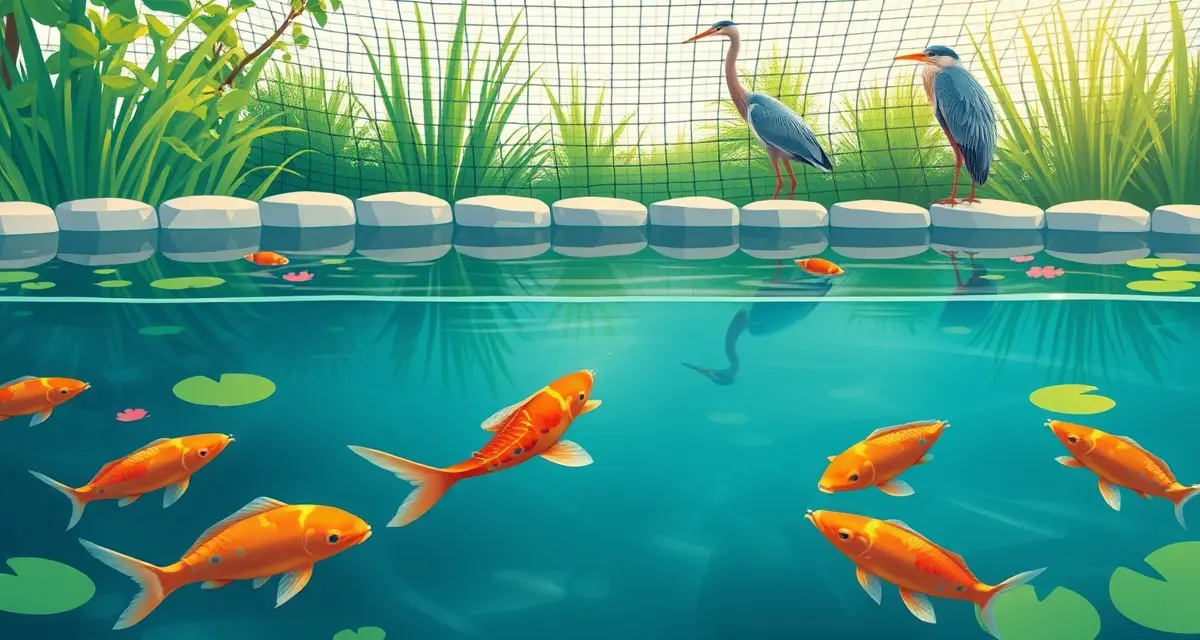
- Netting: Physical overhead netting is the most reliable barrier. Needs to be high enough that herons can't reach through from the edge - at least 2 feet above the water surface.
- Heron decoys: A heron decoy (realistic standing heron statue) near the pond exploits heron territorial behavior. Works for some time - some herons habituate to static decoys. Move the decoy periodically.
- Fishing line grid: Crossing the pond surface with 30-40 lb monofilament at 6-8 inch intervals creates a barrier herons are reluctant to cross to access the water. Less visually intrusive than netting.
- Pond depth: Herons can't wade effectively beyond 12-18 inches. A pond with steep sides and depth quickly from the edge is harder to access than a shallow, gently sloping pond.
Raccoons (Procyon lotor)
Raccoons are agile, dexterous, nocturnal predators. They enter shallow water to catch fish directly or reach over the pond edge.
Characteristic attack pattern: Nocturnal, targeting the pond edge and shallow areas. Raccoons typically grab fish from the edge or wade in shallow areas. They can climb over most physical barriers.
Injury pattern: Claw marks on the dorsum of fish, often along the lateral line. Multiple parallel scratches from gripping claws. Less clean than heron puncture wounds but equally likely to cause infection.
Deterrence:
- Pond depth and steep sides: Raccoons can't reach fish in water deeper than 12-16 inches when accessing from the edge
- Electric fence: A single strand of electric fence tape at 6-8 inches above the ground around the pond perimeter is highly effective
- Motion-activated lights and sound: Some deterrence value but raccoons habituate relatively quickly
- Netting: Effective but raccoons can move or pull at loosely secured netting
Kingfisher, cormorant, and other fish-eating birds:
Smaller fish-eating birds (kingfishers, ospreys) can take smaller koi. Cormorants pose problems for dealers or facilities with open ponds containing larger fish. Physical netting is the primary defense.
Cats and dogs:
Domestic cats occasionally catch small koi from low-edge ponds. Dogs in the pond cause fish stress and occasionally injure fish. Physical barriers and appropriate pond design are the solution.
Treating Predator Injuries
Immediate response after a confirmed predator attack:
- Log the event in KoiQuanta to initiate the high-risk observation period
- Add salt to 0.3% if not already maintained at this level - osmoregulatory support for stressed fish
- Perform a close visual inspection of all fish - look for puncture wounds, scale damage, contusions
- Net and examine any fish showing obvious signs of injury - assess wound severity
- Wound treatment for significant injuries: topical disinfection (dilute Betadine or chlorhexidine) and antibiotic cream if wound is deep
Days 1-4 post-attack:
- Check every fish closely every morning and evening
- Watch for redness or scale lifting near any suspected contact area
- Maintain excellent water quality
- At first sign of secondary bacterial infection, begin antibiotic treatment
Your ulcer treatment program covers the bacterial wound treatment protocol. The bacterial infection treatment tracker manages the antibiotic course documentation.
Frequently Asked Questions
How do I protect my koi pond from herons?
The most reliable approaches combine physical barriers with active deterrence. Motion-activated sprinklers positioned to trigger as herons approach the pond edge are highly effective when positioned correctly. Overhead netting at least 2 feet above the water surface prevents access entirely. Monofilament fishing line (30-40 lb) strung in a grid pattern across the pond surface at 6-8 inch intervals discourages herons without being visually intrusive. Pond depth matters: steep-sided ponds that drop quickly to 24+ inches give herons limited wading access. A heron decoy can deter territorial species temporarily but may need repositioning as birds habituate.
What is the most effective deterrent for koi pond predators?
No single deterrent is fully effective indefinitely against all predators. The most durable protection combines physical barriers (overhead netting for birds, pond depth and steep sides for wading predators) with motion-activated deterrents (sprinklers for herons, lights for nocturnal predators). For raccoons specifically, a single strand of electric fence tape around the pond perimeter at 6-8 inches height is highly effective - raccoons rarely return after a single electric shock experience. For protection, layer multiple approaches rather than relying on any single method.
How do I treat a koi injured by a predator?
Immediately assess the wound: locate any puncture wounds, scratch marks, or areas of scale loss. Clean accessible wounds with dilute Betadine or chlorhexidine. Apply antibiotic cream to deep puncture wounds if available. Log the predator event in KoiQuanta to trigger the elevated monitoring period. Add salt to 0.3% if not already maintained. Monitor the injured fish closely for the next 3-5 days - heron puncture wounds typically develop bacterial infection within 24-48 hours of the attack. At the first sign of wound redness, swelling, or expanding lesion, begin antibiotic treatment rather than waiting for a clear ulcer to develop.
What is Koi Pond Predator Protection: Herons, Raccoons, and Defense Strategies?
Koi pond predator protection refers to the strategies and physical barriers used to defend koi fish from common predators like great blue herons and raccoons. Herons strike at dawn with stabbing attacks that leave puncture wounds, while raccoons typically reach into ponds at night. Effective protection combines physical deterrents, pond design, and post-attack monitoring to prevent both direct predation and the bacterial infections that follow within 24-48 hours of an attack.
How much does Koi Pond Predator Protection: Herons, Raccoons, and Defense Strategies cost?
Predator protection costs vary widely based on your approach. Basic deterrents like pond netting run $50-$200, motion-activated sprinklers cost $30-$100, and heron decoys around $20-$50. More robust solutions such as deep pond redesigns or permanent fencing can range from $500 to several thousand dollars. Apps like KoiQuanta that help you monitor post-attack health risk are typically low-cost subscriptions that complement your physical defenses.
How does Koi Pond Predator Protection: Herons, Raccoons, and Defense Strategies work?
Predator protection works through layered deterrence and post-attack management. Physical barriers like netting, tall pond edges, and motion-activated sprinklers prevent initial access. Pond design plays a role too — deep zones allow koi to escape, and steep walls prevent herons from wading. After any attack, the protocol shifts to health monitoring: logging the event, inspecting fish for puncture wounds, and maintaining salt levels to support immune function during the 24-72 hour high-risk window.
What are the benefits of Koi Pond Predator Protection: Herons, Raccoons, and Defense Strategies?
Effective predator protection preserves your investment in valuable koi, prevents the hidden danger of post-attack bacterial infections, and reduces stress on your fish. Stress from predator encounters suppresses koi immune function for up to 72 hours, leaving them vulnerable to ulcers and disease even if they weren't physically struck. A solid protection system also reduces your own stress — early morning heron visits and overnight raccoon activity are notoriously difficult to catch without preventative measures already in place.
Who needs Koi Pond Predator Protection: Herons, Raccoons, and Defense Strategies?
Any koi pond owner needs predator protection, but it's especially critical for those keeping high-value fish, ponds in suburban or rural areas near water, and ponds without natural cover or depth. If your pond is shallow (under 3 feet), has gentle sloping edges, or is surrounded by open lawn, you're at higher risk. Hobbyists who travel or can't monitor their pond daily are also more vulnerable, since attacks often go unnoticed until secondary bacterial infection appears.
How long does Koi Pond Predator Protection: Herons, Raccoons, and Defense Strategies take?
Setting up physical deterrents typically takes a few hours to a weekend depending on complexity. However, the ongoing protection process is continuous — predators are persistent and adaptive, particularly herons, which are known to return repeatedly to productive feeding sites. Post-attack management requires close daily observation for at least 5-7 days following any logged incident. Building a consistent monitoring habit, ideally supported by structured logging, is what transforms one-time setup into reliable long-term protection.
What should I look for when choosing Koi Pond Predator Protection: Herons, Raccoons, and Defense Strategies?
Look for a layered approach that addresses both prevention and response. On the physical side, prioritize pond depth (minimum 3 feet), steep or tall edges herons can't reach through, and reliable netting or motion deterrents. For response, choose a system or routine that includes structured post-attack logging, fish inspection protocols, and water treatment guidance. Tools that automatically flag a high-risk observation window after a predator event help you catch wound infections before they become serious bacterial outbreaks.
Is Koi Pond Predator Protection: Herons, Raccoons, and Defense Strategies worth it?
Yes — predator protection is one of the highest-return investments a koi keeper can make. A single heron attack can kill or seriously injure multiple fish, and the secondary bacterial infections that follow within 24-48 hours are often more deadly than the strike itself. Given that quality koi can cost hundreds to thousands of dollars each, even basic deterrents pay for themselves quickly. The less visible benefit is earlier intervention after attacks, which dramatically improves survival rates for injured fish.
Related Articles
Sources
- Associated Koi Clubs of America (AKCA)
- Koi Organisation International (KOI)
- University of Florida IFAS Extension Aquaculture Program
- Fish Vet Group
- Water Quality Association