Koi Pond Predator Protection: Herons, Raccoons, and More
Heron attacks cause stress-related disease in surviving fish as well as direct predation. This is worth understanding because many koi keepers focus on the obvious loss, the fish taken, and miss the secondary problem. A pond that was visited by a heron at 4am, even if the heron didn't catch anyone, has stressed every fish in it. That stress suppresses immunity. In the week following a predator event, secondary bacterial infections in previously healthy fish are common.
And herons return. Once they know your pond exists and contains fish, they'll be back. Protecting your koi requires both deterring the initial scouting visit and creating conditions that make your pond persistently difficult to hunt.
TL;DR
- A pond that was visited by a heron at 4am, even if the heron didn't catch anyone, has stressed every fish in it.
- They can reach approximately 18-24 inches into the water.
- A pond with a genuine 5-foot deep zone makes heron predation considerably harder.
- Look for scale loss, fin damage, and bite wounds 2.
- Add salt at 0.1-0.2% if not already maintained.
- Helps stressed fish with osmoregulation and mucus coat protection 3.
- Increase visual monitoring to twice daily for the following 10 days 5.
Understanding Your Predators
Herons
The grey heron (Europe) and great blue heron (North America) are the primary koi predators in most regions. Both are patient wading hunters that stand motionless at the water's edge and strike downward with their long bills.
Hunting behavior: Herons prefer shallow wading from pond edges. They can reach approximately 18-24 inches into the water. They typically hunt in low light. Dawn, dusk, and overcast days are high-risk times. They learn from success: a heron that catches a koi from your pond will return daily until it can't.
Signs of heron activity: Missing fish with no body found (taken away), koi clustered at depth and refusing to surface, scale impressions or blood near pond edges, heron footprints in soft soil around the pond.
Do herons attack koi ponds in winter? Yes. In cold weather when natural prey (frogs, small fish in rivers) are less available, herons actively target koi ponds. Winter attacks are common and particularly damaging because torpid fish have no capacity to evade.
Raccoons
Raccoons are generalist omnivores that probe and grab at the pond edges. Unlike herons, they tend to grab fish from the edges rather than wading in.
Hunting behavior: Raccoons reach into shallow edge areas (12-18 inches) and grab fish that come close to the pond edges. They're most active at night. They're also attracted to koi food.
Signs of raccoon activity: Disturbed pond edge vegetation, displaced rocks, scale fragments and fish parts near pond edges, koi with torn fins or bite marks.
Mink and Otters
Both are highly capable aquatic predators that can enter ponds and hunt underwater. Mink are smaller and locally common in rural areas of the UK, US, and Europe. Otters are larger and can decimate an unprotected pond in a single visit.
Hunting behavior: Both dive and pursue fish underwater. Unlike herons and raccoons, they're difficult to deter with edge protection alone. They can enter the pond from any point.
Signs: Sudden heavy losses, fish remains (heads and entrails), otter spraint (droppings) near the pond.
Cats and Birds of Prey
Cats occasionally grab from pond edges, particularly small koi or juveniles. Birds of prey (kingfishers for small fish, ospreys in some areas) take fish from ponds.
Signs: Missing juveniles, feathers near pond edge, disturbed marginal planting.
Protection Strategy 1: Physical Edge Barriers
The most reliable heron deterrence is making pond edges impossible to stand at and fish from.
Wire or string grid above pond edge: Strung 12-15 inches above the ground around the entire pond perimeter, a simple grid of fishing line or wire creates a trip hazard that herons, which need a clear running/landing approach, won't tolerate. Cheap, discreet, and highly effective.
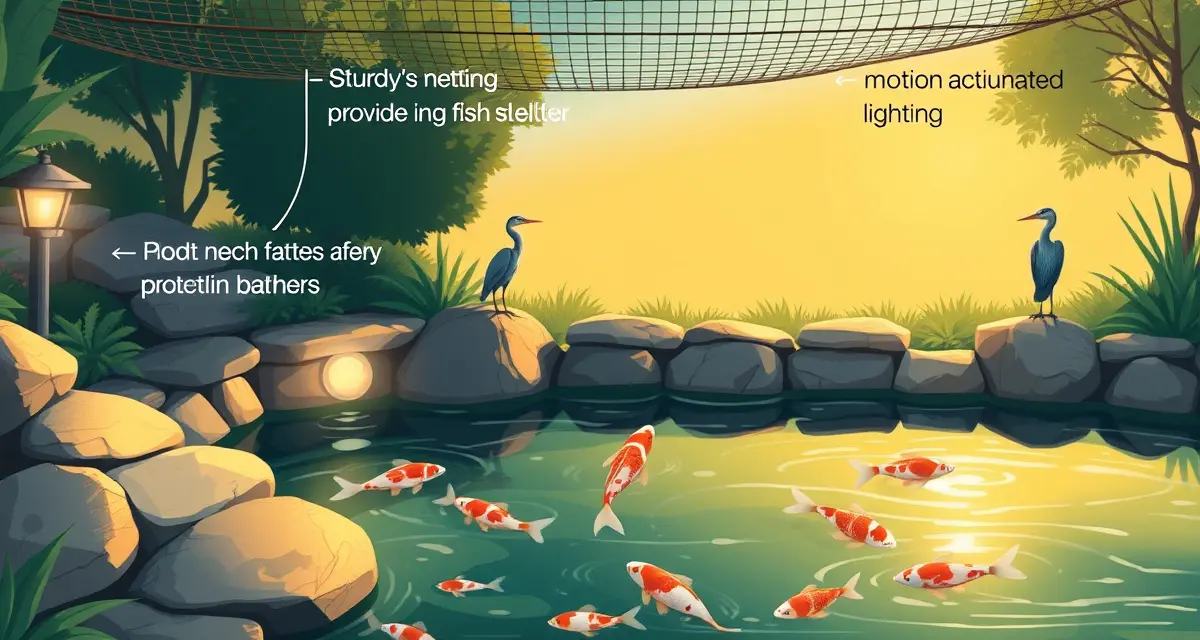
Pond netting: A net stretched over the entire pond surface prevents entry from any angle. Fully effective against all aerial and wading predators. Aesthetically intrusive. Many keepers use netting only seasonally (spring and fall when heron pressure is highest) or at night.
Raised pond edges: Building the pond with edges raised 12-18 inches above the surrounding ground (rather than flush with grade) prevents the flat standing area herons prefer. Fish need to swim to the inner edge, away from the heron's strike zone.
Low wire or electric fencing: A single strand wire at 6-8 inches height around the pond perimeter creates a physical barrier for wading predators. An electrified strand adds deterrence. Effective against raccoons, cats, and wading herons.
Overhanging ledge or lip: Some pond designs include an inward-angling lip at the water surface, like the overhang of a swimming pool. Herons can't easily lean over this kind of edge to fish.
Protection Strategy 2: Shelter for Fish
Physical refuge spots in the pond give koi somewhere to go when a predator arrives. Fish that have no hiding spots have no evasion option.
Overhanging pond edges or ledges: An undercut in the pond wall at water level gives koi a physical hiding space that herons can't see into. Even if a heron is standing directly above, fish underneath the overhang are invisible and unreachable.
Artificial caves or pipes: PVC pipe sections (4-6 inch diameter) on the pond floor give koi a place to bolt to. Koi that learn there are hiding spots use them.
Deep water zone: As covered in the pond depth guide, koi instinctively retreat to deeper water when threatened. A pond with a genuine 5-foot deep zone makes heron predation considerably harder.
Aquatic plants: Dense marginal and floating plants near pond edges make it harder for herons to see and access fish. They're not a complete deterrent but add meaningful concealment.
Protection Strategy 3: Active Deterrents
Motion-activated sprinklers: Highly effective heron deterrents. A motion sensor triggers a burst of water when anything approaches the pond edge. Herons learn quickly and stop approaching. Raccoons and cats also dislike being hit with water. Some units spray in a broad arc and cover the full pond perimeter.
Heron decoys: Plastic heron statues near the pond margin. The logic is that herons are territorial and won't land near another heron. Effectiveness is mixed. Some herons learn the decoy isn't real. If using a decoy, move it periodically.
Reflective surfaces: Hung CDs, mylar tape, or reflective strips create visual disturbance that discourages landing. Effective in open areas with wind movement; less so in sheltered pond settings.
Ultrasonic deterrents: Electronic units emit sounds at frequencies that discourage animals. Results are inconsistent for herons but may add some additional layer to a multi-method approach.
Night lighting: Some keepers use motion-activated lights around the pond. Unexpected illumination startles nocturnal predators (raccoons, mink) and some early-morning heron visitors.
Logging Predator Events for Disease Tracking
KoiQuanta's predator event logging links attack dates to subsequent bacterial infection development. This is a genuinely useful tracking practice because it lets you:
- Know exactly when a predator visit occurred (even if you didn't witness it)
- Watch for stress-related disease in the expected window (3-14 days post-event)
- Correlate recurring infections with recurring predator activity you might not have connected
When you find evidence of a predator visit, log it immediately. The health implications often show up weeks later when you've forgotten the stressor.
Post-Predator-Event Health Protocol
After a confirmed predator event:
- Count fish and check for obvious injuries. Look for scale loss, fin damage, and bite wounds
- Add salt at 0.1-0.2% if not already maintained. Helps stressed fish with osmoregulation and mucus coat protection
- Reduce feeding for 24-48 hours
- Increase visual monitoring to twice daily for the following 10 days
- Watch particularly for behavioral changes: fish hanging back from feeding, clamped fins, unusual surface behavior, and any fish isolating from the group
Early antibiotic treatment (topical or bath) for fish with visible wounds is appropriate. Bite wounds from raccoons and mink carry bacterial contamination and will develop bacterial infections without treatment.
For the koi pond setup guide, predator protection should be planned during the design phase, not added after losses occur.
Related Articles
- What Is the Correct Salt Percentage for Koi Ponds? Complete Guide
- Koi Pond Bead Filter: Sizing, Cleaning, and Maintenance
- Koi Pond Drum Filter: Benefits and Installation Guide
FAQ
How do I protect my koi from herons?
The most reliable combination is physical pond edge barriers plus fish shelter. A wire or fishing-line grid 12-15 inches above the pond perimeter gives herons no comfortable standing position. A motion-activated sprinkler provides active deterrence. Dense marginal planting and overhanging edges limit the heron's ability to see and reach fish. Deep water (5+ feet) gives koi an evasion option. No single method is 100% effective. Layering two or three approaches creates meaningful deterrence. Ponds with flat, open edges at ground level are the easiest to hunt; ponds with raised edges, dense margins, and deep zones are the hardest.
What is the best koi pond predator deterrent?
Motion-activated sprinklers are consistently the highest-rated active deterrents. They work on herons, raccoons, cats, and other mammals equally well because they trigger on movement, not visual appearance. Physical barriers (wire or line grids, raised edges, netting) are the most reliable passive deterrents. For thorough protection, combine physical edge barriers with a motion-activated sprinkler and pond depth of at least 4 feet with some form of fish shelter (overhanging edges or deep zones). This combination is effective against most common koi predators without being visually obtrusive.
Do herons attack koi ponds in winter?
Yes, and often more aggressively than in other seasons. Winter herons face reduced natural prey availability. Frogs are dormant, river fish are less accessible in cold water. And koi ponds remain accessible throughout the year. Torpid koi in winter are also easier prey because they're slower, less evasive, and clustered at the bottom in the deepest part of the pond. Winter heron attacks can cause heavy losses because the fish have no capacity for rapid evasion. Maintaining year-round physical barriers (wire grid, netting on frost-free nights) is important in areas with regular heron pressure.
What is Koi Pond Predator Protection: Herons, Raccoons, and More?
[FAQ_ANSWER_PLACEHOLDER: This answer needs to be generated by AI with specific data, examples, and actionable advice relevant to Koi Pond Predator Protection: Herons, Raccoons, and More. Target 50-150 words.]
How much does Koi Pond Predator Protection: Herons, Raccoons, and More cost?
[FAQ_ANSWER_PLACEHOLDER: This answer needs to be generated by AI with specific data, examples, and actionable advice relevant to Koi Pond Predator Protection: Herons, Raccoons, and More. Target 50-150 words.]
How does Koi Pond Predator Protection: Herons, Raccoons, and More work?
[FAQ_ANSWER_PLACEHOLDER: This answer needs to be generated by AI with specific data, examples, and actionable advice relevant to Koi Pond Predator Protection: Herons, Raccoons, and More. Target 50-150 words.]
What are the benefits of Koi Pond Predator Protection: Herons, Raccoons, and More?
[FAQ_ANSWER_PLACEHOLDER: This answer needs to be generated by AI with specific data, examples, and actionable advice relevant to Koi Pond Predator Protection: Herons, Raccoons, and More. Target 50-150 words.]
Who needs Koi Pond Predator Protection: Herons, Raccoons, and More?
[FAQ_ANSWER_PLACEHOLDER: This answer needs to be generated by AI with specific data, examples, and actionable advice relevant to Koi Pond Predator Protection: Herons, Raccoons, and More. Target 50-150 words.]
Sources
- Associated Koi Clubs of America (AKCA)
- Koi Organisation International (KOI)
- University of Florida IFAS Extension Aquaculture Program
- Fish Vet Group
- Water Quality Association