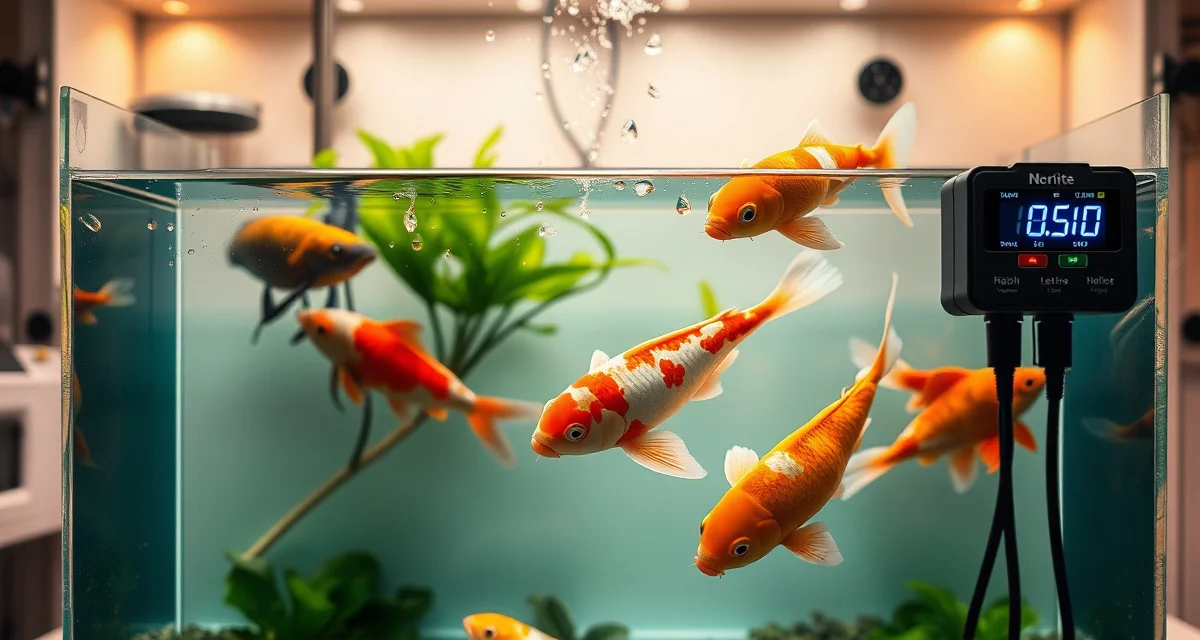
Nitrite and Nitrate Monitoring for Koi Ponds: A Complete Tracking Guide
Nitrite levels above 0.5 ppm cause methemoglobinemia in koi, which looks identical to oxygen starvation and is frequently misdiagnosed. Fish are gasping at the surface. You add more aeration. The fish keep gasping. You add more aeration again. The problem is that the blood can't carry oxygen regardless of how much is in the water, because nitrite has bound to the hemoglobin.
Dual-axis charting of nitrite and nitrate together reveals filter performance issues that single-parameter logs miss. The relationship between these two parameters tells you more about your biofilter health than either alone.
TL;DR
- Here's what the dual-axis chart reveals: Normal healthy pond: Ammonia = 0, nitrite = 0, nitrate rising slowly between water changes then dropping after each change.
- Without the 30-day trend view, this slow rise is invisible in individual tests.
- Nitrite spike 3-7 days after treatment, partial recovery, then restabilization as bacteria regrow.
- Add salt immediately, at 0.1% concentration (sodium chloride, not Epsom salt).
- Partial water change, 25-30% with dechlorinated, fresh water 3.
- Always replace no more than 25% of filter media at a time.
- The trend, consistently at 80 ppm and never coming down, tells the real story.
The Nitrogen Cycle: What You're Actually Tracking
Understanding nitrite and nitrate requires understanding the nitrogen cycle. This is the biological process that makes koi ponds livable.
Ammonia is produced by fish through gill excretion (primary) and waste decomposition. Toxic.
Nitrite is the product of the first stage of biological filtration. Nitrosomonas bacteria convert ammonia to nitrite. Also toxic.
Nitrate is the product of the second stage. Nitrobacter bacteria convert nitrite to nitrate. Much less toxic (harmful only at high chronic concentrations, not acutely toxic at normal pond levels).
In a healthy, cycled pond:
- Ammonia → 0 ppm (converted rapidly by Nitrosomonas)
- Nitrite → 0 ppm (converted rapidly by Nitrobacter)
- Nitrate → accumulates slowly over time (removed only by water changes, plant uptake, or denitrification)
The biofilter's job is to process ammonia and nitrite faster than they're produced. When something disrupts this, whether the bacteria die, the fish load exceeds the filter's capacity, or a medication kills the bacteria, ammonia and nitrite accumulate.
Why Nitrite and Nitrate Should Be Tracked Together
Paper logs make it impossible to spot rising nitrate trends. KoiQuanta's charts make nitrogen cycle problems visible weeks before fish are harmed.
Here's what the dual-axis chart reveals:
Normal healthy pond: Ammonia = 0, nitrite = 0, nitrate rising slowly between water changes then dropping after each change. Clean, predictable pattern.
Developing filter stress: Nitrite begins rising slightly. At the same time, the rate of nitrate rise may slow, because if the Nitrobacter aren't efficiently converting nitrite, nitrate isn't being produced from it either. The nitrite rise is your early warning.
Filter crash in progress: Nitrite spikes. Ammonia rises simultaneously. Nitrate may temporarily stop rising or even fall slightly as the cycle interrupts. This combined view confirms a filter crash rather than just "something weird with nitrite."
Chronic overfeeding / overstocking: Nitrate climbs steadily between water changes. Each water change reduces it, but the baseline rises over weeks. Without the 30-day trend view, this slow rise is invisible in individual tests.
After medication treatment: A biofilter-damaging treatment shows a characteristic pattern. Nitrite spike 3-7 days after treatment, partial recovery, then restabilization as bacteria regrow. Tracking this pattern confirms the biofilter is recovering rather than leaving you guessing.
Nitrite: The Acute Danger
Safe level: 0 ppm
Action level: 0.1 ppm (investigate immediately)
Emergency level: 0.5 ppm (fish are suffering)
The Methemoglobin Problem
Nitrite in the blood binds to hemoglobin more readily than oxygen does. When nitrite-poisoned hemoglobin can't carry oxygen, the condition is called methemoglobinemia, or "brown blood disease." Affected fish look like oxygen-starved fish because they are oxygen-starved at the cellular level, even in well-oxygenated water.
The misdiagnosis is almost universal among new koi keepers. Fish at the surface gasping → add more aeration → no improvement → more aeration → no improvement. Test the nitrite. The reading will tell you what's actually happening.
Nitrite toxicity signs:
- Gasping at the surface
- Congregating near waterfalls and aeration (seeking oxygen that they can't use effectively)
- Lethargy
- Pale gills visible on examination (reduced hemoglobin function reduces gill color)
Emergency response for nitrite above 0.5 ppm:
- Add salt immediately, at 0.1% concentration (sodium chloride, not Epsom salt). Salt at this concentration competes with nitrite at the gill surface and reduces nitrite uptake considerably. This buys time.
- Partial water change, 25-30% with dechlorinated, fresh water
- Stop feeding
- Investigate and fix the cause (see below)
Common Causes of Nitrite Spikes
Biofilter disruption: The same causes as ammonia spikes. Power outage, chemical treatment, filter cleaning too aggressively.
New pond cycling: Normal process. Nitrite typically spikes as Nitrosomonas establish before Nitrobacter have time to grow sufficiently to convert it.
Adding fish faster than the filter can adapt: Each new fish increases ammonia load. The Nitrosomonas colony grows to match, but produces more nitrite temporarily. If Nitrobacter can't keep up, nitrite accumulates.
Spring startup: Nitrobacter recover more slowly from winter dormancy than Nitrosomonas in some situations, creating a temporary nitrite imbalance even in established ponds.
Filter media disruption: Replacing too much filter media at once removes the bacterial colony. Always replace no more than 25% of filter media at a time.
Nitrate: The Chronic Concern
Safe level: Below 40 ppm for display ponds
Optimum for breeding/young fish: Below 20 ppm
Concerning level: Above 80 ppm (chronic immune suppression, reduced growth)
How Nitrate Accumulates
Nitrate is the end product of the nitrogen cycle. It doesn't get processed further in a normal pond. It just builds up. The only ways to remove it are:
- Water changes (most practical)
- Aquatic plant uptake (limited but real)
- Denitrification (anaerobic bacteria convert nitrate to nitrogen gas, which happens naturally in deep anoxic zones but is unreliable)
Nitrate rise rate depends on:
- Fish load (more fish = more ammonia = more nitrate production)
- Feeding rate (more food = more waste = faster nitrate accumulation)
- Water change frequency and volume
- Plant density
Why High Nitrate Is Dangerous (Even Without Acute Symptoms)
Koi don't show obvious nitrate toxicity until levels are very high (above 160 ppm in most cases). The danger is chronic and subtle:
- Suppressed immune function. Fish are more susceptible to every disease.
- Reduced growth rates, especially in young fish
- Reduced color intensity and quality
- Increased susceptibility to bacterial infection during stress events
Ponds running at chronically elevated nitrate (60-100 ppm) often have recurring disease problems without obvious koi pond water quality tracker "failure" because individual tests show "not great but not alarming" readings. The trend, consistently at 80 ppm and never coming down, tells the real story.
KoiQuanta's 30-day nitrate trend shows you whether your current water change schedule is actually keeping nitrate under control or whether it's climbing despite what seem like regular water changes.
Water Change Calculation for Nitrate Control
If your nitrate is rising despite regular water changes, either the water change volume is insufficient or the interval is too long.
Practical calculation:
If nitrate rises from 10 to 40 ppm between weekly 20% water changes:
- 30 ppm rise in one week at current feeding and stocking
- A 20% water change reduces nitrate by 20% (from 40 to 32 ppm)
- But next week it rises another 30 ppm, reaching 62 ppm
- You're losing ground
To stay under 40 ppm: you need a larger or more frequent water change. Either 30-35% weekly, or two 20% changes weekly. Or reduce stocking/feeding.
The koi water quality calculator includes a water change volume calculator that shows you how much water to change to hit your nitrate target given your current reading and weekly rise rate.
Testing Protocol for Nitrite and Nitrate
| Parameter | Minimum frequency | When to increase |
|---|---|---|
| Nitrite | 2x weekly | Daily if any reading above 0 |
| Nitrate | Monthly | Every 2 weeks during high-feeding summer |
Test both at the same session. The relationship between them is most informative when measured simultaneously.
Log both results with date and temperature. The nitrate trend makes no sense without knowing whether you've done water changes between readings.
Related Articles
- Chlorine and Chloramine Removal for Koi Ponds: Complete Guide
- The Complete Koi Quarantine Guide: Everything You Need to Know
FAQ
What is the difference between nitrite and nitrate for koi?
Nitrite (NO2-) is the toxic intermediate in the nitrogen cycle, produced when Nitrosomonas bacteria convert ammonia. Even 0.5 ppm causes brown blood disease (methemoglobinemia) where fish can't use oxygen. It looks exactly like oxygen starvation. In a healthy pond, nitrite reads zero. Nitrate (NO3-) is the final product, produced by Nitrobacter converting nitrite. Much less acutely toxic. It's harmful mainly through chronic accumulation above 40-80 ppm, causing immune suppression and reduced growth. Think of nitrite as the acute danger (emergency if above zero in established ponds) and nitrate as the chronic risk to manage through water changes.
How high can nitrate get before it harms koi?
Acute toxicity in koi requires very high nitrate levels (above 200-300 ppm). The real concern is chronic sub-lethal elevation. Above 40 ppm, chronic nitrate begins to suppress immune function and reduce color quality. Above 80 ppm, growth is meaningfully impaired. Above 120 ppm, fish health declines visibly over weeks to months. The danger isn't a single crisis. It's the background degradation of immune function that makes fish more susceptible to every other challenge. Keep nitrate below 40 ppm for display ponds, below 20 ppm for young fish or breeding operations.
What should I do if nitrite spikes in my koi pond?
Act immediately. Add salt at 0.1% concentration to compete with nitrite at the gill surface (this reduces toxicity considerably while you fix the cause). Do an immediate 25-30% partial water change with dechlorinated water. Stop feeding completely. Then investigate: check filter function (is it running? any unusual smell?), check for dead fish (a decomposing fish is a notable ammonia and nitrite source), check whether you recently added chemicals that could have disrupted the biofilter. Retest in 6 hours and repeat water change if still elevated. Daily water changes may be needed for 5-10 days while the biofilter recovers from whatever caused the disruption.
What is Nitrite and Nitrate Monitoring for Koi Ponds: A Complete Tracking Guide?
Nitrite and Nitrate Monitoring for Koi Ponds: A Complete Tracking Guide is a comprehensive resource for koi keepers covering how to measure, log, and interpret nitrite and nitrate levels in pond water. It explains the nitrogen cycle, how dual-axis charting reveals biofilter health, and how to recognize dangerous spikes before they harm fish. The guide emphasizes 30-day trend tracking, because patterns invisible in single tests become clear over time.
How much does Nitrite and Nitrate Monitoring for Koi Ponds: A Complete Tracking Guide cost?
This is a free informational guide published on KoiQuanta. There is no purchase required. The monitoring methods described use standard liquid test kits or digital meters available from aquatic supply retailers, typically ranging from $10–$60 depending on accuracy and brand. Water change supplies and salt for emergency treatment are the only ongoing costs, both of which are inexpensive and widely available at pond or aquarium shops.
How does Nitrite and Nitrate Monitoring for Koi Ponds: A Complete Tracking Guide work?
The guide works by teaching koi keepers to test nitrite and nitrate regularly, log results on a dual-axis chart, and read the relationship between both parameters over time. A rising nitrate trend with zero nitrite indicates a healthy, stable biofilter. A nitrite spike signals filter disruption. By tracking both together across 30 days, hobbyists can detect problems like overstocking, overfeeding, or filter media damage well before fish show visible symptoms.
What are the benefits of Nitrite and Nitrate Monitoring for Koi Ponds: A Complete Tracking Guide?
The primary benefit is early detection of dangerous water conditions before fish are harmed. Nitrite above 0.5 ppm causes methemoglobinemia, where fish gasp at the surface despite adequate aeration—a condition easily misdiagnosed as oxygen deficiency. Dual-axis trend tracking also reveals slow-rising nitrate that individual tests miss, helping keepers time water changes accurately. The result is fewer emergency interventions, healthier fish, and a more stable, predictable pond ecosystem year-round.
Who needs Nitrite and Nitrate Monitoring for Koi Ponds: A Complete Tracking Guide?
Any koi pond owner who maintains fish in a closed or semi-closed water system will benefit from this guide. It is especially useful for beginners establishing a new pond and cycling a biofilter for the first time, keepers who have recently added fish or changed stocking levels, and anyone who has experienced unexplained fish stress or loss. Experienced hobbyists managing heavily stocked ponds or running multiple systems will also find the trend-charting methodology valuable.
Sources
- Associated Koi Clubs of America (AKCA)
- Koi Organisation International (KOI)
- University of Florida IFAS Extension Aquaculture Program
- Fish Vet Group
- Water Quality Association