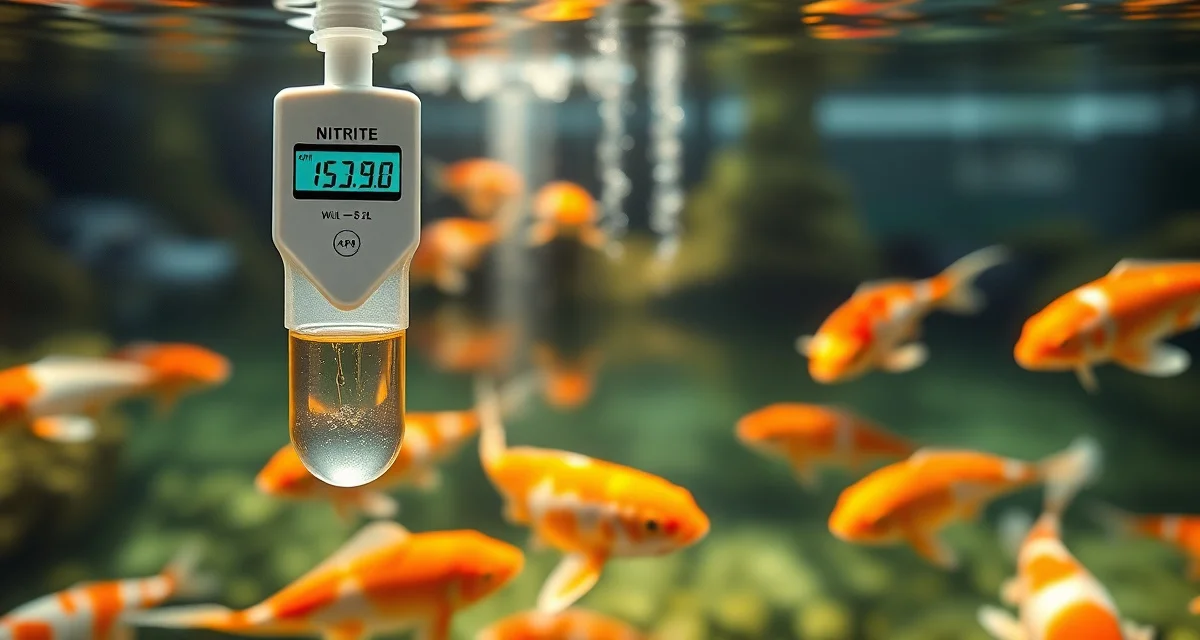
Nitrite in Koi Ponds: Safe Levels and Treatment
Nitrite is the middle step in the nitrogen cycle, and it's the most reliably misunderstood one.
New keepers test for ammonia (good) and then stop when ammonia drops (mistake). Ammonia dropping during the nitrogen cycle doesn't mean the danger is over - it means the Nitrosomonas bacteria have established and are converting ammonia to nitrite. Which is progress, but nitrite is also toxic. In some ways, the nitrite spike during a new pond cycle is more dangerous than the ammonia spike, because it comes after keepers have started to relax.
TL;DR
- Interferes with hemoglobin's ability to carry oxygen - causes a condition called methemoglobinemia or "brown blood disease." Toxic at 0.1 mg/L and above in koi systems.
- During a new pond cycle, you'll see nitrite spike to 1–5 mg/L or higher before the second group of bacteria establishes.
- At 0.3% salt (approximately 2.25 kg per 1,000 liters), chloride concentration is high enough to provide meaningful protection against nitrite toxicity.
- If you do a 50% water change without re-salting, you've just removed the protective chloride and left the nitrite.
- For quarantine tanks during cycling: maintain 0.3% salt and test nitrite daily.
- As long as the nitrite stays in the moderate range (under 1.0 mg/L) and salt is present, fish should tolerate it while the bacterial colony establishes.
- Immediate water change.** 25–40% immediately.
How Nitrite Is Different From Nitrate
These two get confused constantly. One letter difference; very different toxicity.
Nitrite (NO2-): Produced by Nitrosomonas bacteria converting ammonia. Directly toxic to fish. Interferes with hemoglobin's ability to carry oxygen - causes a condition called methemoglobinemia or "brown blood disease." Toxic at 0.1 mg/L and above in koi systems.
Nitrate (NO3-): Produced by Nitrospira and Nitrobacter bacteria converting nitrite. Relatively benign at normal pond concentrations. The "finished product" of the nitrogen cycle that's removed by water changes.
When your test kit shows the difference, the numbers typically look different too. During a new pond cycle, you'll see nitrite spike to 1–5 mg/L or higher before the second group of bacteria establishes. Nitrate then rises gradually and stays elevated in a running pond between water changes.
What Is Safe?
Target: 0 mg/L The same answer as ammonia.
In an established pond with functioning biological filtration, nitrite should be undetectable at any routine test. Any measurable nitrite means the biological filter isn't keeping up - either because it's new, under stress, or undersized for the fish load.
| Nitrite Level | Status |
|---------------|--------|
| 0 mg/L | Normal, healthy |
| 0.1–0.25 mg/L | Stress threshold - investigate |
| 0.25–1.0 mg/L | Significant health risk - act immediately |
| Above 1.0 mg/L | Acute emergency - fish mortality risk |
How Nitrite Harms Koi
Nitrite enters fish through the gills by the same transport mechanism that brings chloride into the fish's body. Once in the bloodstream, nitrite binds to hemoglobin in red blood cells and converts it to methemoglobin - which can't carry oxygen.
Fish with high nitrite exposure look like they're oxygen-deprived even when dissolved oxygen in the water is fine. Gills turn brown (the "brown blood" reference). Fish congregate at aeration sources. Lethargy, reduced appetite, clamped fins, surface-gasping.
In severe nitrite exposure: the fish is functionally suffocating with adequate dissolved oxygen around it. This is why nitrite emergencies kill fish faster than keepers expect.
Why New Ponds Get Nitrite Spikes
The nitrogen cycle has two sequential bacterial communities:
- Nitrosomonas (and similar): convert ammonia to nitrite. These establish first.
- Nitrospira/Nitrobacter: convert nitrite to nitrate. These establish second, slightly later.
During a cycle, you see this pattern:
- Week 1–2: Ammonia rises
- Week 2–3: Ammonia drops, nitrite rises (Nitrosomonas are working, but Nitrospira haven't caught up)
- Week 3–5: Nitrite drops, nitrate rises (Nitrospira are now processing the nitrite)
- Week 5–6+: Both ammonia and nitrite at or near zero - fully cycled
The danger window is when ammonia has come down and keepers relax, not knowing the nitrite spike is coming.
Salt: The Life-Saving Nitrite Treatment
This is one of the most important pieces of chemistry in koi keeping that's not widely known:
Salt (sodium chloride) blocks nitrite uptake at the gill.
The same gill transport protein that takes up nitrite also transports chloride. When you have high chloride concentration in the water (from salt), chloride competes with and blocks nitrite for that transport pathway. The fish is exposed to nitrite in the water but can't absorb as much of it - dramatically reducing the toxic impact.
At 0.3% salt (approximately 2.25 kg per 1,000 liters), chloride concentration is high enough to provide meaningful protection against nitrite toxicity. This is why salt dose calculator is standard during the nitrogen cycle in new koi ponds.
This only works while the salt is present in the water. Salt doesn't remove nitrite - it blocks its uptake. If you do a 50% water change without re-salting, you've just removed the protective chloride and left the nitrite.
For quarantine tanks during cycling: maintain 0.3% salt and test nitrite daily. As long as the nitrite stays in the moderate range (under 1.0 mg/L) and salt is present, fish should tolerate it while the bacterial colony establishes.
Emergency Response to Nitrite Spike
If you find elevated nitrite in an established pond (should be zero normally):
1. Immediate water change. 25–40% immediately. This dilutes the nitrite and adds fresh water. Temperature-match and dechlorinate.
2. Add salt if not already present. Get to 0.3% to protect fish through the gill-chloride competition mechanism while you identify and fix the cause.
3. Stop feeding. Less nitrogen input while the system recovers.
4. Find the cause. In an established pond, a nitrite spike means something disrupted the biological filter:
- Was there a medication dosing recently (antibiotics, KMnO4)?
- Did something die in the pond?
- Was the filter cleaned with tap water (chlorine kills bacteria)?
- Did the filter pump fail temporarily?
- Is there a power outage recovery situation?
5. Don't add more fish or increase feeding until nitrite has been at zero for two weeks.
Nitrite in Quarantine Tanks
In bare quarantine tanks without mature biological filtration, nitrite is a constant management concern - especially in the second and third weeks when the bacterial colony is partially established and processing some ammonia to nitrite.
Daily testing is non-negotiable in a new quarantine tank during the first 4–6 weeks. The nitrite reading in quarantine needs to be logged and tracked with the same attention as ammonia.
KoiQuanta tracks nitrite alongside ammonia in the daily observation log and shows the trend line - which is how you see if nitrite is building over several days before it becomes a crisis. A reading of 0 for 5 days followed by 0.1 is a warning that needs investigation. A reading trending from 0 to 0.1 to 0.2 over 3 days means your biofilter is struggling and your water change schedule needs to increase.
The relationship between nitrite and filter management events is one of the most useful correlations in KoiQuanta - filter cleaning dates, medication events, and nitrite readings tell a story together that individual measurements never reveal.
Related Articles
- What Is the Correct Salt Percentage for Koi Ponds? Complete Guide
- Is It Safe to Treat Koi While Fish Are Actively Feeding?
- How to Use Potassium Permanganate on Koi: Safe Dosing Guide
FAQ
What is the safe nitrite level for koi?
Zero milligrams per liter is the target for any established koi pond. Nitrite should be undetectable in a properly cycled pond with functional biological filtration. Any reading above 0 indicates the biological filter isn't keeping up - either it's new, was disrupted by treatment, was cleaned too aggressively, or is undersized for the current fish load.
How does nitrite harm koi?
Nitrite enters koi through the same gill transport mechanism that takes up chloride ions. Once in the bloodstream, nitrite converts hemoglobin to methemoglobin - a form that can't carry oxygen. This causes methemoglobinemia (brown blood disease), where fish effectively suffocate even with adequate dissolved oxygen in the water. Gills may turn brownish. Fish show gasping, lethargy, and oxygen-stress behavior even in well-aerated water.
Does salt protect koi from nitrite poisoning?
Yes - this is one of the most important applications of salt in koi keeping. Chloride from salt competes with nitrite for the same gill transport pathway, blocking nitrite uptake and dramatically reducing toxic impact. Maintaining 0.3% salt (approximately 2.25 kg per 1,000 liters) during a new pond cycle provides significant protection during the nitrite spike phase. The protection is only active while salt is present - water changes must be followed by salt replacement to maintain the chloride concentration.
What is Nitrite in Koi Ponds: Safe Levels and Treatment?
[FAQ_ANSWER_PLACEHOLDER: This answer needs to be generated by AI with specific data, examples, and actionable advice relevant to Nitrite in Koi Ponds: Safe Levels and Treatment. Target 50-150 words.]
How much does Nitrite in Koi Ponds: Safe Levels and Treatment cost?
[FAQ_ANSWER_PLACEHOLDER: This answer needs to be generated by AI with specific data, examples, and actionable advice relevant to Nitrite in Koi Ponds: Safe Levels and Treatment. Target 50-150 words.]
How does Nitrite in Koi Ponds: Safe Levels and Treatment work?
[FAQ_ANSWER_PLACEHOLDER: This answer needs to be generated by AI with specific data, examples, and actionable advice relevant to Nitrite in Koi Ponds: Safe Levels and Treatment. Target 50-150 words.]
What are the benefits of Nitrite in Koi Ponds: Safe Levels and Treatment?
[FAQ_ANSWER_PLACEHOLDER: This answer needs to be generated by AI with specific data, examples, and actionable advice relevant to Nitrite in Koi Ponds: Safe Levels and Treatment. Target 50-150 words.]
Who needs Nitrite in Koi Ponds: Safe Levels and Treatment?
[FAQ_ANSWER_PLACEHOLDER: This answer needs to be generated by AI with specific data, examples, and actionable advice relevant to Nitrite in Koi Ponds: Safe Levels and Treatment. Target 50-150 words.]
Sources
- Associated Koi Clubs of America (AKCA)
- Koi Organisation International (KOI)
- University of Florida IFAS Extension Aquaculture Program
- Fish Vet Group
- Water Quality Association