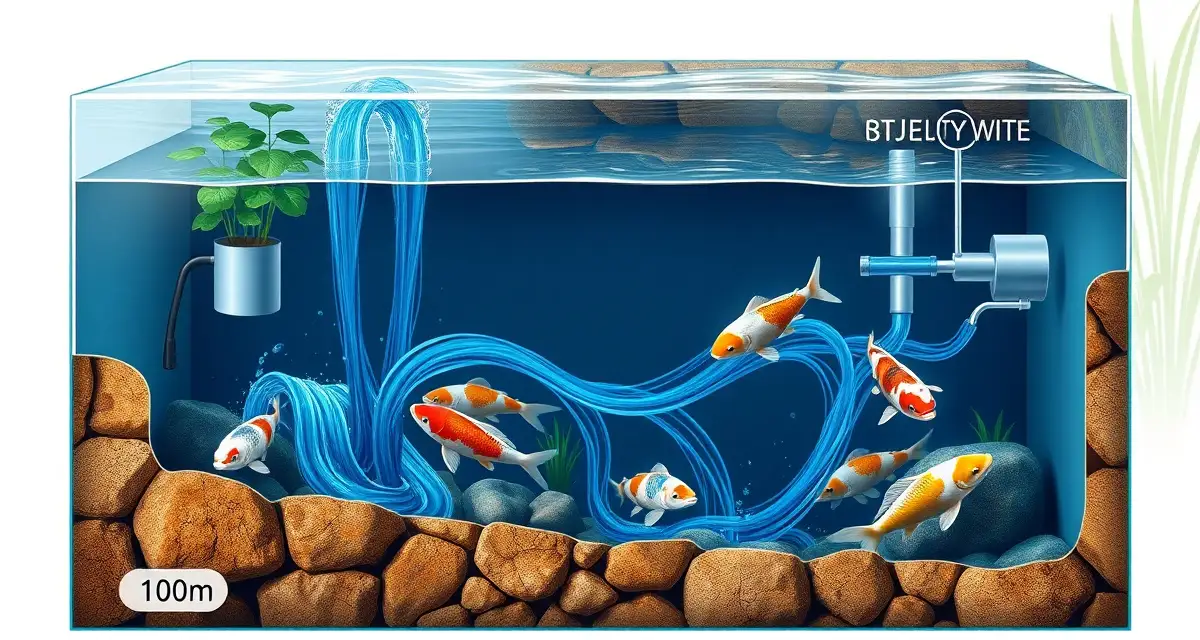
Koi Pond Turnover Rate: What It Means and Why It Matters
A koi pond should turn over completely through filtration at least once per hour. This single number tells you more about whether your filtration system can actually maintain koi pond water quality tracker than the brand of filter or the size of your pump. Turnover rate is the practical measure of whether your filter is processing waste fast enough to keep up with the fish you're keeping.
Under-filtration is the most common design mistake in koi ponds. The turnover rate calculation reveals it clearly.
TL;DR
- A turnover rate of 1x means the full pond volume is filtered every hour.
- A rate of 0.5x means it takes two hours to filter the full volume.
- For koi ponds, the target is a minimum of 1x per hour.
- Many experienced koi keepers aim for 1.5-2x per hour, particularly in ponds with higher stocking density or with large koi producing considerable waste loads.
- A pump rated at 3,000 gallons per hour at zero head might deliver 1,500-2,000 gallons per hour at your actual installation.
- If you have a 2,000-gallon pond and your pump delivers 2,500 gallons per hour at operating head: 2,500 / 2,000 = 1.25 turnovers per hour.
- If you have the same pond with a pump that delivers 800 gallons per hour: 800 / 2,000 = 0.4 turnovers per hour.
What Turnover Rate Means
Turnover rate is how many times per hour all the water in your pond passes through your filtration system. A turnover rate of 1x means the full pond volume is filtered every hour. A rate of 0.5x means it takes two hours to filter the full volume.
For koi ponds, the target is a minimum of 1x per hour. Many experienced koi keepers aim for 1.5-2x per hour, particularly in ponds with higher stocking density or with large koi producing considerable waste loads.
Why it matters: Koi produce ammonia continuously. Your biological filter converts it, but only as fast as water passes through the filter media. If your turnover rate is too low, ammonia and organic waste accumulate between filter cycles. You'll see this in elevated ammonia and nitrite readings, increased algae growth, and often in more frequent disease problems -- fish under chronic low-level ammonia stress are more susceptible to pathogens.
How to Calculate Your Koi Pond Turnover Rate
The calculation is straightforward once you know two numbers: your pond volume and your pump's flow rate at the head height of your actual installation.
Step 1: Calculate pond volume. For a simple rectangular pond: length x width x average depth = volume in cubic feet, then convert to gallons (multiply by 7.48). For irregular ponds, break the shape into approximate rectangles and sum the volumes, or use the fill method (time how long it takes to fill a known volume, then use that rate).
Step 2: Get your actual pump flow rate. Pump manufacturers publish flow curves showing output at different head heights (the vertical distance water is pumped plus friction losses from pipe length and bends). The flow rate printed on the pump box is typically measured at zero head -- it drops significantly as head height increases. A pump rated at 3,000 gallons per hour at zero head might deliver 1,500-2,000 gallons per hour at your actual installation. Use the pump's flow curve and your measured head height to find the realistic number.
Step 3: Calculate turnover rate. Turnover rate = pump flow rate (gallons/hour) / pond volume (gallons).
If you have a 2,000-gallon pond and your pump delivers 2,500 gallons per hour at operating head: 2,500 / 2,000 = 1.25 turnovers per hour. That meets the minimum 1x target.
If you have the same pond with a pump that delivers 800 gallons per hour: 800 / 2,000 = 0.4 turnovers per hour. Well under the minimum.
KoiQuanta's pond setup includes turnover rate calculation from pump and pond volume specs, flagging setups that fall below the minimum target.
What Happens When Turnover Rate Is Too Low
Ammonia accumulation: Your biological filter can only process waste at the rate water flows through it. Low turnover means the filter processes a smaller fraction of pond water per hour, allowing ammonia to build between filter cycles. In a well-stocked koi pond, this becomes problematic quickly.
Poor solids removal: Low flow means solids drift slowly or settle before reaching the filter. In a gravity-fed system with a bottom drain, adequate flow is needed to keep solids moving toward the drain rather than settling in pond corners and on the bottom.
Temperature stratification: In deeper ponds, inadequate circulation allows temperature stratification -- cooler water at depth, warmer at the surface. Koi moving between layers experience sudden temperature shifts, which is stressful. Adequate turnover and circulation prevents this.
Reduced aeration: Water movement is critical for oxygen exchange. Underperforming filtration flow usually means underperforming surface agitation, which reduces oxygen levels particularly on warm days when dissolved oxygen drops.
When Higher Turnover Rates Are Needed
The 1x minimum is a baseline for normally stocked ponds. Push toward 1.5-2x per hour when:
Stocking density is high: More fish means more waste. If you're stocking more than approximately 1 inch of fish per 10 gallons of pond volume, turnover needs to increase proportionally.
Fish are large: Large koi produce far more waste than small koi. A collection of 24-28 inch koi in a 3,000-gallon pond needs higher turnover than the same number of 8-10 inch fish in the same volume.
Summer heat: Warm water holds less dissolved oxygen and accelerates biological processes. Higher turnover in summer improves both waste processing and oxygenation.
After feeding: Feeding increases ammonia production sharply. Some keepers run UV sterilizers and maximize aeration during and after feeding for this reason.
Adjusting Turnover Rate
Replacing the pump: The most direct solution if your current pump is undersized. Use the pump's flow curve data (not the headline maximum flow) to select a pump that delivers adequate flow at your actual head height.
Reducing head height: Every additional foot of head height reduces pump output. Reducing pipe run length, increasing pipe diameter, and minimizing elbows and turns reduces friction losses and improves actual flow rate from the same pump.
Adding a second pump: Running a dedicated circulation pump alongside a filter-feed pump increases total water movement without necessarily increasing filter flow -- useful for large ponds where circulation is inadequate even with adequate filtration flow.
For the broader filtration system design context, the koi pond filtration guide covers filter sizing and system design. For pump selection specifically, the koi pond pump sizing guide covers how to match pump to pond requirements.
Frequently Asked Questions
How do I calculate my koi pond turnover rate?
Divide your pump's actual flow rate (in gallons per hour at your operating head height) by your pond volume in gallons. A 2,000-gallon pond with a pump delivering 2,200 gallons per hour at operating head has a turnover rate of 1.1x per hour -- just meeting the minimum target. Get your pump's actual flow rate from its published flow curve using your real head height measurement, not the maximum headline flow rating, which is measured at zero head and doesn't reflect real-world performance.
Is my koi pond filtration fast enough?
The minimum target is 1x turnover per hour for normally stocked koi ponds. Calculate your actual rate using your pond volume and your pump's realistic flow at your head height. If the result is below 1x per hour, filtration is likely insufficient and you'll see the consequences in elevated ammonia and nitrite, more algae growth, and fish health problems. For heavily stocked ponds or large fish, target 1.5-2x per hour. If you're experiencing persistent water quality issues despite regular water changes, check turnover rate as the first design variable.
What happens if my koi pond turnover rate is too low?
Ammonia and organic waste accumulate faster than your filter can process them, causing elevated ammonia and nitrite levels. Solids settle in the pond rather than being transported to filtration. Water stratification can develop in deeper ponds, causing temperature gradients that stress fish. Surface agitation and oxygenation suffer, reducing dissolved oxygen -- a critical issue in warm water when oxygen levels are already lower. Chronic low-level ammonia stress makes fish more susceptible to disease. Fixing an inadequate turnover rate is often the single most impactful improvement you can make to a struggling pond.
What is Koi Pond Turnover Rate: What It Means and Why It Matters?
Koi pond turnover rate measures how many times your entire pond volume passes through your filtration system each hour. A 1x turnover means a 2,000-gallon pond filters 2,000 gallons per hour. It's the most practical indicator of whether your filtration can keep pace with the waste load your koi produce, outweighing brand name or filter size as a measure of system effectiveness.
How much does Koi Pond Turnover Rate: What It Means and Why It Matters cost?
Turnover rate itself is a free calculation — divide your pump's actual flow rate at operating head by your pond volume. The cost lies in equipment: pumps, filters, and plumbing sized to achieve adequate turnover. Under-sized systems are the most common and expensive mistake, often requiring full pump or filter replacement to reach the minimum 1x per hour target.
How does Koi Pond Turnover Rate: What It Means and Why It Matters work?
Your pump draws water from the pond and pushes it through mechanical and biological filtration before returning it. Turnover rate tells you how many complete cycles occur each hour. At 1x, all pond water is processed once per hour. At 2x, twice. The higher the rate, the faster ammonia, nitrite, and suspended waste are captured before they accumulate to harmful levels.
What are the benefits of Koi Pond Turnover Rate: What It Means and Why It Matters?
Adequate turnover rate keeps ammonia and nitrite at safe levels, supports beneficial bacteria with consistent flow, improves dissolved oxygen distribution, and reduces the risk of dead zones where waste accumulates. Higher turnover — 1.5–2x per hour — provides a buffer during hot weather, heavy feeding periods, or when stocking density increases over time.
Who needs Koi Pond Turnover Rate: What It Means and Why It Matters?
Any koi keeper benefits from understanding turnover rate, but it's especially critical for those with heavily stocked ponds, large koi producing significant waste, or ponds in warm climates where biological processes accelerate. New pond builders should calculate turnover before purchasing equipment to avoid the common and costly mistake of under-sizing their filtration system.
How long does Koi Pond Turnover Rate: What It Means and Why It Matters take?
The turnover rate calculation takes seconds: divide pump flow at actual operating head by pond volume. Getting the inputs right takes more effort — you'll need your pond volume and your pump's performance curve at real installation head, not zero-head ratings. Pumps often deliver 40–60% less flow at typical installation pressures than their advertised maximum.
What should I look for when choosing Koi Pond Turnover Rate: What It Means and Why It Matters?
Look for a pump with a published performance curve, not just a peak flow rating. Calculate actual flow at your installation head — accounting for pipe length, diameter, and vertical rise. Target at least 1x turnover per hour at that real flow rate, and size up if stocking density is high. Pair with a filter rated for the same or higher flow capacity.
Is Koi Pond Turnover Rate: What It Means and Why It Matters worth it?
Yes. Turnover rate is the single most actionable number in pond filtration design. Under-filtration causes ammonia spikes, fish stress, and disease — problems far more expensive to fix than properly sizing equipment upfront. A simple flow-rate calculation before buying a pump can prevent the most common and costly mistake koi keepers make when building or upgrading a pond.
Related Articles
Sources
- Associated Koi Clubs of America (AKCA)
- Koi Organisation International (KOI)
- University of Florida IFAS Extension Aquaculture Program
- Fish Vet Group
- Water Quality Association