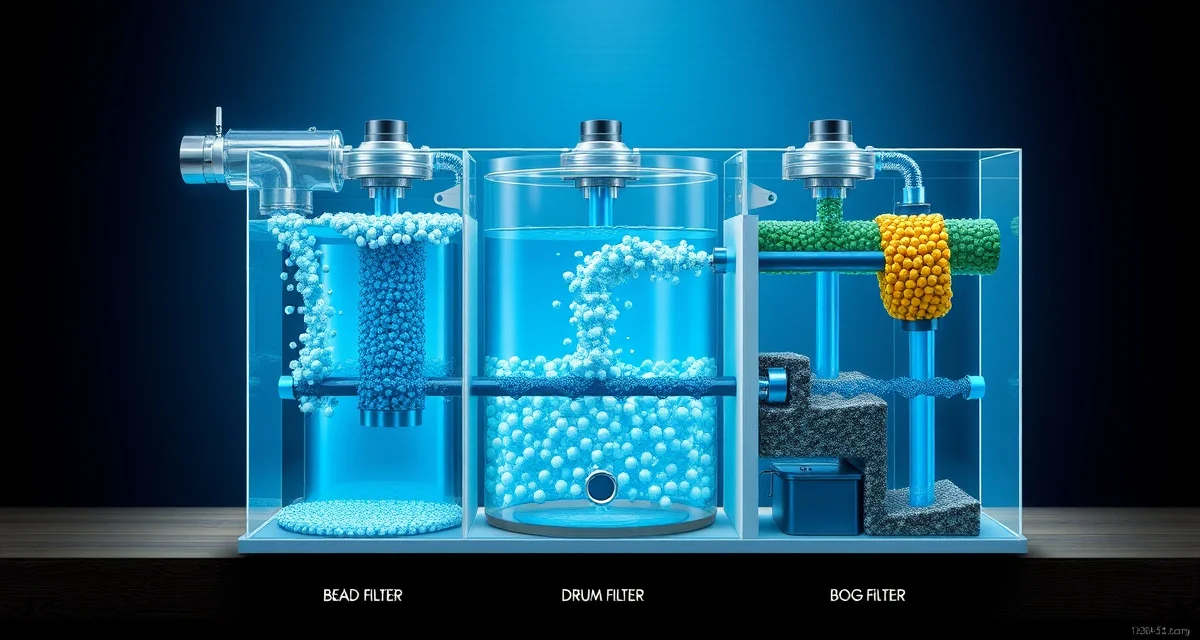
Koi Pond Filtration: Bead Filter vs Drum Filter vs Bog Filter
Your filtration system is the most important structural decision in koi keeping. Get it right and koi pond water quality tracker management becomes manageable. Get it wrong and you're perpetually fighting ammonia, nitrite, and disease events that trace back to an inadequate filter struggling with the bioload.
Undersized filtration is responsible for roughly 40% of established pond disease events in otherwise well-managed ponds. The fish and the keeper are doing everything right - the filter is the bottleneck.
This guide compares the main filtration approaches for koi, from the economics to the practical performance differences.
TL;DR
- Undersized filtration is responsible for roughly 40% of established pond disease events in otherwise well-managed ponds.
- A properly sized bead filter for 1.5–2× pond volume per hour turnover is reliable for most hobbyist operations.
- A practical guideline: the total biological media surface area should be rated for at least 1.5× your fish's calculated oxygen consumption (which scales with fish biomass).
- For a moderately stocked hobbyist pond, a quality bead filter rated at 1.5–2× the pond volume is reliable and manageable.
- For ponds under 1,500 gallons with light stocking, a quality pressurized all-in-one filter is adequate.
- Match the bead filter's rated capacity to at least 1.5× your actual pond volume.
- If the manufacturer rates a filter for a 5,000-gallon pond, use it on a 3,000-gallon pond for appropriate capacity buffer.
What Any Koi Filtration System Must Do
Three functions, all required:
Mechanical filtration: Remove solid waste (fish feces, uneaten food, dead algae) from the water column before it breaks down into dissolved ammonia. The faster solids are removed, the lower the ongoing ammonia and nitrate production.
Biological filtration: House the beneficial bacteria (Nitrosomonas and Nitrospira) that convert ammonia to nitrite to nitrate. This requires a large surface area of media that's consistently exposed to oxygen-rich water.
Water throughput: Circulate the entire pond volume through the filtration system at least once per hour - ideally 1.5–2× per hour for heavily stocked ponds.
Option 1: Pressurized Filter (All-in-One, Entry Level)
Examples: Laguna Pressure-Flo, Oase Filtoclear, Tetra Pond
How it works: Pump pushes water under pressure through a single sealed canister containing mechanical media (sponges, fiber) and biological media, then out through a return. UV sterilizer is often integrated inline.
Best for: Ponds under 1,500 gallons with moderate stocking. Entry-level keepers or casual hobbyists.
Advantages:
- Simple installation (one unit, one pump, low-profile)
- Integrated UV available
- Low cost ($150–400)
Limitations:
- Moderate mechanical filtration - doesn't remove solids as efficiently as a drum filter
- Biological capacity limited by media volume in the canister
- Requires frequent manual cleaning of mechanical media (weekly in summer for heavily stocked ponds)
- Not practical for large or heavily stocked ponds
- Cleaning disrupts biological media and can cause temporary ammonia spikes
Performance for koi: Adequate for lightly stocked display ponds under 2,000 gallons. Not appropriate for dealer operations or heavily stocked ponds.
Option 2: Bead Filter
Examples: Aqua Ultraviolet Ultima II, Pentair FB Bead Filter
How it works: Water flows through a vessel filled with floating plastic beads. Solids are trapped between beads (mechanical filtration); bacteria colonize the bead surfaces (biological filtration). Periodic backwashing purges accumulated solids.
Best for: Mid-range koi ponds 2,000–10,000 gallons with moderate-to-heavy stocking.
Advantages:
- Combines mechanical and biological filtration in one unit
- High biological surface area for the size
- Backwashing cleans mechanical media without destroying biological capacity
- Lower maintenance frequency than sponge/mat filters
Limitations:
- Can't handle very high solid loads as well as a drum filter
- Backwashing pressure requirements mean specific pump sizing
- Medium-to-high cost ($400–1,500 depending on size)
- Backwashing during disease treatment washes out treatments and may disrupt medicated water management
Performance for koi: Solid mid-range choice. A properly sized bead filter for 1.5–2× pond volume per hour turnover is reliable for most hobbyist operations.
Option 3: Drum Filter (Rotary Screen Filter)
Examples: Helix Evolution, Aqua Medic Ultradrum, various European-manufactured units
How it works: A rotating drum with a fine mesh screen (typically 60–120 microns) continuously filters solids from incoming water. A spray bar automatically backwashes the drum screen when pressure drops (solids accumulate) - continuously self-cleaning. Solids are captured and can be directed to waste.
Best for: High-stocking ponds, dealer operations, systems above 3,000 gallons.
Advantages:
- Exceptional mechanical filtration - removes solids faster than bead or sponge filters
- Continuous, automatic cleaning - no manual intervention for mechanical stage
- Reduces biological filter load by removing more solids before biological processing
- Scales to any pond size
Limitations:
- Higher upfront cost ($1,500–5,000+)
- Requires a separate biological filter (drum only provides mechanical filtration)
- Higher water consumption from continuous backwash spray
- More components and potential failure points than simpler systems
Performance for koi: The best mechanical filtration available for koi ponds. Standard equipment in Japanese koi facilities and serious dealer operations for good reason. Paired with a multi-chamber biological filter (moving bed, bead filter, or static media), this is the highest-performance filtration combination available.
Option 4: Gravity / Multi-Gravity Filtration
How it works: Water flows by gravity from the pond into a series of filter chambers (settlement, mechanical, biological). Each chamber handles a different function. Typically includes settlement chamber (removes heavy solids), brush/filter block/mat chamber (fine mechanical), and biological media chamber (high-surface-area bio media).
Best for: Custom-built ponds where gravity filtration can be designed in from the start. Common in UK-style koi pond construction.
Advantages:
- Highly customizable - can be sized for any pond
- Multiple independent chambers allow targeted cleaning without disrupting the whole system
- No backwash water loss (solids cleaned manually per chamber)
- Biological chamber can be very large
Limitations:
- Requires the filter to be lower than the pond water level (can't be retrofitted to all ponds)
- Higher DIY or custom build cost
- Manual solid removal required
Performance for koi: Excellent when well-designed. The independent-chamber approach allows chamber-by-chamber cleaning without crashing the whole biofilter - an advantage over single-canister systems.
Option 5: Bog Filter (Vegetable Filter)
How it works: Pond water is pumped through a planted area (gravel, rocks, or other media) where aquatic plants are rooted. The plants consume ammonia, nitrate, and other nutrients directly, while the gravel provides biological filtration surface area.
Best for: Supplemental filtration; low-stocking naturalistic ponds; complement to mechanical primary filtration.
Advantages:
- Removes nitrate as well as ammonia (plants consume it)
- Aesthetically attractive
- Low operational maintenance once established
- Creates habitat for beneficial insects and filter feeders
Limitations:
- Not sufficient as sole filtration for any meaningful koi stocking
- Performance varies by season (plants grow faster in summer)
- Plant die-back in winter adds organic load
- Not a mechanical filter - needs a mechanical component upstream
Performance for koi: Excellent supplemental filtration. Typically paired with a mechanical primary filter (drum or bead) rather than used alone.
How to Size Your Filtration
Biological filter sizing: The biological filter should handle at least 1.5–2× the pond volume per hour of water flow AND provide enough biological media surface area for your fish bioload.
A practical guideline: the total biological media surface area should be rated for at least 1.5× your fish's calculated oxygen consumption (which scales with fish biomass). If you're stocking heavily, err toward a larger biological filter than the minimum specification.
Mechanical filter sizing: Size to handle the peak organic load in your heaviest feeding season (summer). A drum filter's drum mesh size and drum surface area determines how much solids it can process per hour - match this to your maximum organic load.
Pump sizing: The pump must deliver your target turnover rate at the actual head pressure of your system (accounting for the height the water is being lifted and any pipe friction). Many keepers undersize pumps by not accounting for head pressure.
Related Articles
- How to Buffer pH in a Koi Pond: Stable Chemistry Guide
- What Is the Correct Salt Percentage for Koi Ponds? Complete Guide
- First Koi Pond Guide: Everything New Hobbyists Need to Know
FAQ
What is the best filter for a koi pond?
For a serious koi pond with meaningful stocking: a drum filter (mechanical) paired with a separate high-capacity biological filter (moving bed, bead filter, or multi-chamber gravity) is the highest-performance combination. For a moderately stocked hobbyist pond, a quality bead filter rated at 1.5–2× the pond volume is reliable and manageable. For ponds under 1,500 gallons with light stocking, a quality pressurized all-in-one filter is adequate.
How do I size a bead filter for my koi pond?
Match the bead filter's rated capacity to at least 1.5× your actual pond volume. If the manufacturer rates a filter for a 5,000-gallon pond, use it on a 3,000-gallon pond for appropriate capacity buffer. Heavier stocking requires sizing up further. Ensure your pump delivers the manufacturer's recommended flow rate at the actual head pressure in your system - a pump that delivers the rated flow on flat ground may deliver significantly less when lifting water 4 feet to a filter.
What is a drum filter and do I need one?
A drum filter is a mechanical filtration device that uses a rotating fine-mesh screen to continuously remove solids from pond water. It's the most effective mechanical filtration available for koi. Dealers, high-stocking ponds, and anyone who wants the cleanest possible water with minimal manual maintenance should use a drum filter. For a lightly-stocked hobby pond under 3,000 gallons, a quality bead or gravity filter provides sufficient mechanical filtration at lower cost.
What is Koi Pond Filtration: Bead Filter vs Drum Filter vs Bog Filter?
Koi pond filtration compares three primary systems: bead filters, drum filters, and bog filters. Bead filters use pressurized media beads for mechanical and biological filtration. Drum filters use rotating mesh screens to remove solids automatically. Bog filters use gravel beds and aquatic plants to process waste naturally. Each approach has distinct advantages depending on pond size, stocking density, budget, and how hands-on you want your maintenance to be. Understanding these differences helps you match the right system to your specific pond setup.
How much does Koi Pond Filtration: Bead Filter vs Drum Filter vs Bog Filter cost?
Costs vary significantly by type and scale. Bead filters range from $200–$800 for hobbyist models. Drum filters typically start at $500–$1,500 and can exceed $3,000 for high-end automated units. Bog filters are the most economical long-term option — primarily a construction cost of $100–$500 depending on size — with minimal ongoing expense. Operating costs also differ: drum filters consume more electricity, while bog filters are nearly passive. Undersized filtration costs far more in fish losses and chemical treatments than investing in properly sized equipment upfront.
How does Koi Pond Filtration: Bead Filter vs Drum Filter vs Bog Filter work?
Each filter type processes waste differently. Bead filters tumble pressurized plastic beads to trap solids and grow beneficial bacteria that convert toxic ammonia into nitrite, then nitrate. Drum filters spin a fine mesh screen to remove suspended solids before they decompose, reducing ammonia load on downstream biological media. Bog filters slow water through a gravel bed planted with marginal plants, where bacteria colonize the substrate and plants uptake excess nutrients. All three rely on the nitrogen cycle — the key difference is how efficiently they handle mechanical versus biological filtration.
What are the benefits of Koi Pond Filtration: Bead Filter vs Drum Filter vs Bog Filter?
Proper filtration delivers stable water chemistry, reduced disease risk, and healthier fish with better color and growth. Bead filters offer compact, reliable biological capacity with easy backwashing. Drum filters automate solids removal, dramatically reducing maintenance time in heavily stocked ponds. Bog filters provide natural nutrient export, beneficial insects, and aesthetic value alongside water quality benefits. All three, when correctly sized at 1.5–2× pond volume turnover per hour, address the root cause of roughly 40% of established pond disease events: inadequate filtration creating chronic low-level ammonia and nitrite stress.
Who needs Koi Pond Filtration: Bead Filter vs Drum Filter vs Bog Filter?
Any koi keeper benefits from understanding filtration options, but the right system depends on your situation. Hobbyists with ponds under 1,500 gallons and light stocking can manage with a quality bead filter or pressurized all-in-one unit. Serious hobbyists with moderate to heavy stocking should consider drum filters for reduced maintenance burden. Keepers prioritizing naturalistic ponds and lower operating costs will find bog filters compelling. Breeders and collectors with high-density systems often combine drum filtration for solids removal with separate biological stages for maximum water quality control.
Sources
- Associated Koi Clubs of America (AKCA)
- Koi Organisation International (KOI)
- University of Florida IFAS Extension Aquaculture Program
- Fish Vet Group
- Water Quality Association