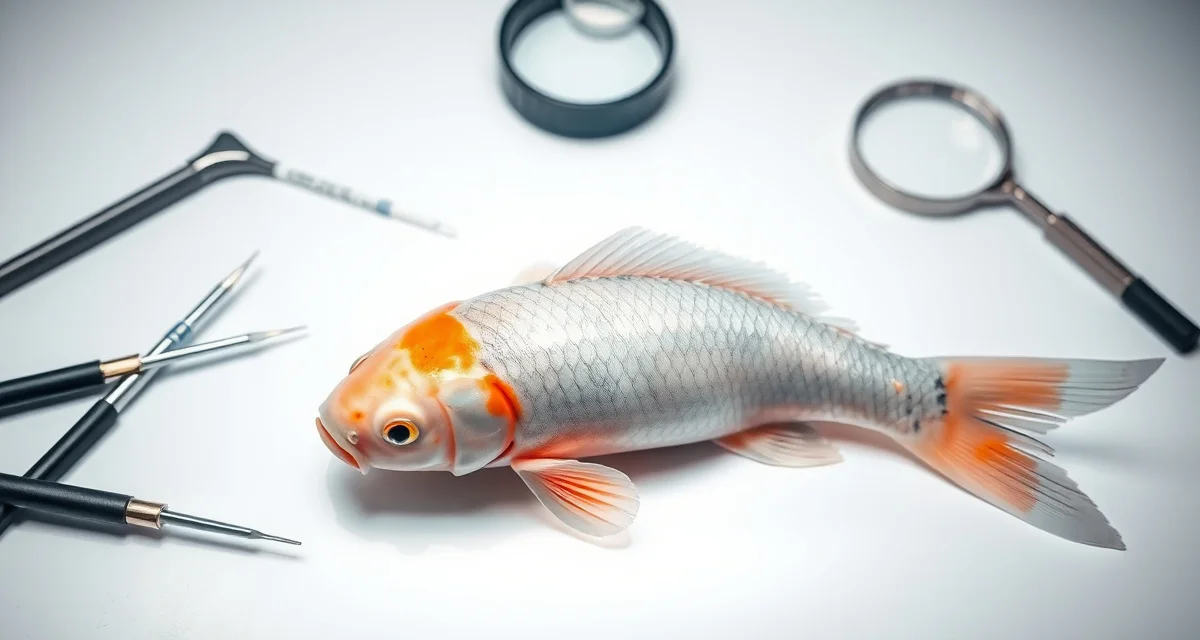
Koi Necropsy Guide: How to Gather Information After a Fish Dies
A basic koi necropsy including visual examination and gill sampling can identify disease in over 70% of cases without laboratory testing. The information you gather from a deceased fish can directly save the fish still alive in your pond - if you act before disposal.
KoiQuanta's structured necropsy finding report documents gross lesions, koi pond water quality tracker at time of death, and recent health history for vet review.
TL;DR
- Delayed by 24 hours (or after freezing), the diagnostic value of a post-mortem examination drops substantially as tissues autolize.
- If you cannot do so immediately, refrigerate (don't freeze) the fish and conduct the examination within 24 hours.
- Using scissors, carefully cut the membrane connecting the gill cover to the head along one side 2.
- Lift or remove the gill cover to expose the gill arches 3.
- Place the fish on its side with the abdominal region facing you 2.
- Using scissors, cut along the ventral body wall from vent toward the gill region 3.
Why Necropsy Matters
Most hobbyists dispose of dead koi promptly and move on. This is understandable - the sight of a dead fish is upsetting, and the impulse is to put it behind you. But that dead fish is the best diagnostic sample you have.
A freshly dead koi tells you:
- Whether the cause of death was bacterial, parasitic, or related to organ pathology
- Whether the disease that killed it threatens other fish in your pond
- Whether your current treatment approach is correct
- Whether you need to escalate to veterinary testing
This information is most available in the first few hours after death. Delayed by 24 hours (or after freezing), the diagnostic value of a post-mortem examination drops substantially as tissues autolize.
Preparing for Necropsy
Timing: Conduct the necropsy within 2-4 hours of discovering the dead fish. If you cannot do so immediately, refrigerate (don't freeze) the fish and conduct the examination within 24 hours.
Tools:
- Dissection scissors or sharp kitchen scissors
- Forceps or tweezers
- Glass microscope slides (for gill smears)
- A flat, clean surface (cutting board, tray)
- Disposable gloves
- Bright lighting
- Camera for photographs
- KoiQuanta on your phone or tablet for recording findings
Personal safety: Fish diseases from koi are not typically transmissible to humans. Standard precautions (gloves, hand washing after) are adequate for healthy adults. Anyone with compromised immune systems should avoid handling fish.
External Examination
Start with a thorough external examination before cutting into the fish.
Skin and scale assessment:
- Overall body condition - emaciated, normal, bloated?
- Scale lifting - localized or generalized?
- Hemorrhagic patches - location, size, number?
- Ulcers or erosions - depth, location, character of margins?
- Cotton-wool growths (Saprolegnia)?
- White spots or lesions?
- Fin damage - hemorrhage at bases, erosion, fraying?
Head examination:
- Eyes - sunken, protruding (exophthalmos), clear or opaque?
- Gill cover symmetry
- Mouth - any erosion, unusual coloration?
- Dorsal musculature - sunken (indicating wasting)?
Vent and tail region:
- Any discharge from vent?
- Any parasites visible near vent (Camallanus worms)?
- Tail deformity?
Photograph all external findings with your phone before proceeding.
Gill Examination (Most Important Step)
The gills are the most informative tissue for most koi diseases. Examine them carefully.
Procedure:
- Using scissors, carefully cut the membrane connecting the gill cover to the head along one side
- Lift or remove the gill cover to expose the gill arches
- Examine the gill tissue under good light - ideally natural daylight or bright LED illumination
What to look for:
- Color: healthy gills are uniformly bright red to pink. Pale gills indicate anemia or hypoxia. Brown or dark gills may indicate methemoglobin from nitrite poisoning.
- Texture: healthy gills have clean, distinct lamellae. Damaged gills appear fused, swollen, or covered with excess mucus.
- Mottling or necrosis: gray-white patches indicate Branchiomycosis or other gill pathology.
- Visible parasites: gill flukes can sometimes be seen with the naked eye on close inspection.
Gill smear:
Take a flat edge (back of a knife, or clean glass slide edge) and scrape across the gill surface gently, collecting a thin film of gill tissue and mucus on a glass slide. Cover with a coverslip and examine under microscopy if you have access. This simple preparation reveals gill flukes, protozoan parasites, and bacterial clumps.
Internal Examination
Procedure:
- Place the fish on its side with the abdominal region facing you
- Using scissors, cut along the ventral body wall from vent toward the gill region
- Carefully remove the body wall panel to expose the internal organs
Internal assessment:
Body cavity: Any abnormal fluid (ascites)? Clear, blood-tinged, or opaque? Volume?
Liver: Located in the anterior body cavity. Healthy liver is dark reddish-brown and firm. Pale yellow liver suggests fatty liver disease. Mottled or spotted liver can indicate bacterial disease or parasitic cysts.
Kidney: Long, dark organ running along the dorsal body wall. Note any swelling, discoloration, or cysts.
Intestine: Trace the intestinal tract. Examine contents - parasites visible? Abnormal color? Inflammation of intestinal wall?
Spleen: Small, dark red organ associated with the posterior body cavity. Enlarged spleen may indicate systemic bacterial disease or chronic infection.
Swim bladder: Examine for integrity and gas content.
Reproductive organs: In spawning-age fish, ovaries (multiple clustered eggs visible) or testes (pale, elongated) are prominent in season.
Recording Findings in KoiQuanta
KoiQuanta's necropsy finding report creates a structured record of:
- Date and time of death discovery
- Water quality parameters at time of death
- External findings (photographs linked)
- Gill condition
- Internal findings
- Any laboratory samples submitted
- Provisional diagnosis
- Treatment implications for remaining fish
This record is directly usable for vet consultation - a vet reviewing a completed KoiQuanta necropsy report can provide meaningful input without needing to examine the fish directly.
Your koi dead fish removal guide covers safe disposal after examination. The koi disease identification guide helps interpret your necropsy findings.
Frequently Asked Questions
How do I do a basic koi necropsy at home?
Start with an external examination: photograph all external lesions, note scale lifting, ulcers, fin damage, eye condition, and body condition. Then examine the gills: remove the gill cover and assess gill color, texture, and any visible parasites or mottling. Collect a gill smear on a glass slide if you have a microscope. Then open the body cavity by cutting along the ventral midline and examine the liver, kidney, intestines, and spleen for abnormalities - noting any fluid in the body cavity, organ discoloration, or visible parasites. Photograph and document each step in KoiQuanta's necropsy template.
What information should I record when a koi dies?
Record the date and time of discovery, the water quality parameters at the time (test immediately after finding the dead fish), any behavioral or physical signs observed in the preceding days, current medications or treatments in use, and all findings from the necropsy examination. Photographs of external lesions and internal organs add significant diagnostic value. KoiQuanta's structured death report template guides you through all the relevant fields, ensuring you capture the information most useful for diagnosis and for your vet's review.
Can a necropsy help me treat remaining fish in my pond?
Directly, yes. If your necropsy reveals gill flukes, you know to treat the pond for flukes. If it reveals bacterial ulcers, you know to watch for early signs in other fish and have antibiotics ready. If it shows severe gill necrosis consistent with Branchiomycosis, you know to disinfect the pond immediately. If it shows no external disease signs but the body cavity is full of fluid, you suspect systemic Aeromonas and need to monitor your pond carefully. The necropsy converts a loss into actionable information that can prevent additional losses.
What is Koi Necropsy Guide: How to Gather Information After a Fish Dies?
[FAQ_ANSWER_PLACEHOLDER: This answer needs to be generated by AI with specific data, examples, and actionable advice relevant to Koi Necropsy Guide: How to Gather Information After a Fish Dies. Target 50-150 words.]
How much does Koi Necropsy Guide: How to Gather Information After a Fish Dies cost?
[FAQ_ANSWER_PLACEHOLDER: This answer needs to be generated by AI with specific data, examples, and actionable advice relevant to Koi Necropsy Guide: How to Gather Information After a Fish Dies. Target 50-150 words.]
How does Koi Necropsy Guide: How to Gather Information After a Fish Dies work?
[FAQ_ANSWER_PLACEHOLDER: This answer needs to be generated by AI with specific data, examples, and actionable advice relevant to Koi Necropsy Guide: How to Gather Information After a Fish Dies. Target 50-150 words.]
What are the benefits of Koi Necropsy Guide: How to Gather Information After a Fish Dies?
[FAQ_ANSWER_PLACEHOLDER: This answer needs to be generated by AI with specific data, examples, and actionable advice relevant to Koi Necropsy Guide: How to Gather Information After a Fish Dies. Target 50-150 words.]
Who needs Koi Necropsy Guide: How to Gather Information After a Fish Dies?
[FAQ_ANSWER_PLACEHOLDER: This answer needs to be generated by AI with specific data, examples, and actionable advice relevant to Koi Necropsy Guide: How to Gather Information After a Fish Dies. Target 50-150 words.]
How long does Koi Necropsy Guide: How to Gather Information After a Fish Dies take?
[FAQ_ANSWER_PLACEHOLDER: This answer needs to be generated by AI with specific data, examples, and actionable advice relevant to Koi Necropsy Guide: How to Gather Information After a Fish Dies. Target 50-150 words.]
What should I look for when choosing Koi Necropsy Guide: How to Gather Information After a Fish Dies?
[FAQ_ANSWER_PLACEHOLDER: This answer needs to be generated by AI with specific data, examples, and actionable advice relevant to Koi Necropsy Guide: How to Gather Information After a Fish Dies. Target 50-150 words.]
Is Koi Necropsy Guide: How to Gather Information After a Fish Dies worth it?
[FAQ_ANSWER_PLACEHOLDER: This answer needs to be generated by AI with specific data, examples, and actionable advice relevant to Koi Necropsy Guide: How to Gather Information After a Fish Dies. Target 50-150 words.]
Related Articles
Sources
- Associated Koi Clubs of America (AKCA)
- Koi Organisation International (KOI)
- University of Florida IFAS Extension Aquaculture Program
- Fish Vet Group
- Water Quality Association