Chagoi Koi Care Guide: The Friendly Giant
Chagoi often reach 80cm or more and are among the fastest-growing koi varieties. That's worth stating upfront because the care implications are real. A fish that's pushing a meter in length needs a pond designed around its adult size, not its purchase size. And a fish growing that fast needs feeding, koi pond water quality tracker, and space management that keeps pace with growth.
But Chagoi are worth the effort. They're genuinely different from other koi in temperament. Hand-taming Chagoi, and they tame easily, has a documented calming effect on other pond fish. Experienced koi keepers add a Chagoi specifically to settle nervous, shy pond populations. It's one of the more unusual and useful things a single fish can do.
TL;DR
- A young Chagoi can add 10-15cm of body length in a single growing season in optimal conditions.
- The result is the jumbo fish (70-100cm) you see at serious koi shows that stop people in their tracks.
- An 80cm Chagoi is a serious animal that needs real space.
- A single 80cm Chagoi produces the waste of 3-4 average adult koi.
- Size your biological filtration accordingly, not for the fish's current size but for where it will be in 3 years.
- Weekly water changes of 15-20% are the minimum.
- Some serious growers do 25-30% weekly during the growth season to keep nitrates low and replace the trace minerals that drive scale and tissue development.
What Makes Chagoi Different
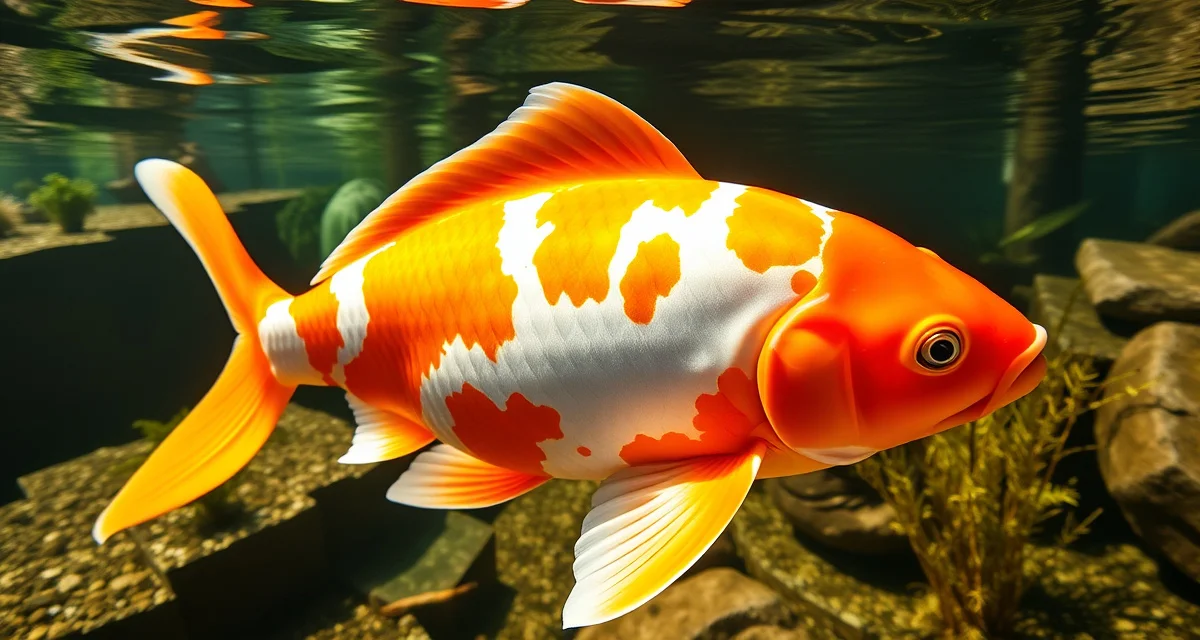
Chagoi (literally "tea-colored koi") are a single-color variety in shades ranging from light brown and golden-tan to deep olive and dark brown. The scale pattern is typically reticulated. Each scale has a slightly darker edge that creates a net-like effect across the body. They're not showy in the way a Kohaku or Showa is showy, but there's a depth to their coloration and an imposing presence when they grow to full size.
The two standout Chagoi characteristics:
Tameness. Chagoi are calm, curious, and habituate to human presence faster than almost any other koi variety. They're often the first fish to approach and feed from the hand. This boldness, approaching without fear, signals to other pond fish that the area is safe. This is why adding one to a shy pond can change the entire population's behavior within weeks.
Growth rate. Under good feeding and water conditions, Chagoi grow at rates that regularly exceed other varieties by 30-50%. A young Chagoi can add 10-15cm of body length in a single growing season in optimal conditions. The result is the jumbo fish (70-100cm) you see at serious koi shows that stop people in their tracks.
Step 1: Pond Size Requirements
Do not buy a Chagoi for a small pond. This is the most important care consideration and the one most often ignored.
Minimum pond volume for a single adult Chagoi: 2000-3000 gallons
Recommended for long-term growth: 5000+ gallons
Minimum pond depth: 5 feet (1.5m). Chagoi are large fish that need vertical space.
A Chagoi in a pond it's grown too large for isn't just unhappy. It becomes increasingly prone to mechanical injury (fins against walls and edges), oxygen competition with other fish, and stress-related immune suppression.
If you're setting up a pond specifically for Chagoi or planning to include one in a mixed pond, design around the adult size of this variety. A 50cm Chagoi is already a large koi. An 80cm Chagoi is a serious animal that needs real space.
Step 2: Feeding for Maximum Growth
Chagoi grow fast, but that growth only happens with quality nutrition at appropriate quantity.
Feeding priorities:
- High-protein food (40%+ protein) during the main growing season (May-September) in temperate climates
- Feed 2-4 times daily at 20-25°C. More than other koi varieties given the growth demand.
- Use premium growth formula rather than standard maintenance food
- Supplement with natural treats: orange slices, watermelon, shrimp. Chagoi readily accept these and they support growth and enrichment.
Temperature-adjusted feeding:
- Below 15°C: switch to wheat germ, reduce frequency to once daily
- Below 10°C: stop feeding entirely
- Above 28°C: reduce feeding to once daily or less (warm water risks water quality crash from heavy feeding)
Because Chagoi grow considerably faster than other koi, their nutritional requirements during the growing season are more demanding. If you're feeding your mixed pond once daily at a general rate, your Chagoi may not be getting enough food to reach its genetic growth potential. Monitor your Chagoi's growth trajectory and adjust feeding accordingly.
KoiQuanta's growth tracking can compare individual Chagoi growth against variety benchmarks, so you can see whether your fish is growing on track or whether nutrition or water quality is holding it back.
Step 3: Water Quality for Fast-Growing Fish
Fast growth means high metabolic rate, which means high waste production. Chagoi in their growth phase can produce more ammonia per unit of body weight than smaller or slower-growing varieties.
Key water parameters:
- Ammonia: 0 ppm (non-negotiable for growth; even 0.1 ppm suppresses growth hormone production)
- Nitrate: below 40 ppm for growth; ideally below 20 ppm
- Dissolved oxygen: above 8 mg/L. Large active fish need serious oxygen availability.
- pH: stable 7.2-8.0
Filtration requirements for Chagoi:
If you're keeping a mature Chagoi, your filtration needs to be sized for the bioload of a very large fish. A single 80cm Chagoi produces the waste of 3-4 average adult koi. Size your biological filtration accordingly, not for the fish's current size but for where it will be in 3 years.
Weekly water changes of 15-20% are the minimum. Some serious growers do 25-30% weekly during the growth season to keep nitrates low and replace the trace minerals that drive scale and tissue development.
Step 4: Health Monitoring for Chagoi
Chagoi are generally hardy, but their size creates specific health considerations.
What to watch for:
Skin and scale condition. Large koi can develop bacterial skin infections after minor injuries that might heal without issue in smaller fish. Abrasions on the flank from spawning, pond edges, or nets can become deep ulcers. Check your Chagoi's flanks during every routine observation.
Fin condition. At 70-80cm, koi fins are impressive structures that take real damage during spawning or from vigorous handling. Fin rot in a large fish can progress quickly. Catch it early.
Swollen joints and arthritis. Very large koi occasionally develop joint issues in their fin bases, visible as localized swelling. This is more common in older fish and in ponds where they've had repeated physical injuries. Track any swelling observations against historical records.
Weight and body condition. A healthy Chagoi should be barrel-shaped with good depth, not thin-looking. If your Chagoi is losing condition (becoming visibly thinner), investigate: internal parasites, poor nutrition, or disease.
Step 5: Chagoi and Pond Social Dynamics
The calming effect of Chagoi on other koi is real and well-documented by hobbyists. If you add a Chagoi to a pond of fish that are shy, don't approach the surface, and won't hand-feed, the Chagoi's bold approach behavior changes the dynamic. Other fish follow. Within weeks, fish that previously hid at the far end of the pond are approaching you with the Chagoi.
This effect is most pronounced when:
- The Chagoi is the largest or one of the largest fish in the pond
- The Chagoi is well-tamed (hand-fed regularly)
- The other fish are of breeds prone to wariness (Shiro Utsuri, some Kohaku)
There are no downsides to the Chagoi's social effect. They don't bully or dominate. They're simply confident, and confidence in the pond is contagious.
If you want to hand-feed your pond, start with the Chagoi. Feed it from the hand daily. Within 2-4 weeks, other fish will be joining the approach.
Common Mistakes in Chagoi Keeping
Buying young and underestimating growth. A 15cm Chagoi at purchase is a 70cm fish in 4 years. Plan for the adult, not the juvenile.
Underfeeding during the growth season. Chagoi need more food than the same-length fish of other varieties. Match food quantity to growth demand.
Insufficient filtration. A large Chagoi overwhelms filtration designed for smaller fish. When growth rates slow unexpectedly, check whether ammonia and nitrate are creeping up.
Netting carelessly. Chagoi at full size are very strong fish and difficult to net without injury. Use large, smooth-mesh nets and get help for any intervention involving a large Chagoi.
For more on koi feeding principles across varieties, see the koi feeding guide. For variety comparisons, visit the koi variety guide.
Related Articles
FAQ
Why do koi keepers add Chagoi to their pond?
Chagoi are the most consistently hand-tame variety of koi and have a documented effect on pond social dynamics. When a Chagoi confidently approaches a keeper at the pond edge, other fish follow, including fish that previously wouldn't come near humans. Keepers add Chagoi specifically to "open up" a shy pond, to enable hand-feeding in a pond where it wasn't previously possible, and to create that sense of connection with the fish that koi keeping is really about. The secondary benefit is that Chagoi grow large and impressive, adding a different visual scale to a pond of smaller varieties.
How big do Chagoi koi get?
Chagoi are among the fastest-growing and largest-reaching koi varieties. In optimal conditions with quality feeding and good water quality, Chagoi regularly reach 70-80cm (27-31 inches) and some exceed 90-100cm (35-39 inches). A mature pond Chagoi kept for 8-10 years under excellent conditions can genuinely be a meter-long fish. Growth rate is influenced by water temperature, water quality, and feeding quality. Fish in warm ponds with premium food and excellent water quality grow the fastest.
Do Chagoi need special feeding to support rapid growth?
They need more food than same-length fish of other varieties, and they benefit from high-protein growth formula during the active growing season (water above 18°C). Use premium protein-rich food (40%+ protein) fed 2-4 times daily in summer, and supplement with natural treats like orange, watermelon, and shrimp. Switch to wheat germ during cooler months as water temperature drops. The key insight is that Chagoi's growth potential only expresses fully with consistent quality nutrition. Standard maintenance feeding rates typical for mixed ponds may under-feed a growing Chagoi.
What is Chagoi Koi Care Guide: The Friendly Giant?
[FAQ_ANSWER_PLACEHOLDER: This answer needs to be generated by AI with specific data, examples, and actionable advice relevant to Chagoi Koi Care Guide: The Friendly Giant. Target 50-150 words.]
How much does Chagoi Koi Care Guide: The Friendly Giant cost?
[FAQ_ANSWER_PLACEHOLDER: This answer needs to be generated by AI with specific data, examples, and actionable advice relevant to Chagoi Koi Care Guide: The Friendly Giant. Target 50-150 words.]
How does Chagoi Koi Care Guide: The Friendly Giant work?
[FAQ_ANSWER_PLACEHOLDER: This answer needs to be generated by AI with specific data, examples, and actionable advice relevant to Chagoi Koi Care Guide: The Friendly Giant. Target 50-150 words.]
What are the benefits of Chagoi Koi Care Guide: The Friendly Giant?
[FAQ_ANSWER_PLACEHOLDER: This answer needs to be generated by AI with specific data, examples, and actionable advice relevant to Chagoi Koi Care Guide: The Friendly Giant. Target 50-150 words.]
Who needs Chagoi Koi Care Guide: The Friendly Giant?
[FAQ_ANSWER_PLACEHOLDER: This answer needs to be generated by AI with specific data, examples, and actionable advice relevant to Chagoi Koi Care Guide: The Friendly Giant. Target 50-150 words.]
Sources
- Associated Koi Clubs of America (AKCA)
- Koi Organisation International (KOI)
- University of Florida IFAS Extension Aquaculture Program
- Fish Vet Group
- Water Quality Association