Koi Ulcer Disease: Complete Treatment and Wound Care Guide
An ulcer on a koi is a visible sign of a systemic bacterial problem - not just a surface wound. The hole in the skin is the symptom. The bacteria that created it, and the conditions that allowed it to take hold, are the actual disease.
Treating an ulcer means addressing both the local wound and the systemic infection. Doing one without the other fails. I've seen keepers apply topical treatment beautifully and never start antibiotics - the wound appeared to be healing on the surface while the infection tracked deeper into the muscle. And I've seen keepers run antibiotics without wound care and watch the wound expand outward even as the systemic infection is being controlled.
You need both.
TL;DR
- Ulcers larger than 3cm, or ulcers that have expanded more than 20% in 24 hours, are actively progressing infections requiring immediate systemic antibiotics alongside topical care.
- Net the fish carefully and place it on the support surface - the fish should be mostly in water with the wound area accessible 2.
- Gently remove any loose necrotic tissue from the wound with sterile gauze or forceps - don't remove healthy red tissue, only obviously dead white or gray tissue 3.
- Flush the wound with dilute povidone-iodine (1 part iodine to 10 parts sterile saline or dechlorinated water) 4.
- Apply antibiotic wound paste (if available) or petroleum jelly over the wound surface - this protects the wound from waterborne pathogens and secondary Saprolegnia 5.
- Return the fish to the tank within 60 seconds Repeat daily for the first week, then every other day as the wound begins contracting.
- Don't use in very hard water (above 250 mg/L CaCO3) - calcium binds tetracycline and reduces efficacy dramatically.
Assessing the Ulcer
Before starting treatment, assess the wound:
Depth:
- Superficial: skin and scale layer only. Reddened, but no tissue loss below the dermis. Best prognosis.
- Moderate: penetrates through skin into the subcutaneous fat layer. Open wound, tissue loss visible. Good prognosis with treatment.
- Deep: penetrates into muscle tissue. White or yellow muscle fibers visible. Requires aggressive treatment; prognosis depends on size and location.
- Very deep: approaches or reaches the body cavity. Rare, but associated with poor prognosis even with treatment.
Size:
Ulcers smaller than 1cm diameter are early-stage and respond well to treatment. Ulcers larger than 3cm, or ulcers that have expanded more than 20% in 24 hours, are actively progressing infections requiring immediate systemic antibiotics alongside topical care.
Signs of secondary infection:
- White, fluffy growth around the edges (Saprolegnia fungal infection)
- Expanding redness beyond the wound margins (spreading bacterial infection)
- Foul smell (necrotic tissue)
- Very wet, macerated appearance to wound tissue
Location:
Ulcers near major blood vessels (along the lateral line, near the caudal peduncle) are higher risk for hemorrhage and rapid deterioration. Ulcers at the base of fins can undermine the fin attachment if not treated aggressively.
Wound Care Protocol
How to Treat an Ulcer Out of Water
For any ulcer that's deeper than superficial, direct topical treatment requires a brief period out of water. You don't need to anesthetize the fish unless it's very large and difficult to control.
Preparation:
- Fill a soft mesh net or wet foam mat with enough water to support the fish
- Prepare your wound care materials: sterile gauze, povidone-iodine solution or chlorhexidine, antibiotic wound gel or petroleum jelly (to protect from secondary Saprolegnia), forceps for tissue removal
Procedure:
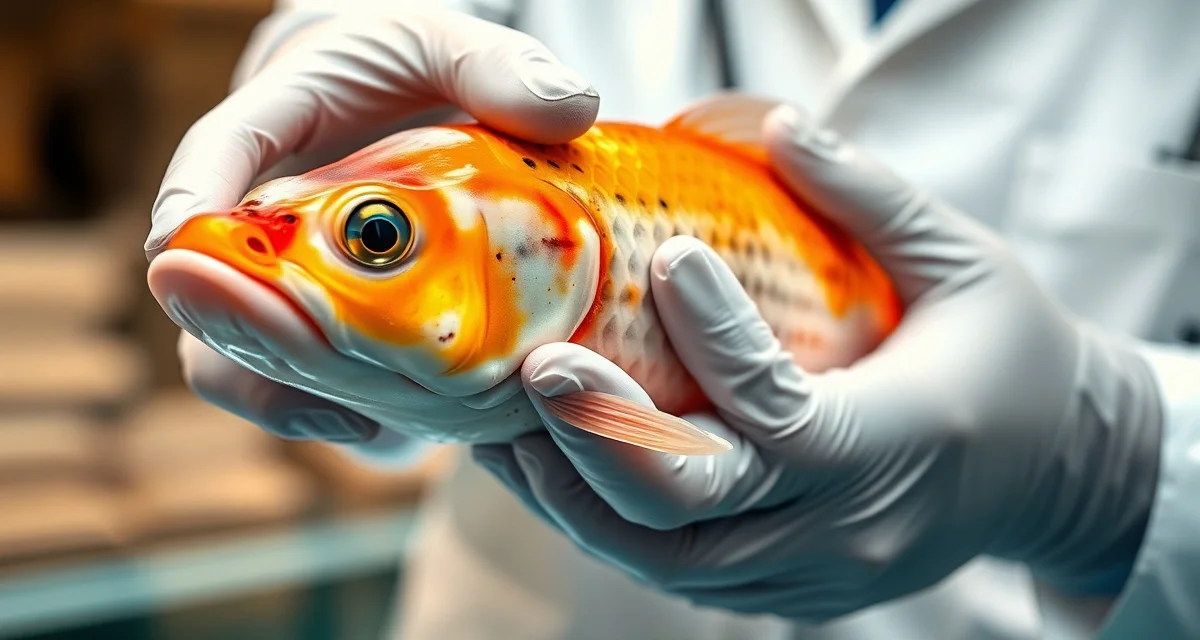
- Net the fish carefully and place it on the support surface - the fish should be mostly in water with the wound area accessible
- Gently remove any loose necrotic tissue from the wound with sterile gauze or forceps - don't remove healthy red tissue, only obviously dead white or gray tissue
- Flush the wound with dilute povidone-iodine (1 part iodine to 10 parts sterile saline or dechlorinated water)
- Apply antibiotic wound paste (if available) or petroleum jelly over the wound surface - this protects the wound from waterborne pathogens and secondary Saprolegnia
- Return the fish to the tank within 60 seconds
Repeat daily for the first week, then every other day as the wound begins contracting.
Don't:
- Use undiluted povidone-iodine directly in the wound - it's tissue-damaging at full concentration
- Attempt to close the wound with sutures unless performed by a veterinarian
- Scrub healthy granulating tissue that's growing in from the wound edges
Systemic Antibiotic Treatment
For any ulcer more than 1cm, systemic antibiotics are necessary alongside topical wound care.
Oxytetracycline bath: 10–20 mg/L for 10–14 days minimum. The standard accessible option for hobbyists. Don't use in very hard water (above 250 mg/L CaCO3) - calcium binds tetracycline and reduces efficacy dramatically.
Enrofloxacin (prescription): Better tissue penetration than oxytetracycline, excellent Aeromonas coverage. Injectable enrofloxacin has the most reliable delivery for serious cases - contact an aquatic veterinarian.
Florfenicol (prescription): Good option for large fish where bath treatment delivery may be inconsistent.
Duration: Complete the full antibiotic course and extend by 3–5 days past apparent healing. The most common treatment failure in ulcer disease is antibiotic course cut short by 3–5 days when the fish "looks better."
Monitoring Healing Progress
A healing ulcer should show predictable progress:
Week 1 of treatment:
- Redness around wound margins should decrease (not increase)
- Wound size should stabilize (not enlarge)
- Appetite should begin returning by day 5–7
Week 2:
- Wound edges should be contracting - the wound getting smaller from the perimeter inward
- Pink, moist granulation tissue growing from wound edges is good (new skin forming)
- Any dead tissue at center of wound being cleared by immune response
Week 3–4:
- Active closure - wound significantly smaller than initial presentation
- New skin covering progressively
- Full closure for small ulcers; partial closure for large wounds
Signs of treatment failure (change protocol if seen):
- Wound expanding despite 5 days of antibiotics
- No granulation tissue forming at wound edges by day 10
- New ulcers appearing elsewhere on the same fish
- Fish deteriorating clinically while wound appears static
KoiQuanta's wound tracking allows you to log the ulcer dimensions at each observation, creating a measurable closure rate over time. If the rate stalls or reverses, you have objective data to support changing treatment.
Secondary Saprolegnia (Fungal) Treatment
Saprolegnia fungus colonizes koi ulcers opportunistically. If you see white, fluffy growth around or in the wound - treat it.
Topical: 3% hydrogen peroxide directly applied to the fungal growth (out of water) for 30–60 seconds, then rinse. Destroys fungal hyphae on contact. Can repeat daily.
Bath treatment: Formalin at 15–25 mg/L kills Saprolegnia in the water column and on skin surfaces. Run maximum aeration. Salt at 0.3–0.5% also has some antifungal action at wound sites.
Treating only the Saprolegnia without the underlying Aeromonas infection will fail - the fungus will return to the unprotected wound as long as the bacterial infection is active.
What's the Expected Healing Timeline?
| Ulcer Size | Expected Closure Time (With Treatment) |
|------------|---------------------------------------|
| < 1cm (superficial) | 2–3 weeks |
| 1–2cm (moderate) | 4–6 weeks |
| 2–4cm (deep) | 6–10 weeks |
| > 4cm | 10–16 weeks or incomplete closure |
Large, deep ulcers may close with scar tissue rather than fully regenerated skin - the appearance will differ from surrounding skin but the fish can be completely healthy. Scale regrowth over healed scar tissue sometimes occurs within 6–12 months post-healing.
Related Articles
- Complete Koi Care Guide: Everything You Need to Know
- Koi Disease Reference Manual: Complete Pathogen Guide
- Koi Parasite Treatment: Complete Protocol Guide
- How Much Salt to Add to a Koi Pond: The Complete Dosing Guide
FAQ
How do I treat a koi ulcer?
Koi ulcer treatment requires two simultaneous approaches: systemic antibiotic treatment (oxytetracycline bath at 10–20 mg/L for 10–14 days minimum) to address the underlying Aeromonas infection, and daily topical wound care out of water (debridement, dilute povidone-iodine flush, antibiotic wound gel application). Salt at 0.3% and optimal water quality support the fish's immune function throughout. Address both the wound and the systemic infection - topical alone or antibiotics alone will typically fail.
Should I take my koi out of water to treat an ulcer?
Yes, for any ulcer deeper than superficial skin damage. Direct topical wound care - cleaning, antiseptic application, and antibiotic gel application - can't be done effectively with the fish in water. Brief out-of-water treatment (30–60 seconds) on a wet, supportive surface is safe for most koi and allows proper wound care. Very small surface ulcers can be managed with in-water treatments, but moderate to deep ulcers benefit from daily or every-other-day out-of-water wound care.
How long do koi ulcers take to heal?
With proper antibiotic treatment and wound care, small ulcers under 1cm typically close in 2–3 weeks. Moderate 1–2cm ulcers take 4–6 weeks. Large or deep ulcers of 2–4cm may take 6–10 weeks or longer to fully close. Healing progression should be visible weekly - wound contracting from the edges, new pink granulation tissue forming. An ulcer that isn't visibly smaller by week 2 of treatment needs a protocol review.
What is Koi Ulcer Disease: Complete Treatment and Wound Care Guide?
Koi Ulcer Disease: Complete Treatment and Wound Care Guide is an in-depth resource covering the diagnosis, treatment, and wound management of bacterial ulcers in koi fish. It explains that ulcers are symptoms of systemic bacterial infections, not just surface wounds, and outlines a dual-approach treatment protocol combining topical wound care with systemic antibiotics to effectively resolve both the visible wound and the underlying infection.
How much does Koi Ulcer Disease: Complete Treatment and Wound Care Guide cost?
This is a free educational guide published on KoiQuanta. There is no cost to access the article. It provides hobbyist and serious koi keepers with professional-level treatment protocols, wound care steps, and antibiotic guidance at no charge, making expert koi health information accessible to anyone managing a backyard pond or koi collection.
How does Koi Ulcer Disease: Complete Treatment and Wound Care Guide work?
The guide works by walking keepers through a two-pronged treatment approach: local wound care (removing necrotic tissue, flushing with dilute povidone-iodine, applying topical antimicrobials) combined with systemic antibiotic treatment. It explains that addressing only one aspect consistently fails, and provides clear escalation thresholds — such as ulcers larger than 3cm or expanding more than 20% in 24 hours — to guide treatment decisions.
What are the benefits of Koi Ulcer Disease: Complete Treatment and Wound Care Guide?
Following this guide helps koi keepers avoid the two most common treatment failures: surface healing that masks a deepening infection, and systemic antibiotic use without wound care that allows the wound to expand. Benefits include faster recovery, reduced fish loss, clear step-by-step handling instructions, and confidence in knowing when a case requires urgent intervention versus standard home treatment.
Who needs Koi Ulcer Disease: Complete Treatment and Wound Care Guide?
Any koi keeper who has a fish showing open sores, lesions, or skin ulceration needs this guide. It is especially valuable for pond owners who have noticed a wound appearing or growing, keepers who have tried topical treatments without success, and anyone managing multiple fish where infection could spread. Even prevention-focused keepers benefit from understanding the bacterial causes and early warning signs.
Sources
- Associated Koi Clubs of America (AKCA)
- Koi Organisation International (KOI)
- University of Florida IFAS Extension Aquaculture Program
- Fish Vet Group
- Water Quality Association