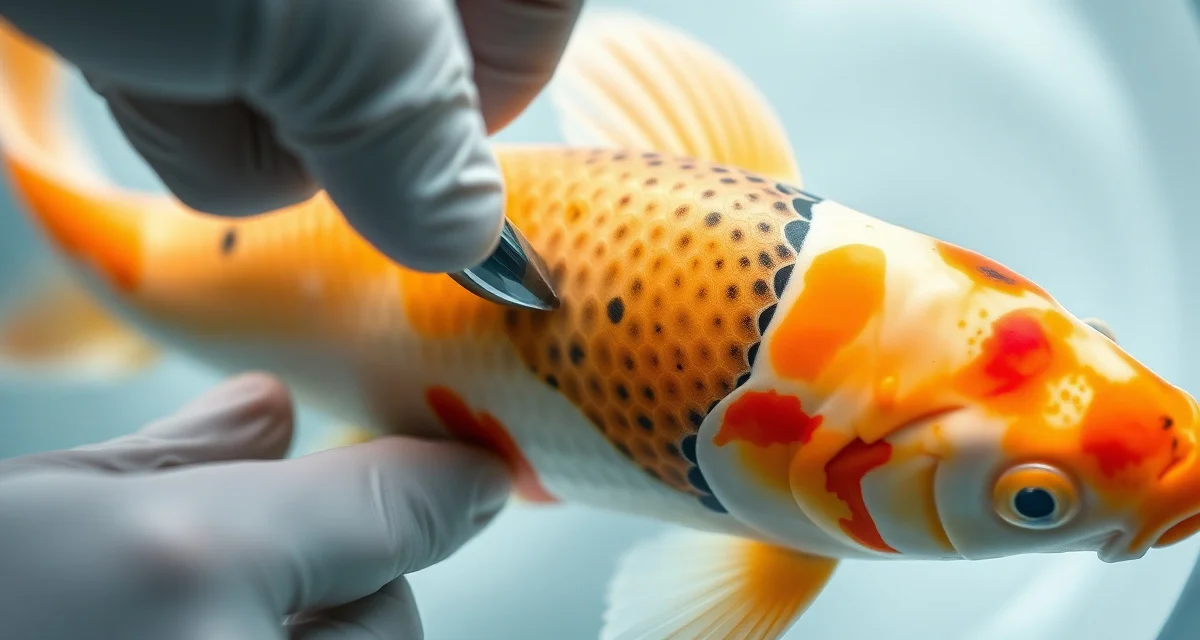
Koi Wound Healing Tracker: Monitor Recovery from Injury and Surgery
Koi wounds that fail to show visible healing progress within 5 days of treatment initiation indicate treatment failure requiring protocol revision. This 5-day window is an important benchmark that helps you distinguish normal healing from a wound that isn't responding - before another week passes and the situation has deteriorated further.
KoiQuanta's daily photo healing comparison feature shows wound closure rate and alerts when healing has stalled.
TL;DR
- This 5-day window is an important benchmark that helps you distinguish normal healing from a wound that isn't responding - before another week passes and the situation has deteriorated further.
- The alert function flags when no update has been entered for more than 48 hours (a prompt to check the fish), and can be configured to flag when healing metrics haven't changed over a defined period.
- By day 5-7 of effective treatment, you should see at least some of these signs.
- Any of these at the 5-7 day mark should prompt antibiotic change based on culture and sensitivity, addition of topical treatment, or veterinary consultation.
- Seasonal changes require adjusted monitoring schedules; automated reminders help maintain consistency.
Why Track Wound Healing Systematically
Wound healing in koi is slower than most hobbyists expect. A significant ulcer that took weeks to develop won't heal in days. Realistic expectations about healing timelines prevent premature conclusions - both the mistaken belief that treatment has failed when it hasn't, and the opposite error of watching a non-healing wound for too long before acting.
Systematic tracking serves three functions:
Confirming treatment is working. Progressive granulation, wound edge advancement, and reduction in wound area over time confirm that your treatment protocol is effective. Without documentation, it's difficult to assess whether a wound looks "better" than it did last week or about the same.
Catching treatment failure early. A wound that shows no measurable improvement over 5-7 days of treatment is likely not responding. This is the point to seek a second opinion, consider a different antibiotic, or add topical treatment. Catching this early prevents weeks of ineffective treatment.
Creating the vet consultation record. If you need veterinary help with a non-healing wound, a series of dated photographs showing the wound's progression (or lack thereof) is far more useful to the vet than your verbal description.
What Normal Koi Wound Healing Looks Like
Understanding the normal healing sequence helps you interpret what you're observing:
Days 1-5 (Inflammatory phase): The wound edges may appear more inflamed and slightly reddened during the first several days. This is normal - it represents the acute inflammatory response that is the first phase of healing. Do not interpret increased inflammation in the first few days as treatment failure.
Days 5-14 (Early granulation): New tissue (granulation tissue) begins forming across the wound bed. This appears as slightly raised, moist, pinkish-red tissue. The wound edges begin advancing over this new tissue.
Days 14-30+ (Granulation and re-epithelialization): Granulation tissue fills the wound from the base. The surface begins to be covered by new epithelium advancing from the wound edges. The wound appears to shrink from the margins inward.
Weeks to months (Scar maturation and pigment restoration): Even after the wound surface is closed, the area may be darker or lighter than surrounding skin. Pigment restoration is slow and often incomplete in significant ulcers.
Factors affecting healing speed:
- Water temperature: warmer water (18-24°C) speeds healing; cold water dramatically slows it
- Nutritional status: a well-fed fish with adequate protein heals faster
- Water quality: excellent water quality is essential; poor water quality inhibits healing
- Secondary infection: uncontrolled bacterial infection prevents wound closure
- Wound size: large wounds heal more slowly than small ones regardless of treatment
Photo Documentation Protocol
Consistent photography is the foundation of useful wound tracking. Inconsistent photography - different angles, lighting, and distances each time - makes comparison difficult.
Establish a standard:
- Same position for the fish (left lateral view for left-side wounds, right lateral for right-side wounds, top-down for dorsal)
- Same approximate distance from the wound
- Same lighting conditions (natural daylight at the same time of day is ideal)
- Include a measurement reference in the frame (a ruler, a coin, or a printed scale marker)
Initial documentation (at treatment start):
- Photograph the wound from multiple angles
- Measure the wound diameter (longest dimension and perpendicular width)
- Note wound depth, color, and edge character in KoiQuanta
- Record current water temperature, treatment being used, and antibiotic if applicable
Daily or every-other-day updates:
- New photograph from the same angle
- Updated measurement
- Brief observation note: granulation present? Edge advancing? Wound appears cleaner? Any new exudate or change in color?
Weekly comparison: KoiQuanta's daily photo healing comparison function makes side-by-side comparison of early and recent photographs straightforward. This is where healing progress or stalling becomes visible clearly.
When to Revise Treatment
Signs of treatment working:
- Wound edge appears to be advancing (wound area measurably smaller)
- Granulation tissue present in wound bed
- Wound appears cleaner and less necrotic
- No new lesion development on the same or other fish
Signs treatment needs revision (act within 5-7 days of stall):
- No measurable change in wound area over 5-7 days of treatment
- Wound appears the same or larger despite treatment
- New satellite lesions developing around the primary wound
- Fish's overall condition declining despite specific wound treatment
- New lesions developing on other fish suggesting inadequate systemic control
When to revise:
- Consider switching antibiotic class if bacterial culture and sensitivity testing hasn't been done
- Add topical wound treatment if only systemic antibiotics are being used
- Consider surgical debridement of necrotic tissue if a vet is available
- Request veterinary consultation for non-healing wounds in high-value fish
KoiQuanta Tools for Wound Tracking
The daily photo healing comparison feature is the centerpiece. Alongside photographs, the wound observation log in KoiQuanta allows structured daily entries covering wound size, color, edge character, granulation presence, and any treatment changes. The alert function flags when no update has been entered for more than 48 hours (a prompt to check the fish), and can be configured to flag when healing metrics haven't changed over a defined period.
Your ulcer treatment program provides the treatment protocol that the wound tracker documents. The bacterial infection treatment tracker maintains the antibiotic log that the wound tracker references.
Frequently Asked Questions
How do I track koi wound healing?
The most effective wound tracking combines consistent photography from standardized angles and distances, regular measurement of wound dimensions, and structured written observations logged at each assessment. KoiQuanta's wound healing tracker provides the framework: upload photos, record measurements, and add observations - and the daily comparison function makes progress (or lack of it) visible by placing sequential images side by side. Assess wounds at minimum every other day, daily for wounds being actively treated with antibiotics.
What indicates a koi wound is healing properly?
The primary indicator of proper healing is measurable reduction in wound area over time - the wound should be getting smaller, not the same or larger. Granulation tissue (moist, pinkish-red, slightly raised tissue) appearing in the wound bed indicates healthy healing. Wound edges that appear to be advancing over the granulation tissue confirm the tissue repair process is active. The wound should appear progressively cleaner and less necrotic. By day 5-7 of effective treatment, you should see at least some of these signs.
When should I be concerned that a koi wound is not healing?
If a wound shows no measurable improvement over 5-7 days of active treatment, revise the treatment protocol. Specific concerns include: wound area not decreasing, no granulation tissue visible after 7 days of treatment, wound appearing more necrotic rather than cleaner over time, development of satellite lesions around the primary wound, or declining overall condition of the fish. Any of these at the 5-7 day mark should prompt antibiotic change based on culture and sensitivity, addition of topical treatment, or veterinary consultation. Continuing an ineffective protocol for weeks is a common error that allows wounds to become much more severe than necessary.
What is Koi Wound Healing Tracker: Monitor Recovery from Injury and Surgery?
The Koi Wound Healing Tracker is a systematic monitoring tool on KoiQuanta that helps pond keepers document and assess recovery from injuries and surgery in koi fish. It uses daily photo comparisons to visualize wound closure rates, flags healing stalls with automated alerts, and provides a structured 5-day benchmark framework to distinguish normal recovery from treatment failure — helping you act before a situation deteriorates further.
How much does Koi Wound Healing Tracker: Monitor Recovery from Injury and Surgery cost?
KoiQuanta's Koi Wound Healing Tracker is available as part of the KoiQuanta platform. Pricing depends on your subscription tier, so visit KoiQuanta.com for current plan details. Given that a single missed infection or delayed treatment revision can result in fish loss, the cost of a monitoring tool is minimal compared to the value of your koi collection.
How does Koi Wound Healing Tracker: Monitor Recovery from Injury and Surgery work?
You log daily observations — including photos, wound measurements, and behavioral notes — directly in KoiQuanta. The platform's photo comparison feature overlays images to show closure progress over time. Automated alerts notify you if no entry has been logged within 48 hours or if healing metrics haven't changed over a defined period, prompting timely intervention before problems compound.
What are the benefits of Koi Wound Healing Tracker: Monitor Recovery from Injury and Surgery?
Systematic tracking removes guesswork from wound management. The 5-day benchmark alerts you to treatment failure before another week passes. Photographic records let you spot subtle improvements or regressions invisible to memory alone. Automated reminders maintain monitoring consistency across seasonal changes when schedules shift. You also build a historical record useful for veterinary consultations or future treatment decisions.
Who needs Koi Wound Healing Tracker: Monitor Recovery from Injury and Surgery?
Any koi keeper managing fish recovering from net injuries, predator strikes, ulcers, fin rot, or post-surgical wounds will benefit. It is especially valuable for hobbyists with high-value koi, pond owners who travel or have irregular schedules, and anyone who has previously lost fish to infections that were caught too late to treat effectively.
How long does Koi Wound Healing Tracker: Monitor Recovery from Injury and Surgery take?
Active monitoring typically continues until the wound is fully closed and healthy tissue has regenerated — often 2 to 6 weeks depending on wound severity, water temperature, and treatment effectiveness. The 5-day initial window is the critical early phase; by days 5–7 you should see measurable progress. Cooler water slows metabolism and healing, extending timelines in autumn and winter.
What should I look for when choosing Koi Wound Healing Tracker: Monitor Recovery from Injury and Surgery?
Look for a tracker that provides visual progress comparison rather than just text logs, configurable alert thresholds so you can set your own stall-detection window, and reminders that account for seasonal monitoring schedule changes. Integration with water quality data is a strong plus, since parameters like temperature and pH directly affect healing rate and should be viewed alongside wound progress.
Is Koi Wound Healing Tracker: Monitor Recovery from Injury and Surgery worth it?
Yes — for any koi keeper invested in their fish's health, systematic wound tracking is worth it. Koi heal slowly, infections escalate quickly, and early detection of a stalled response allows a treatment pivot before the situation becomes critical. The combination of photographic comparison, automated alerts, and structured benchmarks gives you the oversight that informal observation simply cannot provide.
Related Articles
- Koi Pop Eye (Exophthalmia): Causes, Treatment, and Recovery
- Koi Pond Ammonia Tracking: Log Tests, Spot Trends, Act Fast
Sources
- Associated Koi Clubs of America (AKCA)
- Koi Organisation International (KOI)
- University of Florida IFAS Extension Aquaculture Program
- Fish Vet Group
- Water Quality Association