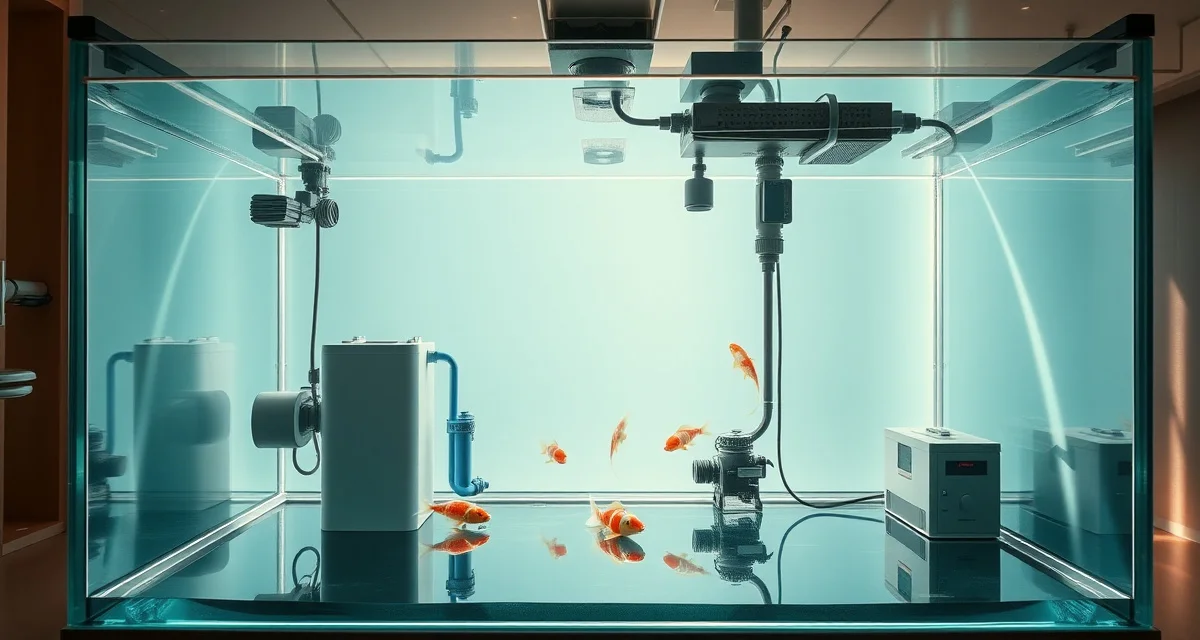
Koi Quarantine Tank Setup: Equipment and Configuration Guide
A bare-bottom tank reduces parasite refugia by eliminating substrate. That's not just a design preference - it's the single most important structural decision in quarantine tank setup, and most hobbyists get it wrong by trying to make quarantine look like a display pond.
Quarantine tanks are functional tools, not aesthetic spaces. Here's how to build one that actually works.
TL;DR
- I prefer 150-200 gallons - tosai are small but they produce waste proportionally, and larger water volume gives you more buffer against ammonia spikes during the stress of quarantine.
- If you'd normally keep 10 tosai per 500 gallons, keep 10 tosai per 1000 gallons in quarantine.
- A 300-gallon IBC tote or fiberglass vat is a practical choice for most operations.
- For large nisai or sanke in the 24-inch-plus range, I use 750-1000 gallon systems.
- Typical dealer setup: 4-6 independent quarantine tanks of 500-1000 gallons each, with dedicated filtration for each system.
- Salt treatment at 0.3-0.5% reduces oxygen-carrying capacity slightly.
- I run air stones at both ends of the tank plus one in the middle for anything over 300 gallons.
Why Quarantine Tank Setup Differs from a Display Pond
Your display pond is optimized for beauty, water volume, and stable long-term conditions. Your quarantine tank needs to be optimized for observation, treatment flexibility, and easy sanitation.
Those are different goals. A planted, gravel-substrate, heavily decorated system is nearly impossible to treat effectively - medications bind to substrate and organic material, parasites find refugia in gravel and plant roots, and you can't see a fish clearly against a dark bottom.
Strip it down. Bare bottom. Minimal decoration. Maximum visibility and treatment access.
Tank Size Requirements by Fish Size
Tosai (4-8 inches)
Minimum 100 gallons for up to 10 fish. I prefer 150-200 gallons - tosai are small but they produce waste proportionally, and larger water volume gives you more buffer against ammonia spikes during the stress of quarantine.
Stocking density for quarantine should be roughly half your display density. If you'd normally keep 10 tosai per 500 gallons, keep 10 tosai per 1000 gallons in quarantine.
Nisai (8-14 inches)
Minimum 250-300 gallons for 5-8 fish. At this size, fish bioload becomes significant and koi pond water quality tracker management gets harder with smaller volumes. A 300-gallon IBC tote or fiberglass vat is a practical choice for most operations.
Jumbo and Tategoi (16+ inches)
Five hundred gallons minimum, and that's for a small group. For large nisai or sanke in the 24-inch-plus range, I use 750-1000 gallon systems. These fish are stressed by confinement, and insufficient volume amplifies that stress.
Dealer-Scale Quarantine
If you're running a commercial operation and quarantining 50-100 fish at a time, you need multiple independent systems. Never combine new arrivals from different sources into the same quarantine system - if one group carries disease, you've contaminated everything.
Typical dealer setup: 4-6 independent quarantine tanks of 500-1000 gallons each, with dedicated filtration for each system.
Filtration
The Bare Minimum
A mature sponge filter is the minimum acceptable filtration for a quarantine tank. It's easy to move, easy to sanitize, and the sponge can be seeded from an established system to provide instant biological filtration capacity.
The limitation: sponge filters alone may not handle heavy bioload from large fish.
Recommended: Canister or Bead Filter
For tanks over 300 gallons or housing large fish, a canister filter with biological media gives you more capacity and better mechanical filtration. Keep filter media from your established pond as a seed source.
Important: some medications - particularly salt at high concentrations, and malachite green - can crash a biological filter by killing nitrifying bacteria. Know your filter's tolerance before you dose.
Avoid
- Substrate-based biological filtration (makes parasite management harder)
- Large sumps with complex plumbing (too hard to sanitize between uses)
- Shared filtration between quarantine and display systems (this defeats the purpose entirely)
Aeration
Koi in quarantine are stressed, and stressed fish consume more oxygen. Salt treatment at 0.3-0.5% reduces oxygen-carrying capacity slightly. Some treatments (formalin, potassium permanganate) can also reduce dissolved oxygen.
Err on the side of more aeration, not less. I run air stones at both ends of the tank plus one in the middle for anything over 300 gallons. You want visible surface agitation across the whole tank.
Have a backup air pump on hand. A power failure during quarantine treatment is a genuine emergency.
Heating
This is non-negotiable for serious quarantine. You cannot get meaningful disease observation at fluctuating ambient temperatures.
Target 65-68°F for standard quarantine. This temperature:
- Keeps KHV in its expression window so you'll see clinical signs if the virus is present
- Slows parasite reproduction relative to peak summer temps
- Supports fish immune function without suppressing it (as cold temperatures do)
- Keeps fish active enough to eat and be observed clearly
Use a reliable aquarium or aquaculture heater with a thermostat. Calibrate against a reference thermometer - heater thermostats drift. If your quarantine tank is indoors, you have much better temperature control year-round.
For an outdoor quarantine setup in a climate with cold winters, you'll need a significant heater or need to move the tank indoors during cold months. Running an outdoor quarantine tank at 45°F in January is not quarantine - it's cold storage.
Monitoring Equipment
You need to be testing water quality at minimum once daily during an active quarantine.
Essential:
- Ammonia test kit (liquid reagent, not strips - strips aren't accurate enough)
- Nitrite test kit
- pH test kit
- KH test kit
- Calibrated thermometer
Strongly recommended:
- Nitrate test kit (elevated nitrate compromises immune function)
- Dissolved oxygen meter or test kit (especially if running treatments that affect oxygen)
- Refractometer if you're using salt (for precise salinity measurement)
Log everything. Not just "checked water - looks ok." Write the actual numbers. You won't remember what ammonia was on day 6 when you're trying to figure out why a fish crashed on day 14.
Lighting
Adequate but not intense. You need to see the fish clearly - their skin, their fins, their posture - which means reasonable light for at least 8-10 hours per day.
Avoid intense lighting that creates glare on the tank surface and makes observation harder. Keep lights on a timer for consistency.
Sanitation Between Uses
Between quarantine batches, every surface the fish touched needs to be sanitized.
- Empty and drain completely
- Scrub all surfaces, equipment, and plumbing with a stiff brush
- Soak in 1:10 bleach solution for 20-30 minutes
- Rinse thoroughly - multiple times
- Fill with fresh water and dose with sodium thiosulfate to neutralize any residual chlorine
- Let filtration re-establish before adding fish (or re-seed from your established system)
Every net, every bucket, every piece of equipment that went in the quarantine tank should be treated the same way before it touches anything else.
KoiQuanta Integration
KoiQuanta links each quarantine tank as a separate profile with its own parameter history, treatment log, and fish inventory. You can track multiple tanks simultaneously without cross-contaminating records. When a quarantine session ends and all discharge criteria are met, the system generates a summary report that can be included in buyer documentation.
Related Articles
- Kohaku Quarantine Guide: Protecting Japan's Most Popular Koi Variety
- Microscope Setup for Koi Disease Diagnosis
FAQ
What size tank do I need to quarantine koi?
A rough starting point: 150 gallons minimum for small tosai, 300 gallons for nisai, 500-750 gallons for large fish. But volume alone isn't the only factor - stocking density matters. You should be running at half the density you'd use in a display pond. When in doubt, go bigger. More water volume means more buffer against ammonia spikes and easier treatment dilutions.
Do I need a heater in my quarantine tank?
Yes, if you're doing this properly. Without temperature control, you cannot maintain a consistent KHV observation window, and parasite lifecycles will vary wildly based on ambient temperature. Heating the tank to 65-68°F gives you a controlled, reproducible environment. This is especially important for fall and winter quarantine - an unheated tank at 50°F is not a functional quarantine system.
How do I cycle a quarantine tank quickly?
Seed the filter media from an established, healthy system. A handful of biological media from a mature filter has enough nitrifying bacteria to handle the bioload of a small quarantine tank from day one. Alternatively, use a commercial bacterial product (Seachem Stability, Fritz Turbo Start, or equivalent) and feed the filter with ammonia for a few days before fish arrive. Test daily until you see ammonia and nitrite reading zero before you introduce fish.
What is Koi Quarantine Tank Setup: Equipment and Configuration Guide?
A Koi Quarantine Tank Setup guide covers the equipment, configuration, and best practices for isolating new or sick koi before introducing them to a display pond. It includes tank sizing recommendations (150–1000 gallons depending on fish size), filtration choices, aeration strategies, and structural decisions like bare-bottom design to eliminate parasite refugia. The guide helps hobbyists and dealers build functional quarantine systems that protect their collections from disease introduction.
How much does Koi Quarantine Tank Setup: Equipment and Configuration Guide cost?
This guide is free educational content published on KoiQuanta. The equipment itself varies in cost: a 300-gallon IBC tote is an affordable starting point, while full dealer setups with 4–6 independent 500–1000 gallon systems represent a larger investment. Filtration, air stones, and salt treatments add to the budget. Overall setup costs range from a few hundred dollars for a basic hobbyist tank to several thousand for a professional multi-tank quarantine system.
How does Koi Quarantine Tank Setup: Equipment and Configuration Guide work?
A properly configured quarantine tank uses a bare-bottom design to eliminate hiding spots for parasites, dedicated filtration per tank to prevent cross-contamination, and heavy aeration—air stones at both ends plus the middle for tanks over 300 gallons. Fish are held at reduced stocking density (roughly half normal capacity), and salt treatments at 0.3–0.5% help manage pathogens while the keeper monitors for disease before any fish enter the main pond.
What are the benefits of Koi Quarantine Tank Setup: Equipment and Configuration Guide?
A well-designed quarantine setup protects your entire collection by catching diseases before they spread. The bare-bottom approach eliminates parasite refugia, making treatments more effective. Larger water volume buffers against ammonia spikes during the stress of transit. Dedicated filtration per tank prevents cross-contamination between batches. For dealers and serious hobbyists, proper quarantine dramatically reduces livestock losses and gives new fish—especially high-value tosai or nisai—the best chance of a healthy transition.
Who needs Koi Quarantine Tank Setup: Equipment and Configuration Guide?
Anyone keeping koi benefits from a quarantine tank, but it is especially critical for hobbyists who regularly purchase new fish, breeders introducing stock from multiple sources, and dealers managing large inventories. If you keep high-value koi like tosai or nisai over 24 inches, or run systems with 4–6 independent tanks, a proper quarantine setup is essential. Even casual pond owners should quarantine any new fish for 2–4 weeks before adding them to an established pond.
Sources
- Associated Koi Clubs of America (AKCA)
- Koi Organisation International (KOI)
- University of Florida IFAS Extension Aquaculture Program
- Fish Vet Group
- Water Quality Association