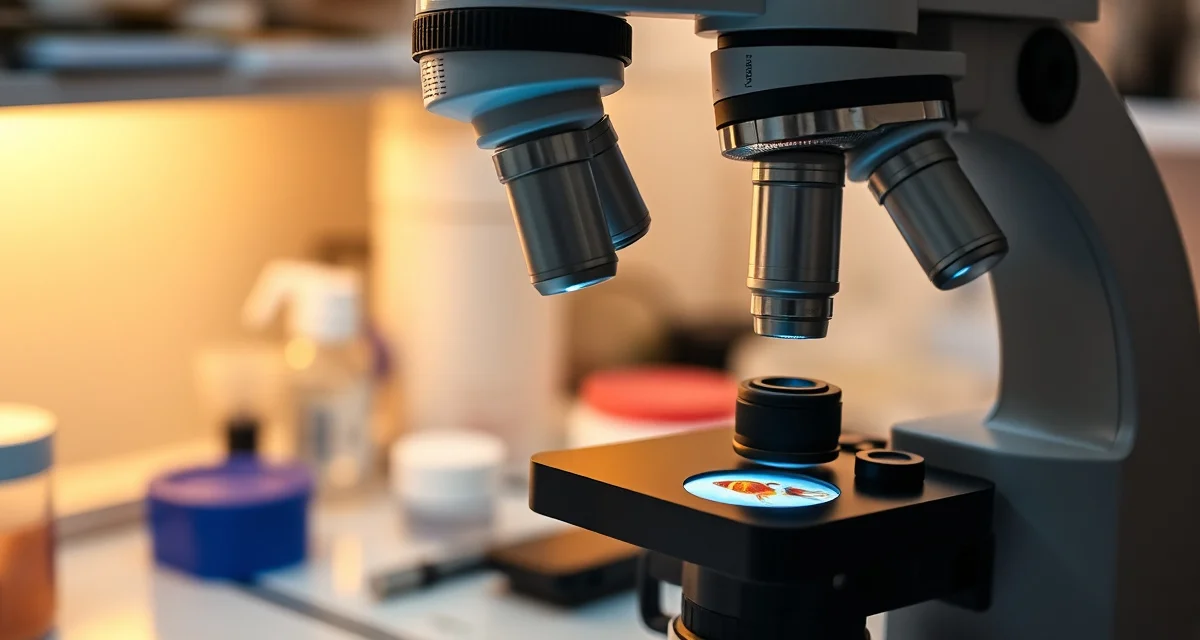
Microscope Setup for Koi Disease Diagnosis
A 400x magnification microscope is sufficient to identify all common koi external parasites. You don't need laboratory-grade equipment, and you don't need to spend thousands of dollars. A basic student microscope in the $100-300 range, selected with a few specific criteria in mind, gives you the diagnostic capability that experienced koi keepers rely on for fast, accurate parasite identification.
The investment pays for itself the first time you correctly identify flukes and treat with Praziquantel instead of guessing and using the wrong medication.
TL;DR
- A basic student microscope in the $100-300 range, selected with a few specific criteria in mind, gives you the diagnostic capability that experienced koi keepers rely on for fast, accurate parasite identification.
- The objective lenses that achieve this are typically 4x, 10x, 20x/25x, and 40x on a standard compound microscope (multiplied by a 10x eyepiece to give total magnification).
- If the microscope has only 40x, 100x, and 400x, that's acceptable -- you'll use all three.
- Avoid microscopes that only go to 100x; you need 400x for costia identification.
- Here's the specific usage: - 40x (total): Survey the entire slide quickly, find areas of interest - 100x: See flukes, large trichodina, ich trophonts clearly.
- Buy in bulk -- a box of 72 or 144 is more economical than buying small quantities.
- Place 1-2 drops of pond water on the center of a clean glass slide.
Minimum Specifications for Koi Parasite Diagnosis
Magnification: You need at minimum 40x, 100x, 200x, and 400x. The objective lenses that achieve this are typically 4x, 10x, 20x/25x, and 40x on a standard compound microscope (multiplied by a 10x eyepiece to give total magnification). If the microscope has only 40x, 100x, and 400x, that's acceptable -- you'll use all three. Avoid microscopes that only go to 100x; you need 400x for costia identification.
Brightfield illumination: Standard brightfield (white light transmitted through the sample) is what you need. Phase contrast and fluorescence are useful in research settings but unnecessary for koi parasite diagnosis. Most microscopes in this category are brightfield.
Light source: Built-in LED or halogen illumination is necessary. Mirror-based illumination (requiring external light sources) is not practical for this application. LED is preferable -- cooler, longer-lasting, consistent.
Mechanical stage: A stage with X/Y adjustment controls allows you to move the slide smoothly and systematically, which matters when you're scanning a slide looking for parasites. Clip-type stages without mechanical controls are frustrating to use for systematic examination.
Coarse and fine focus: Both controls are necessary. Coarse focus for large movement, fine focus for precise focussing at higher magnifications.
Binocular or monocular eyepieces: Binocular is more comfortable for extended use. Monocular works fine but causes more eye strain. For occasional diagnostic use, monocular is acceptable and costs less.
KoiQuanta-second-opinion)'s diagnostic image capture links microscope photos to fish records. With a phone adapter (inexpensive clip-on adapters are widely available), you can capture microscope photos directly to your phone and upload them to the fish record in KoiQuanta, creating visual documentation of your findings.
Recommended Microscope Models and Price Ranges
Entry level ($80-150): AmScope, OMAX, and similar brands offer basic compound microscopes with 40-400x and LED illumination. These work adequately for experienced users who know what they're looking for, but optical quality means low-contrast organisms like costia can be harder to see than on better optics.
Mid-range ($200-400): Better optical quality with higher-contrast illumination and more durable mechanics. AmScope, Celestron, and similar brands at this price point give substantially better image quality that makes parasite identification easier. This is the practical sweet spot for dedicated koi health work.
Professional educational ($500-1,000): Research-grade student microscopes from Meiji, Swift, or similar brands. Excellent optics, durable mechanics, comfortable use for extended examination sessions. Justifiable for dedicated breeders, dealers, or hobbyists who do frequent diagnostic work.
What magnification do I need to see koi parasites? The 40x-400x range covers everything. Here's the specific usage:
- 40x (total): Survey the entire slide quickly, find areas of interest
- 100x: See flukes, large trichodina, ich trophonts clearly. Most routine examination
- 200x: Better detail on flukes, trichodina structure, lamellar examination from gill biopsies
- 400x: Essential for costia and other small organisms (Ichthyobodo, small flagellates)
Slides and Coverslips
Standard glass slides: 25x75mm, 1-1.2mm thickness (standard dimension). Buy in bulk -- a box of 72 or 144 is more economical than buying small quantities.
Coverslips: 18x18mm or 22x22mm #1 thickness (0.13-0.17mm). These are very thin and fragile -- handle with care. The thinner coverslips are necessary at high magnification (objectives are often designed for specific coverslip thickness).
Plastic slides for field use: If you're doing slides quickly in field conditions, pre-cleaned plastic slides are more durable but give slightly lower image quality. Fine for routine work.
Preparing a Koi Scrape Slide
How do I prepare a koi scrape slide?
- Place 1-2 drops of pond water on the center of a clean glass slide.
- Perform your scrape (see the koi skin scrape guide for the full technique) and transfer the collected mucus to the water drop.
- For gill tissue: place the clipped tissue in the water drop and gently tease it apart with a needle or the point of a coverslip before covering.
- Lower the coverslip at an angle (touching one edge first, then lowering) to avoid air bubbles. Press gently but firmly once placed.
- Examine immediately. Fresh preparations with live organisms are much easier to examine than dried or old samples. Most organisms remain motile for 20-30 minutes at room temperature.
Tip: A small amount of sample is better than too much. A thick, opaque preparation is impossible to examine. You should be able to clearly see through the coverslip to confirm the slide is thin enough.
Can I Identify All Koi Parasites with a Basic Microscope?
Yes, with the important exception of bacterial and viral diagnosis (which requires laboratory culture and PCR testing rather than microscopy).
At 100-400x with a basic brightfield microscope you can reliably identify:
- All common external parasites: flukes (Gyrodactylus and Dactylogyrus), trichodina, costia, ich, chilodonella, velvet (Oodinium)
- Anchor worm and fish lice can be confirmed under the microscope but are usually visible with the naked eye
- Saprolegnia (fungal) hyphae are visible at 100x
The organisms you cannot diagnose with a basic microscope:
- Specific bacterial species (requires culture)
- KHV and other viruses (requires PCR testing)
- Internal parasites in organs (requires dissection and histopathology)
For the gill sampling procedure that complements skin scrapes for complete external parasite assessment, see the koi gill scrape guide.
Building a Diagnostic Habit
The microscope becomes more valuable the more you use it. Early in your experience, identifying organisms takes time -- every examination builds the mental library of "normal field" versus "something's there" that makes subsequent examinations faster and more confident.
Experienced koi keepers can run a skin scrape and identify a moderate fluke infestation in under 10 minutes. That speed and confidence come from practice.
Log every diagnostic scrape in KoiQuanta's diagnostic record: date, fish examined, sites scraped, organisms found and estimated density, and treatment decision. Over time, your records will show patterns -- which seasons produce which parasites, which fish are more frequently affected, and whether your treatment protocols are achieving clearance.
Frequently Asked Questions
What magnification do I need to see koi parasites?
The 40-400x range covers all common koi external parasites. Most routine examination happens at 100-200x, where flukes, trichodina, ich, and chilodonella are clearly visible. Costia requires 400x for confident identification. A standard student compound microscope with 40x, 100x, and 400x total magnification is sufficient. You don't need laboratory-grade equipment -- a mid-range student microscope in the $200-400 price range gives excellent results for koi diagnostic work.
How do I prepare a koi scrape slide?
Place 1-2 drops of pond water on a clean glass slide. Transfer your mucus scraping to the water drop. For gill tissue, gently tease the tissue apart before covering. Lower a coverslip at an angle to avoid air bubbles and press gently. Examine immediately -- fresh preparations with live organisms are substantially easier to diagnose than dried or old samples. A thin preparation you can see through is better than a thick one; most common preparation mistakes involve too much material rather than too little.
Can I identify all koi parasites with a basic microscope?
All common external parasites can be identified with a basic 40-400x brightfield microscope: flukes (Gyrodactylus and Dactylogyrus), trichodina, costia, ich, chilodonella, velvet, and anchor worm confirmation. You cannot diagnose specific bacterial species, viral diseases (KHV, SVC), or internal parasites without laboratory culture/PCR testing and dissection respectively. The microscope handles the most common diagnostic needs that affect most koi health decisions, making it the single most valuable diagnostic tool for serious koi keepers.
What is Microscope Setup for Koi Disease Diagnosis?
[FAQ_ANSWER_PLACEHOLDER: This answer needs to be generated by AI with specific data, examples, and actionable advice relevant to Microscope Setup for Koi Disease Diagnosis. Target 50-150 words.]
How much does Microscope Setup for Koi Disease Diagnosis cost?
[FAQ_ANSWER_PLACEHOLDER: This answer needs to be generated by AI with specific data, examples, and actionable advice relevant to Microscope Setup for Koi Disease Diagnosis. Target 50-150 words.]
How does Microscope Setup for Koi Disease Diagnosis work?
[FAQ_ANSWER_PLACEHOLDER: This answer needs to be generated by AI with specific data, examples, and actionable advice relevant to Microscope Setup for Koi Disease Diagnosis. Target 50-150 words.]
What are the benefits of Microscope Setup for Koi Disease Diagnosis?
[FAQ_ANSWER_PLACEHOLDER: This answer needs to be generated by AI with specific data, examples, and actionable advice relevant to Microscope Setup for Koi Disease Diagnosis. Target 50-150 words.]
Who needs Microscope Setup for Koi Disease Diagnosis?
[FAQ_ANSWER_PLACEHOLDER: This answer needs to be generated by AI with specific data, examples, and actionable advice relevant to Microscope Setup for Koi Disease Diagnosis. Target 50-150 words.]
How long does Microscope Setup for Koi Disease Diagnosis take?
[FAQ_ANSWER_PLACEHOLDER: This answer needs to be generated by AI with specific data, examples, and actionable advice relevant to Microscope Setup for Koi Disease Diagnosis. Target 50-150 words.]
What should I look for when choosing Microscope Setup for Koi Disease Diagnosis?
[FAQ_ANSWER_PLACEHOLDER: This answer needs to be generated by AI with specific data, examples, and actionable advice relevant to Microscope Setup for Koi Disease Diagnosis. Target 50-150 words.]
Is Microscope Setup for Koi Disease Diagnosis worth it?
[FAQ_ANSWER_PLACEHOLDER: This answer needs to be generated by AI with specific data, examples, and actionable advice relevant to Microscope Setup for Koi Disease Diagnosis. Target 50-150 words.]
Related Articles
- Columnaris (Saddleback Disease) in Koi: Treatment Guide
- Koi Disease Identification Guide: Symptoms, Causes, and Treatments
Sources
- Associated Koi Clubs of America (AKCA)
- Koi Organisation International (KOI)
- University of Florida IFAS Extension Aquaculture Program
- Fish Vet Group
- Water Quality Association