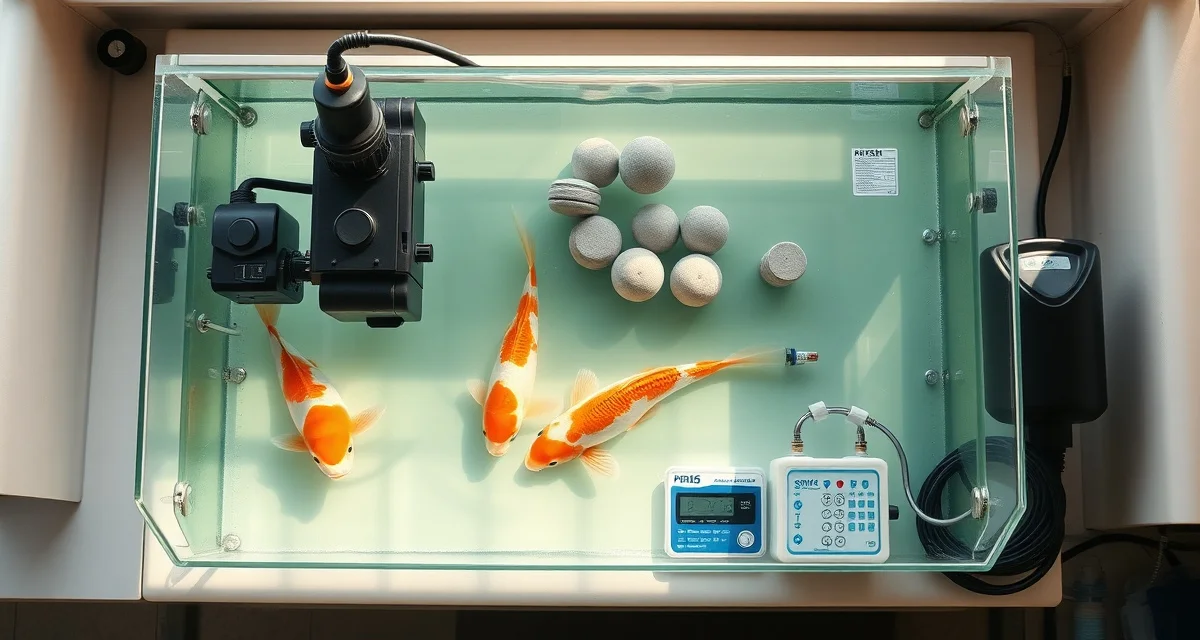
Koi Quarantine Tank Equipment: Complete Shopping List
Having a pre-stocked quarantine setup reduces emergency response time from hours to minutes. When a new fish arrives or an existing fish gets sick, the time you spend scrambling to source equipment is time the fish doesn't have. This list covers everything you need for a functional koi quarantine setup, with options at different price points.
KoiQuanta's setup wizard generates an equipment checklist during tank creation, so you can confirm you have each item before your first fish enters.
TL;DR
- For larger koi (20 inches and up), 200-300 gallons.
- Adequate for 100-150 gallon tanks with light to moderate stocking.
- Running quarantine at a controlled 18-20°C gives you more predictable treatment outcomes than ambient temperature, which varies seasonally.
- Used at multiple levels from supportive (0.1%) to therapeutic (0.3-0.5%).
- Medications add another $50-100 for a basic inventory.
- A more capable setup with a larger tank, canister filtration, and a more complete medication inventory runs $500-800.
- The external controller (Inkbird ITC-306 or similar, approximately $30-35) is more reliable than in-heater thermostats and allows precise temperature setting.
The Tank
Minimum size: 100 gallons for quarantine of fish up to 18 inches. For larger koi (20 inches and up), 200-300 gallons. Undersizing the quarantine tank is one of the most common setup mistakes -- stress in a crowded tank makes disease worse, not better.
Tank types:
Round or oval stock tanks (100-300 gallons, $100-300): The most practical quarantine tank for most hobbyists. Galvanized stock tanks need to be coated inside with aquarium-safe paint or replaced with polyethylene (Rubbermaid stock tanks work well). They're durable, easy to clean, and come in relevant sizes.
Rectangular fiberglass or polyethylene tanks ($200-800): Custom or commercial options, more expensive but very durable and easy to drain fully. Used by most dealers.
Large aquariums (75-125 gallon, $150-500): Work well for smaller quarantine fish. Glass or acrylic, standard aquarium equipment fits them easily. Heavy and less convenient than stock tanks for larger fish.
Budget option: 100-gallon Rubbermaid stock tank, approximately $120-150 new.
Better option: 150-200 gallon oval polyethylene tank, approximately $200-350.
Filtration
Sponge filter ($15-40): The simplest and most beginner-friendly option. Powered by an air pump, a large sponge filter provides both mechanical and biological filtration. Easy to seed with bacteria from an established pond by squeezing media from an established sponge filter into the new one. Adequate for 100-150 gallon tanks with light to moderate stocking.
Canister filter ($80-250): More filtration capacity than a sponge filter, can be seeded with established media. Models from Fluval, Sunsun, or Eheim are commonly used. Better mechanical filtration than a sponge filter.
Hang-on-back filter ($30-100): Convenient and effective for aquarium-style quarantine tanks. Less ideal for stock tanks due to geometry.
Recommendation: For most hobbyist quarantine setups, two large sponge filters powered by one reliable air pump provides adequate biological and mechanical filtration for a 100-150 gallon tank. The redundancy (two filters instead of one) means if one fails, filtration doesn't collapse entirely.
Critical point: Seed filter media from your established pond before you need to use the quarantine tank. A cycled filter makes the whole setup work.
Aeration
Air pump ($20-60): Get a quality air pump rated for your tank volume with reserve capacity. Quiet operation matters if the quarantine tank is near living space. Recommended: Tetra Whisper, Fluval Q series, or Aquatop for quiet operation.
Air stones or diffusers ($5-15): Two or more large air stones or disc diffusers placed at opposite ends of the tank. Fine bubble diffusers maximize surface area for gas exchange.
Airline tubing and check valves ($10-20): Check valves prevent water backflow into the pump if power fails. Don't skip these.
Maximum aeration is not optional. Most koi medications reduce dissolved oxygen. Many disease states do too. Air your quarantine tank more aggressively than your main pond.
Heating
Submersible aquarium heater ($30-100): For a 100-150 gallon tank, a heater rated for that volume -- typically 300-500 watt. Get a heater with an external temperature controller or a controller unit separate from the heater for more reliable temperature management. In-heater thermostats can fail, and the result (overheating) can kill fish faster than most diseases.
External temperature controller ($30-70): Inkbird ITC-306 and similar controllers plug between the heater and outlet, giving you independent temperature control. Highly recommended for quarantine use where precise temperature management affects treatment outcomes.
Budget approach: 300W heater with an Inkbird controller, approximately $60-80 total. Reliable and repairable if a component fails.
Why heating matters in quarantine: Temperature affects parasite lifecycle speed, antibiotic uptake, immune function, and KHV activity windows. Running quarantine at a controlled 18-20°C gives you more predictable treatment outcomes than ambient temperature, which varies seasonally.
Water Testing Equipment
Test kits (liquid, not strips):
- Ammonia test kit (API Master Test Kit or similar)
- Nitrite test kit
- pH test kit
- Temperature thermometer (digital, $10-15)
API Freshwater Master Test Kit ($30-40): Covers ammonia, nitrite, nitrate, and pH. This is the baseline minimum. You'll use it daily during active quarantine.
Additional tests:
- KH/GH test kit ($10-15): needed for copper treatment dosing and understanding pH stability
- Copper test kit ($10-20): essential if you use copper sulfate treatment
Test daily for ammonia and nitrite during active quarantine, especially during medication with antibiotics or other biofilter-disrupting drugs.
Net and Handling Equipment
Net ($15-30): A dedicated quarantine net that never leaves the quarantine area. Do not share nets between quarantine and display tanks -- this is a disease vector. Soft knotless mesh is gentler on fish.
Bucket ($5-10): Again, quarantine-only. Do not share with other tank areas.
Bowl or smaller container: For holding individual fish during examination or treatment.
Towels: For handling fish. Keep quarantine-only towels separate.
Medication Inventory
Having medications on hand before you need them is what turns a slow emergency response into a fast one.
Baseline quarantine medication kit:
Praziquantel ($20-40): For flukes. This should be in every quarantine kit. Most koi carry fluke burden and Praziquantel is the reliable treatment.
Salt ($10-30 for 5kg): Non-iodized pond salt or aquarium salt. Used at multiple levels from supportive (0.1%) to therapeutic (0.3-0.5%).
Seachem Prime ($10-20): Dechlorinator plus ammonia binder. Used for water changes and emergency ammonia management.
Methylene blue ($10-20): Antifungal, useful for new fish that arrive with gill damage or fungal concerns.
Your quarantine medications guide: The koi quarantine medications overview covers which additional medications to have on hand based on your fish sources and quarantine program.
Record-Keeping
Waterproof notebook or dedicated quarantine log: Record the date, parameters, observations, and any treatments for every day of quarantine. Physical records are reliable even when digital systems fail.
Digital records (KoiQuanta): KoiQuanta's quarantine tank setup captures all parameters, links observations to individual fish records, and produces discharge documentation. The koi quarantine tank setup guide covers the setup process.
Frequently Asked Questions
What equipment do I need for a koi quarantine tank?
The core requirements are: a tank of appropriate size (minimum 100 gallons for fish up to 18 inches), biological filtration (sponge filter or canister seeded from established media), adequate aeration (two large air stones from a reliable pump), a heater with temperature control, water test kits for ammonia, nitrite, pH, and temperature, dedicated handling equipment (net and bucket) that stay in the quarantine area, and a baseline medication inventory including Praziquantel, salt, and a dechlorinator. Record-keeping supplies complete the setup.
What is a good budget for setting up koi quarantine?
A functional quarantine setup for fish up to about 20 inches can be assembled for $250-400: a 100-150 gallon stock tank ($120-200), sponge filters and air pump ($50-80), heater with external controller ($60-80), test kits ($40-60), and handling equipment ($20-30). Medications add another $50-100 for a basic inventory. A more capable setup with a larger tank, canister filtration, and a more complete medication inventory runs $500-800. The cost of a single lost koi of any quality exceeds the setup cost many times over, which puts the investment in perspective.
Which quarantine tank heater is best for koi?
Any submersible heater of adequate wattage (roughly 3-5 watts per gallon for a quarantine tank that may need to reach 28-30°C for disease management) paired with an external temperature controller. The external controller (Inkbird ITC-306 or similar, approximately $30-35) is more reliable than in-heater thermostats and allows precise temperature setting. A heater failure in one direction (stuck off) means cold fish; stuck on means cooked fish. An external controller removes the in-heater thermostat from the safety chain. For a 100-150 gallon tank: a 300-500W heater plus an external controller is the reliable combination.
What is Koi Quarantine Tank Equipment: Complete Shopping List?
A koi quarantine tank equipment shopping list is a curated inventory of everything needed to set up a functional isolation tank for new or sick koi. It typically includes a tank (100-300 gallons depending on fish size), filtration, a heater with external controller, aeration, water testing supplies, and a basic medication inventory. Having this equipment pre-stocked means you can respond to fish health emergencies in minutes rather than hours spent sourcing supplies.
How much does Koi Quarantine Tank Equipment: Complete Shopping List cost?
A basic functional quarantine setup costs roughly $200-400, covering a 100-150 gallon tank with light to moderate stocking, a heater, simple filtration, and a starter medication kit. A more capable setup with a larger tank, canister filtration, and a complete medication inventory runs $500-800. Budget an additional $50-100 for medications like salt and treatments. Costs vary by tank size, filtration quality, and whether you buy new or used equipment.
How does Koi Quarantine Tank Equipment: Complete Shopping List work?
A quarantine setup works by isolating new or sick koi in a separate, controlled environment away from your main pond. The tank is kept at a stable 18-20°C using a heater and external temperature controller for predictable treatment outcomes. Filtration maintains water quality during the isolation period, while medications like salt (used at 0.1-0.5%) treat pathogens. The fish remain in quarantine until they are confirmed healthy before introduction or reintroduction.
What are the benefits of Koi Quarantine Tank Equipment: Complete Shopping List?
The primary benefit is dramatically reducing emergency response time when a fish becomes sick or a new arrival needs observation. Pre-stocked quarantine equipment means treatment can begin immediately. Controlled temperatures between 18-20°C produce more reliable medication outcomes than seasonal ambient variation. Isolation also prevents disease transmission to your main pond population, protecting your entire collection from a single compromised fish.
Who needs Koi Quarantine Tank Equipment: Complete Shopping List?
Any koi keeper who introduces new fish or maintains a pond with multiple fish needs a quarantine setup. It is especially important for hobbyists with valuable or large koi (20 inches and up), where a single disease outbreak can cause significant financial and emotional loss. Breeders, pond retailers, and serious hobbyists with established collections benefit most, but even beginners should have a basic quarantine capability before purchasing their first fish.
How long does Koi Quarantine Tank Equipment: Complete Shopping List take?
The quarantine period itself typically lasts 2-6 weeks depending on the fish's health status and what is being treated or observed. Setting up the physical equipment takes a few hours. However, the filter needs to cycle before the tank is biologically ready, which can take 2-4 weeks unless you seed it with established filter media. Having everything pre-assembled means the only variable is the biological cycle, not equipment sourcing.
What should I look for when choosing Koi Quarantine Tank Equipment: Complete Shopping List?
Prioritize tank size first — at least 100 gallons for fish up to 18 inches, 200-300 gallons for larger koi. Choose a heater with an external controller like the Inkbird ITC-306 for reliability over built-in thermostats. Filtration should match your tank volume and expected stocking level. For medications, ensure you have salt at minimum, plus treatments for common issues. Ease of draining and cleaning is often overlooked but critical for practical usability.
Is Koi Quarantine Tank Equipment: Complete Shopping List worth it?
Yes, for any serious koi keeper a quarantine setup is essential rather than optional. The cost of losing a single valuable koi — or watching a disease spread through an entire pond — far exceeds the $200-800 investment in proper quarantine equipment. Beyond financial value, having a pre-stocked setup reduces stress for both you and your fish during health events. KoiQuanta's setup wizard can help you confirm you have every item before your first fish enters quarantine.
Related Articles
Sources
- Associated Koi Clubs of America (AKCA)
- Koi Organisation International (KOI)
- University of Florida IFAS Extension Aquaculture Program
- Fish Vet Group
- Water Quality Association