Koi Pond Vortex Chamber: Function and Sizing Guide
A correctly sized vortex chamber removes 80%+ of solid waste before it reaches biological filtration. This first-stage mechanical filtration function is what makes the rest of your filter system work more efficiently -- biological media that receives pre-filtered water operates more reliably, requires less maintenance, and doesn't get clogged by the large solid waste that biological media isn't designed to handle.
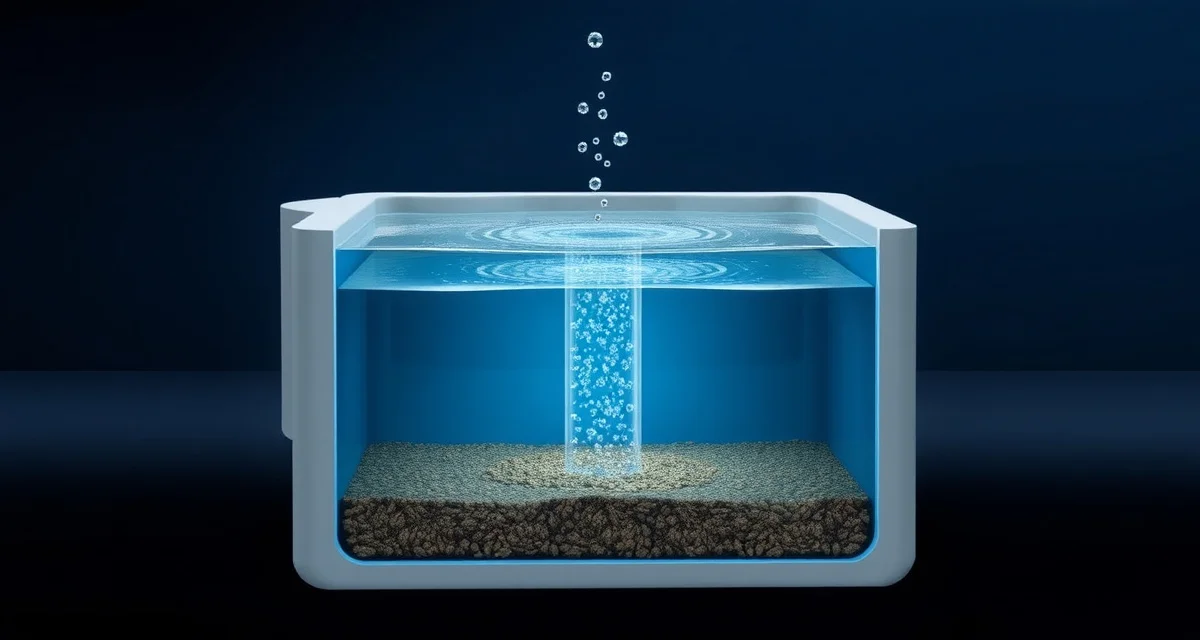
A vortex chamber is essentially a settling chamber that uses centrifugal force to concentrate waste in the center bottom while allowing cleaner water to exit from the top.
TL;DR
- Key sizing parameters: Dwell time: Water should spend at minimum 3-5 minutes in the vortex chamber for adequate settling.
- For 5-minute dwell time: 317 L/min x 5 min = 1,585 liters.
- Your vortex chamber should hold at least 1,500-2,000 liters (about 400-500 gallons) to achieve adequate settling.
- Inlet is typically positioned 70-80% of the way up the chamber wall.
- For a typical koi pond, flushing every 2-7 days is appropriate depending on stocking density and feeding rate.
- As a starting point, check every 3-4 days and flush when waste occupies more than 10% of chamber volume.
- A correctly sized chamber removes 80%+ of solid waste at this first stage, significantly reducing the load on downstream biological filtration.
How a Vortex Chamber Works
The operating principle is straightforward:
Water enters the chamber tangentially (from the side, not the top or bottom) at a downward angle. This creates a circular flow -- a vortex -- inside the chamber. Heavier solid particles (fish waste, uneaten food, organic debris) are pushed by centrifugal force toward the outer wall of the chamber, then settle downward to the bottom center as the rotational energy decreases.
The cleaned water, now largely free of heavy solids, exits from the top of the chamber (usually through a pipe positioned above the settled waste zone) and continues to your biological filtration.
The settled waste accumulates at the bottom of the chamber and is removed through a bottom drain valve -- you open the valve periodically and the concentrated sludge drains out. This is much cleaner than dealing with waste distributed through your entire biological filter.
KoiQuanta's equipment tracking includes vortex chamber specs and cleaning schedule. Logging your chamber's dimensions, inlet and outlet positions, and cleaning frequency alongside koi pond water quality tracker parameter readings helps identify whether your cleaning schedule is optimal or whether you're letting waste sit too long between cleanings.
The Benefits Over Other First-Stage Mechanical Filtration
Vortex chambers are common in traditional UK and European-style koi pond filtration. Compared to alternatives:
vs. Settlement tanks (gravity settling): A vortex chamber is more efficient than simple gravity settlement because the centrifugal effect concentrates solids faster. The same chamber volume processes more water per hour.
vs. Drum filters: Drum filters are more efficient and lower-maintenance than vortex chambers (they're self-backwashing), but they're significantly more expensive. A vortex chamber is a cost-effective first stage for ponds where drum filter investment isn't justified.
vs. Brush filters: Brushes capture solids through contact filtration but become loaded and require manual cleaning. A vortex chamber removes waste to a drain without manual filter cleaning -- just a valve flush.
vs. No pre-filtration: Without a first-stage mechanical filter, solid waste reaches your biological media directly. Biological media becomes clogged with solids, developing anaerobic dead zones, requiring more frequent cleaning, and operating less efficiently.
Sizing a Vortex Chamber
Sizing is the most common mistake with vortex chamber design. An undersized chamber doesn't allow adequate dwell time for particles to settle before exit, which means solids carry over into the biological filter.
Key sizing parameters:
Dwell time: Water should spend at minimum 3-5 minutes in the vortex chamber for adequate settling. Calculate: volume (liters) divided by flow rate (liters per minute) = dwell time in minutes.
For a 5,000-gallon (19,000-liter) pond with a target turnover of once per hour: Flow rate = 19,000 L/hour = 317 L/min. For 5-minute dwell time: 317 L/min x 5 min = 1,585 liters. Your vortex chamber should hold at least 1,500-2,000 liters (about 400-500 gallons) to achieve adequate settling.
Inlet and outlet positioning: The inlet must be positioned tangentially (not axially) to create the vortex. Inlet is typically positioned 70-80% of the way up the chamber wall. Outlet is at or near the top of the water level, positioned away from the inlet to avoid short-circuiting (water taking the direct path from inlet to outlet without completing the vortex).
Chamber shape: Cylindrical chambers work best. Tall, narrow cylinders create stronger vortex effect but may be harder to drain completely. Wider, shorter cylinders are easier to drain but generate less centrifugal force.
Cleaning Schedule and Maintenance
The chamber bottom should be flushed when waste accumulates to about 10-15% of the chamber depth. Allowing waste to build up too deep reduces effective chamber volume and can result in anaerobic decomposition that releases hydrogen sulfide into the water column.
For a typical koi pond, flushing every 2-7 days is appropriate depending on stocking density and feeding rate. Heavy feeding seasons require more frequent flushing. In winter with reduced or no feeding, weekly flushing is typically adequate.
To flush: close the outlet valve, open the bottom drain valve, and allow concentrated waste to exit. The initial outflow will be thick and brown. Continue flushing until the outflow runs clearer. Close the drain valve and reopen the outlet.
How often do I clean a koi pond vortex chamber? As a starting point, check every 3-4 days and flush when waste occupies more than 10% of chamber volume. Develop your own schedule based on your stocking density, feeding rate, and how quickly waste accumulates in your specific system.
Integration with Downstream Filtration
The vortex chamber output connects to your biological filtration -- whether that's a moving bed biofilm reactor (MBBR), a static media filter, a bead filter, or multiple media stages.
The cleaner water leaving the vortex chamber extends the service life of your biological media, reduces the frequency of biological filter cleanings, and allows biological filtration to focus on ammonia and nitrite conversion rather than physical solids handling.
For the complete filtration system picture including how vortex chambers fit into different filter designs, see the koi pond filtration guide and the koi pond setup guide.
Frequently Asked Questions
What does a vortex chamber do in a koi pond?
A vortex chamber uses centrifugal force to separate solid waste from pond water before it reaches biological filtration. Water enters tangentially, creating a rotating vortex. Heavy solids move to the outer wall and settle to the bottom center, while cleaner water exits from the top. Concentrated waste is periodically drained through a bottom valve rather than being distributed through biological filter media. A correctly sized chamber removes 80%+ of solid waste at this first stage, significantly reducing the load on downstream biological filtration.
How do I size a vortex chamber?
Calculate the required volume to achieve 3-5 minutes of dwell time at your target flow rate. Divide pond volume by desired turnover time (usually once per hour) to get flow rate in liters per minute. Multiply by your target dwell time (5 minutes) to get required chamber volume. For a 5,000-gallon pond (19,000 liters) with one-hour turnover, that's 317 L/min x 5 min = 1,585 liters minimum chamber volume. Err on the side of larger -- an oversized vortex chamber performs better than an undersized one, with longer dwell time producing cleaner exit water.
How often do I clean a koi pond vortex chamber?
Flush when waste accumulates to about 10-15% of the chamber depth. For most well-stocked koi ponds, this means flushing every 2-7 days during the active feeding season, and weekly or less in winter. Check your chamber every 3-4 days when starting out and adjust the schedule based on how quickly waste accumulates in your specific system. Flushing more frequently than necessary doesn't harm anything; waiting too long allows anaerobic waste decomposition that can release hydrogen sulfide into the water column.
What is Koi Pond Vortex Chamber: Function and Sizing Guide?
A vortex chamber is a first-stage mechanical filter for koi ponds that uses centrifugal force to spin water in a circular pattern, concentrating solid waste at the center bottom while allowing cleaner water to exit from the top. It acts as a settling chamber that removes 80%+ of solid waste before water reaches biological filtration, protecting your biofilter media and making your entire filter system more efficient and easier to maintain.
How much does Koi Pond Vortex Chamber: Function and Sizing Guide cost?
Vortex chambers vary widely in price depending on size and material. DIY builds using large food-grade barrels or fiberglass tanks can cost $100–$400. Pre-manufactured units range from $300 to over $1,500 for large-capacity chambers. For a typical koi pond requiring 1,500–2,000 liters of chamber volume, budget $400–$800 for a quality setup. The upfront cost is offset by reduced maintenance on downstream biological filters and improved water quality.
How does Koi Pond Vortex Chamber: Function and Sizing Guide work?
Water enters the chamber through an inlet positioned 70–80% up the wall, creating a circular flow. Centrifugal force pushes heavier solid waste toward the center bottom, where it settles and accumulates. Clean water rises and exits through an outlet near the top. The key is dwell time — water must remain in the chamber for at least 3–5 minutes for adequate settling, which is why proper sizing is critical.
What are the benefits of Koi Pond Vortex Chamber: Function and Sizing Guide?
A correctly sized vortex chamber removes over 80% of solid waste at the first filtration stage, dramatically reducing the load on biological media. Benefits include less frequent biofilter maintenance, more stable water chemistry, reduced ammonia spikes, and longer media lifespan. Koi are also healthier in cleaner water with lower suspended solids. The chamber also consolidates waste for easy, infrequent flushing every 2–7 days.
Who needs Koi Pond Vortex Chamber: Function and Sizing Guide?
Any koi keeper running a pond with moderate to heavy stocking density benefits from a vortex chamber. It's especially important for ponds over 5,000 liters, high-feed-rate setups, or systems using biological media like bead filters or moving bed reactors that can clog with heavy solids. If you're experiencing frequent biofilter maintenance, cloudy water, or rising ammonia despite regular cleaning, a vortex chamber is a practical solution.
How long does Koi Pond Vortex Chamber: Function and Sizing Guide take?
Once installed, a vortex chamber operates continuously with minimal intervention. Settling begins immediately as water flows through. The main time commitment is periodic flushing — typically every 2–7 days depending on stocking density and feeding rate. A good starting point is checking every 3–4 days and flushing when waste occupies more than 10% of chamber volume. Each flush takes only a few minutes by opening the bottom drain valve.
What should I look for when choosing Koi Pond Vortex Chamber: Function and Sizing Guide?
The most important factor is volume: your chamber must hold enough water to achieve a 3–5 minute dwell time at your pump flow rate. For a 317 L/min pump flow, that means 1,585 liters minimum. Also consider inlet placement (70–80% up the wall), a smooth interior to encourage circular flow, an accessible bottom drain for flushing, and durable, non-toxic materials. Avoid undersizing — a chamber that's too small won't settle waste effectively.
Is Koi Pond Vortex Chamber: Function and Sizing Guide worth it?
Yes, for any serious koi setup a vortex chamber is one of the highest-value filter investments you can make. By intercepting 80%+ of solids before they reach your biological filter, it extends media life, stabilizes water quality, and reduces maintenance time significantly. The payoff is healthier koi, a more reliable filter system, and less hands-on intervention. Paired with proper biological filtration, it forms the foundation of a low-maintenance, high-performance pond system.
Related Articles
Sources
- Associated Koi Clubs of America (AKCA)
- Koi Organisation International (KOI)
- University of Florida IFAS Extension Aquaculture Program
- Fish Vet Group
- Water Quality Association