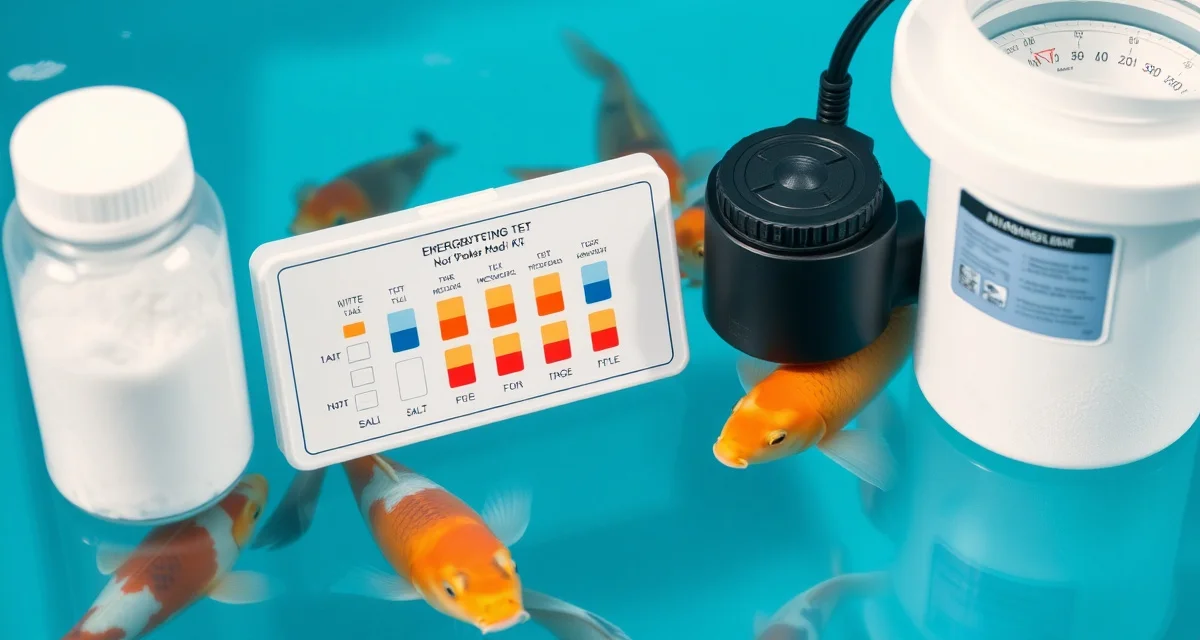
Emergency Response to Nitrite Spike in Koi Pond
Salt added at 0.3% blocks nitrite uptake at the gill - a potentially life-saving emergency measure. This is the first response action for a nitrite spike, because the primary danger of nitrite toxicity is not the nitrite itself but its uptake across the gill membrane, where it converts haemoglobin to methaemoglobin and prevents oxygen transport. Salt's chloride ions competitively inhibit this uptake, buying you time to fix the underlying cause.
KoiQuanta's nitrite alert triggers emergency response guidance with salt dose calculation. No competitor provides nitrite emergency response protocols as part of a health management system.
TL;DR
- Above 1 mg/L, mortality risk is significant.
- Above 5 mg/L, koi can die within 24-48 hours.
- Calculate current salt concentration if any salt is already in the pond 3.
- Calculate additional salt needed to reach 0.3% from current level For a 4,000-litre pond with no current salt: 4,000 × 3g = 12,000g = 12 kg of non-iodized salt.
- The chloride ion concentration at 0.3% salt competitively inhibits nitrite absorption at the gill.
- Don't feed until nitrite returns to zero and has been stable at zero for at least 48 hours.
- Perform a 25% water change with dechlorinated, temperature-matched water, and continue water changes every 4-6 hours until nitrite tests at zero.
How Quickly Can Nitrite Kill Koi?
Nitrite toxicity develops on a time scale of hours to days depending on concentration and water temperature. At higher temperatures and higher concentrations, progression is faster.
Acutely toxic concentrations: Nitrite above 0.5 mg/L (ppm) can cause distress in koi within hours. Above 1 mg/L, mortality risk is significant. Above 5 mg/L, koi can die within 24-48 hours.
Subacute toxic concentrations: Nitrite at 0.1-0.5 mg/L causes chronic stress, immune suppression, and increased susceptibility to secondary infection even without acute mortality.
The safe level is zero detectable nitrite. In an established, properly cycled pond, nitrite should test at zero or below the detectable threshold of your test kit. Any detectable reading warrants investigation.
Step 1: Confirm the Reading
Test kit errors are possible. Before responding to a nitrite reading, confirm it:
- Retest with a fresh sample from a different part of the pond
- Check that your test kit hasn't expired
- If possible, test with a second test kit
False positives are more common with older test reagents. A confirmed reading on two tests is a real event.
Step 2: Add Salt Immediately
If the reading is confirmed at any detectable level, add non-iodized salt to reach 0.3% concentration (3g per litre, or approximately 3 kg per 1,000L of pond water).
How to calculate your dose:
- Know your pond volume in litres
- Calculate current salt concentration if any salt is already in the pond
- Calculate additional salt needed to reach 0.3% from current level
For a 4,000-litre pond with no current salt: 4,000 × 3g = 12,000g = 12 kg of non-iodized salt.
Dissolve the salt in buckets of pond water before adding it to the pond. Don't dump dry salt directly onto the pond surface near fish.
The chloride ion concentration at 0.3% salt competitively inhibits nitrite absorption at the gill. This is the critical protective mechanism. Salt doesn't lower nitrite - it prevents the damage nitrite causes while you reduce the nitrite level.
Important: If zeolite is currently in your filter or pond, remove it before adding salt. Salt causes zeolite to release previously absorbed ammonia, potentially causing a simultaneous ammonia spike.
Step 3: Increase Aeration
Nitrite-poisoned fish have compromised oxygen transport capacity (from methaemoglobin formation). They need higher dissolved oxygen to compensate. Add additional aeration - run all available air stones, surface agitation, and waterfall features at maximum output.
Keep fish in the most oxygenated zone of the pond. Fish that hang at the surface may be seeking the highest-oxygen water.
Step 4: Emergency Water Changes
Salt protects against nitrite uptake; water changes actually reduce the nitrite concentration. Start emergency water changes immediately while salt is protecting the fish.
Water change protocol for nitrite spike:
- 25% water change with dechlorinated, temperature-matched water
- Retest nitrite after each change
- Continue water changes every 4-6 hours until nitrite is at zero or undetectable
- Don't exceed 50% water change in a single session to avoid thermal shock and disrupting beneficial bacteria
Each 25% water change reduces nitrite by approximately 25%. If starting at 2 mg/L:
- After one 25% change: approximately 1.5 mg/L
- After two 25% changes: approximately 1.1 mg/L
- After three 25% changes: approximately 0.85 mg/L
Multiple changes over 24 hours are needed to drive nitrite to zero from elevated starting points.
Step 5: Stop Feeding
Feeding adds nitrogen load to a system that's already overloaded. Don't feed until nitrite returns to zero and has been stable at zero for at least 48 hours.
Step 6: Identify and Address the Root Cause
Salt and water changes address the immediate crisis. The nitrite spike has a cause that will produce another spike if not fixed:
New pond not fully cycled: Ammonia and nitrite spikes during the cycling period before the biological filter is established. Complete the cycling process without fish if possible, or manage with reduced fish load and frequent water changes.
Biological filter disruption: Antibiotic treatment killing filter bacteria, large-scale filter cleaning, extended power outage, or chlorinated water entering the filter can crash biological filtration. The filter needs recovery time and may benefit from bacterial supplement products.
Overstocking or overfeeding: More fish or more food than the biological filter capacity can process. Reduce fish load or feeding rate.
New fish adding load: Recently added fish increase the ammonia load before the filter has adjusted. If you've added fish recently, this is the likely trigger.
Log the nitrite event in KoiQuanta with the reading, the emergency response actions, and the outcome. Note the probable cause. This record is valuable if a similar event occurs in the future.
Signs Koi Are Experiencing Nitrite Poisoning
Recognise nitrite toxicity signs to act before testing confirms it:
- Fish hanging at the surface (seeking oxygen in the surface film)
- Rapid or laboured gill movement
- Disorientation or loss of balance
- Darkened or brownish-tinted gill colour
- Lethargic, unresponsive behaviour
- In advanced cases, fish lying on their side or bottom
These signs overlap with oxygen depletion and pH crash. Test for all three if fish are showing these signs without a confirmed cause.
Frequently Asked Questions
What do I do when nitrite spikes in my koi pond?
Immediately add non-iodized salt to reach 0.3% concentration (3g per litre of pond water) to block nitrite uptake at the gills - this is life-saving protection while you reduce the nitrite level. Increase aeration to maximum. Perform a 25% water change with dechlorinated, temperature-matched water, and continue water changes every 4-6 hours until nitrite tests at zero. Stop feeding immediately. Remove any zeolite before adding salt. Confirm the root cause and address it: crashed biological filter, overstocking, overfeeding, or new pond syndrome are the most common causes. Log the event, the response actions, and the outcome in KoiQuanta.
How much salt stops nitrite poisoning in koi?
Salt at 0.3% (3 grams per litre, or 3 kg per 1,000 litres of pond water) provides effective chloride ion competition against nitrite uptake at the gill membrane. Calculate your pond volume, calculate the salt needed to reach 0.3% from your current concentration, dissolve it in buckets of pond water, and add it gradually over 30-60 minutes. The chloride ions don't reduce the nitrite level in the water - they prevent the nitrite from being absorbed across the gill and converted to methaemoglobin. Salt is the protective measure that buys time; water changes are the nitrite reduction measure. Both are needed.
How quickly can nitrite kill koi?
Nitrite can cause mortality within 24-48 hours at concentrations above 2-5 mg/L, depending on water temperature (higher temperature accelerates toxicity), fish size, current health status, and dissolved oxygen level. Sub-lethal chronic exposure (0.1-0.5 mg/L) causes immune suppression and disease susceptibility without acute mortality. Any detectable nitrite reading (above zero) in an established pond is abnormal and warrants investigation. Confirmed readings above 0.5 mg/L require immediate response. At concentrations above 1 mg/L with fish showing signs of distress (surface hanging, laboured breathing), salt addition and water changes should begin within minutes, not hours.
What is Emergency Response to Nitrite Spike in Koi Pond?
Emergency response to a nitrite spike in a koi pond is a rapid intervention protocol to protect your fish when nitrite levels rise dangerously. Nitrite above 1 mg/L poses significant mortality risk, and above 5 mg/L koi can die within 24-48 hours. The response involves adding non-iodized salt to reach a 0.3% concentration, performing serial water changes, and stopping feeding until levels stabilize. Acting fast is critical because nitrite converts haemoglobin to methaemoglobin, blocking oxygen transport in the blood.
How much does Emergency Response to Nitrite Spike in Koi Pond cost?
Emergency response to a nitrite spike costs very little beyond standard pond-keeping supplies. Non-iodized pond salt is inexpensive — a 4,000-litre pond with no existing salt requires approximately 12 kg to reach the protective 0.3% concentration. The main ongoing cost is dechlorinated, temperature-matched water for serial 25% water changes every 4-6 hours. KoiQuanta's platform automates salt dose calculations as part of its health management system, removing the guesswork at no additional cost during an emergency.
How does Emergency Response to Nitrite Spike in Koi Pond work?
The protocol works in two stages: immediate protection and root-cause correction. First, salt is added to reach 0.3% concentration. The chloride ions in dissolved salt competitively inhibit nitrite uptake at the gill membrane, preventing conversion of haemoglobin to methaemoglobin. This buys critical time. Second, serial 25% water changes with dechlorinated, temperature-matched water dilute nitrite levels progressively. Feeding is stopped entirely to reduce waste load. Monitoring continues until nitrite reads zero and remains stable for at least 48 hours.
What are the benefits of Emergency Response to Nitrite Spike in Koi Pond?
Acting immediately on a nitrite spike protects your koi from brown blood disease, oxygen starvation, and mass die-offs. Salt treatment at 0.3% is fast-acting and uses the biology of competitive inhibition to block the most dangerous pathway of nitrite toxicity. Serial water changes address the underlying cause rather than just the symptom. Stopping feeding prevents additional waste from worsening the spike. Together, these steps significantly increase fish survival rates compared to waiting or relying on a single intervention.
Who needs Emergency Response to Nitrite Spike in Koi Pond?
Any koi keeper whose test results show nitrite above 0.5 mg/L should be familiar with this protocol. Nitrite spikes are most common in new ponds where the nitrogen cycle is not yet established, after medicating a pond (which can kill beneficial bacteria), following heavy feeding periods, or after significant filter disruption. Pond owners managing high stocking densities, ponds under heat stress, or systems recovering from ammonia spikes are at elevated risk and should have emergency supplies on hand before a crisis occurs.
How long does Emergency Response to Nitrite Spike in Koi Pond take?
The salt treatment takes effect within hours of application, as chloride ions begin competitively inhibiting nitrite uptake at the gill almost immediately. However, fully resolving the spike through water changes typically takes 24-72 hours depending on the severity and pond volume. Feeding should remain paused until nitrite has been at zero for at least 48 consecutive hours. Complete biological recovery of the pond's nitrogen cycle, if disrupted, can take one to four weeks depending on the cause of the original spike.
What should I look for when choosing Emergency Response to Nitrite Spike in Koi Pond?
When responding to a nitrite spike, prioritise three things: accuracy, speed, and water quality. Calculate your current salt concentration before adding more — overdosing salt causes its own harm. Use only non-iodized salt, as iodine is toxic to koi. Match water change water to pond temperature to avoid thermal shock. Use a reliable nitrite test kit with a low detection threshold. Tools like KoiQuanta that calculate exact salt doses and trigger emergency guidance based on live test data reduce the risk of dosing errors under pressure.
Is Emergency Response to Nitrite Spike in Koi Pond worth it?
Yes — acting on a nitrite spike correctly is one of the highest-value interventions in koi keeping. The cost of salt and water changes is negligible compared to the loss of fish. At levels above 5 mg/L, koi can die within 24-48 hours, making fast and accurate response essential. The protocol is well-supported by the biology of nitrite toxicity and competitive inhibition. Owners who understand and prepare for this scenario in advance consistently achieve better outcomes than those who react without a plan.
Related Articles
- Bloated Koi: Causes and Emergency Response
- Koi Gasping at Surface: Emergency Response Guide
- Koi Oxygen Depletion Emergency: Recognition and Response
Sources
- Associated Koi Clubs of America (AKCA)
- Koi Organisation International (KOI)
- University of Florida IFAS Extension Aquaculture Program
- Fish Vet Group
- Water Quality Association