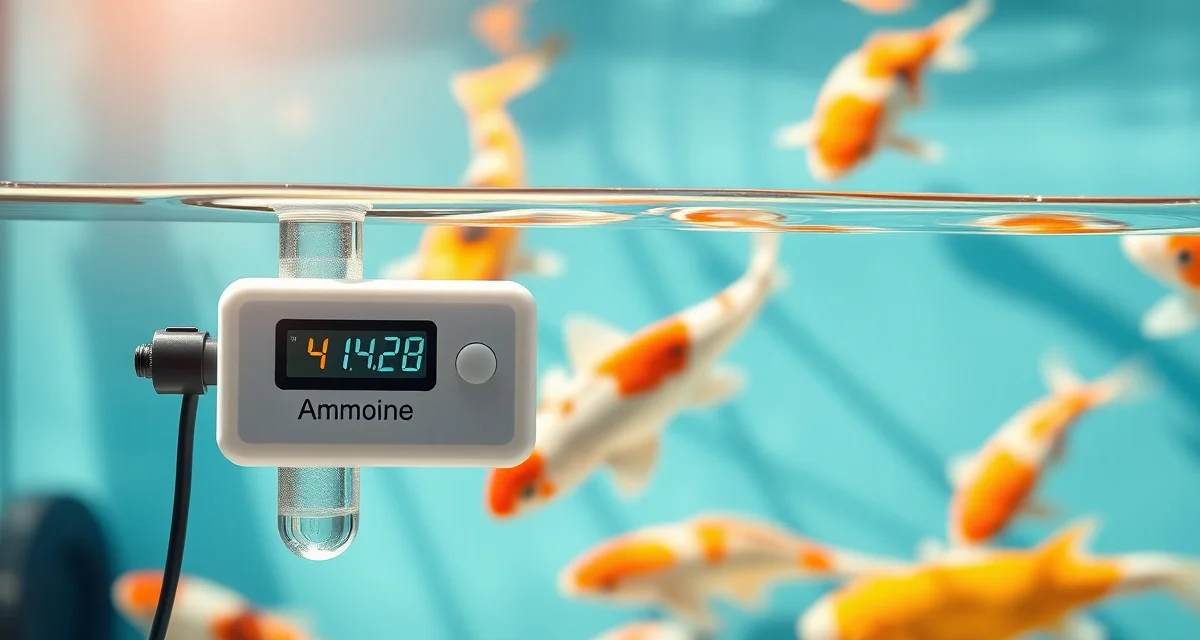
Emergency Response to Ammonia Spike in Koi Pond
A 50% water change reduces ammonia by half - the fastest safe ammonia reduction measure. When ammonia spikes in your koi pond, water changes are the immediate intervention while you identify and address the root cause. This guide covers the step-by-step emergency response and the investigation that prevents the next event.
KoiQuanta's ammonia alert triggers emergency response with water change volume guidance. No competitor provides ammonia emergency response protocols as part of an integrated health management system.
TL;DR
- A reading of 0.5 mg/L total ammonia at pH 7.5 and 20°C is concerning but manageable.
- The same reading at pH 8.2 and 28°C is an emergency.
- Use an NH3 calculator (your test kit instructions or an online calculator) to determine the NH3 fraction if you're concerned about severity.
- A 50% water change with dechlorinated, temperature-matched water reduces total ammonia by approximately 50%.
- Prepare dechlorinated water that matches pond temperature within 2°C 2.
- Begin the water change - drain 50% while simultaneously refilling with treated water 3.
- Retest ammonia after the water change is complete 4.
The Danger of Elevated Ammonia
Ammonia in koi ponds exists in two forms: ionized ammonium (NH4+), which is relatively less toxic, and unionized ammonia (NH3), which is highly toxic. The proportion of each form is determined by pH and temperature.
At higher pH and higher temperature, more ammonia is in the toxic NH3 form:
- At pH 7.0 and 20°C, approximately 0.4% of total ammonia is NH3
- At pH 8.0 and 25°C, approximately 4.8% of total ammonia is NH3 - more than 10 times as toxic at the same total ammonia reading
This means a total ammonia reading of 1 mg/L at pH 8.0 and 25°C is significantly more dangerous than the same reading at pH 7.0 and 15°C. Ammonia toxicity must always be interpreted against pH and temperature.
Toxic ammonia effects on koi:
- Gill damage at the cellular level (first and most sensitive tissue to ammonia)
- Immune suppression creating bacterial infection risk
- Neurological effects at higher concentrations
- Acute mortality at high concentrations or prolonged exposure
Safe level: less than 0.02 mg/L NH3 (unionized ammonia). In practical terms, aim for zero detectable total ammonia in an established pond.
Step 1: Confirm the Reading and Assess pH
Test ammonia with a fresh sample. Confirm the result with a retest.
Immediately also test pH and temperature. This lets you assess the actual toxicity of the reading rather than the total ammonia figure alone. A reading of 0.5 mg/L total ammonia at pH 7.5 and 20°C is concerning but manageable. The same reading at pH 8.2 and 28°C is an emergency.
Use an NH3 calculator (your test kit instructions or an online calculator) to determine the NH3 fraction if you're concerned about severity.
Step 2: Immediate Water Change
Begin a water change immediately. A 50% water change with dechlorinated, temperature-matched water reduces total ammonia by approximately 50%.
Water change protocol:
- Prepare dechlorinated water that matches pond temperature within 2°C
- Begin the water change - drain 50% while simultaneously refilling with treated water
- Retest ammonia after the water change is complete
- If ammonia is still detectable, plan a second water change in 4-6 hours
- Continue until ammonia tests at zero or below the detection threshold
Water change frequency for acute events:
- Moderate spike (0.5-2 mg/L): 25-50% water changes every 4-6 hours until zero
- Severe spike (above 2 mg/L): 50% water changes as frequently as practical (every 2-4 hours if possible) while monitoring fish closely
Temperature matching is critical. Introducing cold water to a warm pond causes thermal shock. In summer, use water that's close to ambient pond temperature. If necessary, partially fill a container and let it warm to outdoor temperature before adding.
Step 3: Stop Feeding
Every food particle adds nitrogen load to an already overloaded system. Stop feeding completely until ammonia has been stable at zero for at least 48-72 hours.
After resuming feeding, restart at half your normal quantity and gradually increase over 5-7 days while monitoring ammonia. A gradual return prevents re-spiking the ammonia as the biological filter catches up.
Step 4: Increase Aeration
Both ammonia itself and the stress it causes increase fish oxygen demand. Maximum aeration helps with:
- Increasing dissolved oxygen for stressed fish
- Enhancing biological filtration activity (nitrifying bacteria need oxygen)
- Surface agitation that helps off-gas some dissolved ammonia
Run all aeration at maximum output during an ammonia event.
Does Reducing Feeding Help With Koi Pond Ammonia?
Yes, significantly. Fish food is the primary nitrogen source in a koi pond. When you feed, the nitrogen in the protein is metabolised and excreted as ammonia through the gills. Overfeeding is responsible for 30-40% of established pond koi pond water quality tracker problems.
Reducing or stopping feeding is both an emergency response measure and a long-term prevention strategy:
- In the emergency: stopping feeding removes the immediate nitrogen input, allowing the biological filter and water changes to drive ammonia down without the system fighting new inputs simultaneously
- Long-term: matching feeding rate to biological filter capacity prevents chronic ammonia load
The standard guideline - feed what fish consume in 5 minutes, remove uneaten food - is specifically designed to prevent the overfeeding that drives ammonia problems.
Step 5: Support Biological Filtration
The biological filter is what processes ammonia long-term. If the spike occurred because the filter is compromised, address the filter:
Don't clean the filter during an ammonia crisis. Cleaning removes beneficial bacteria at the worst possible time. Wait until ammonia is stable and the crisis has passed.
Add beneficial bacteria products if the filter was disrupted (after antibiotic treatment, large cleaning, power outage). Products containing Nitrospira can accelerate filter re-establishment. Add them only to dechlorinated water.
Check for filter blockage. Sometimes a physical blockage in the filter reduces flow through the media, reducing nitrification capacity without fully crashing the filter.
Step 6: Identify the Root Cause
Identify what caused the spike:
New pond/young filter: Ammonia spikes are expected during the cycling period. Use bacterial supplements and water changes to manage.
Recent antibiotic treatment: Antibiotics kill nitrifying bacteria. After any antibiotic course, expect reduced nitrification for 1-3 weeks. Manage with reduced feeding and water changes.
Overfeeding: If food was added faster than fish consumed it and uneaten food is decomposing, overfeeding is the cause. Check for uneaten food in the pond.
Dead fish decomposing: A fish that died unnoticed and is decomposing in the pond produces significant ammonia load. Check for dead fish.
Filtration failure: Pump failure, filter blockage, or power outage disrupts the biological filter. Check equipment.
Temperature change: Warm water reduces dissolved oxygen while simultaneously increasing fish metabolism and ammonia production. Summer temperature increases can outpace filtration capacity.
Log the event in KoiQuanta with the ammonia readings, response actions, and identified root cause. The record supports future prevention and is valuable documentation if the cause is related to disease or equipment failure.
Frequently Asked Questions
What do I do when ammonia spikes in my koi pond?
Perform a 50% water change with dechlorinated, temperature-matched water immediately - this halves the ammonia concentration fastest. Stop feeding completely. Increase aeration to maximum. Test pH and temperature to assess the actual toxicity of the ammonia level. Retest ammonia after the water change and continue 25-50% water changes every 4-6 hours until readings reach zero. Don't clean your biological filter during the event. After the crisis stabilises, identify the root cause: overfeeding, biological filter disruption, dead decomposing fish, or a new pond that hasn't completed cycling.
How many water changes do I need for an ammonia emergency?
The number depends on the starting concentration and how quickly it drops. Each 50% water change reduces ammonia by approximately 50%, so a reading of 4 mg/L becomes 2 mg/L after one change, 1 mg/L after two changes, and 0.5 mg/L after three changes. From a starting point of 4 mg/L, expect 4-6 water changes over 24-48 hours to reach zero in a pond with functional biological filtration. If the biological filter is compromised and not processing the remaining ammonia between changes, progress will be slower. Retest 2 hours after each water change to track progress and schedule the next change.
Does reducing feeding help with koi pond ammonia?
Yes, substantially. Fish food protein is metabolised to ammonia, which is the primary nitrogen source in a koi pond. Stopping feeding removes the main ammonia input, allowing water changes and biological filtration to reduce ammonia without fighting continuous new inputs. In an emergency, stop feeding immediately and maintain zero feeding until ammonia has been stable at zero for 48-72 hours. When resuming feeding, start at half normal quantity and increase gradually over a week while monitoring ammonia daily. Long-term, matching feeding rate to filter capacity prevents chronic ammonia load - feed only what fish consume in 5 minutes and remove any uneaten food.
What is Emergency Response to Ammonia Spike in Koi Pond?
Emergency response to an ammonia spike in a koi pond is a rapid intervention protocol to reduce toxic ammonia levels before fish suffer gill damage or die. The core action is an immediate 50% water change using dechlorinated, temperature-matched water, which cuts total ammonia roughly in half. This buys time to investigate the root cause—overfeeding, filter crash, or dead fish—and restore safe water chemistry before permanent harm occurs.
How much does Emergency Response to Ammonia Spike in Koi Pond cost?
Emergency response to an ammonia spike costs very little beyond your normal pond maintenance budget. The main expense is dechlorinator or water conditioner for the replacement water, which typically runs a few dollars per treatment. Testing kits capable of measuring ammonia accurately cost $15–$40. Tools like KoiQuanta provide ammonia monitoring and response guidance as part of an integrated health management system, eliminating guesswork at no extra per-event cost.
How does Emergency Response to Ammonia Spike in Koi Pond work?
When ammonia is detected above safe thresholds, the protocol begins with testing to confirm severity, then calculating the toxic NH3 fraction based on pH and temperature. A 50% water change is performed by draining and simultaneously refilling with treated water matched within 2°C of pond temperature. After refilling, ammonia is retested. If levels remain elevated, additional partial water changes follow while the root cause—filter failure, dead fish, overfeeding—is identified and corrected.
What are the benefits of Emergency Response to Ammonia Spike in Koi Pond?
Acting fast protects koi from ammonia's primary damage: gill tissue destruction that impairs oxygen uptake and leaves fish vulnerable to secondary infections. Benefits include preventing fish loss, avoiding costly veterinary treatments, and restoring biological filter stability faster. Early intervention also reduces chronic low-level exposure, which suppresses immune function over time. A structured protocol removes panic from the situation, ensuring each step is taken in the right order without making conditions worse.
Who needs Emergency Response to Ammonia Spike in Koi Pond?
Any koi keeper with fish in a pond or water garden needs to understand ammonia emergency response. New pond owners are highest risk due to immature biological filters during the nitrogen cycle. Hobbyists who add new fish, overfeed, or run undersized filtration are also frequently affected. Anyone keeping koi at higher temperatures or elevated pH faces greater danger from the same ammonia reading, since those conditions increase the toxic NH3 fraction significantly.
How long does Emergency Response to Ammonia Spike in Koi Pond take?
The water change itself takes 30–90 minutes depending on pond volume and pump capacity. Preparing dechlorinated, temperature-matched water before starting adds 15–30 minutes. Retesting after the change and confirming results takes another 10 minutes. Investigating and correcting the root cause—cleaning a filter, removing a dead fish, adjusting feeding—can take hours. Full biological filter recovery after a crash may take days to weeks, requiring continued monitoring throughout.
What should I look for when choosing Emergency Response to Ammonia Spike in Koi Pond?
Prioritize speed and water quality when responding to an ammonia spike. Use a reliable liquid test kit rather than strips for accurate readings. Ensure replacement water is dechlorinated and within 2°C of pond temperature to avoid thermal shock. Avoid adding ammonia-detoxifying products as a substitute for a water change—they mask readings without removing ammonia. Look for guidance that accounts for pH and temperature when assessing severity, since total ammonia alone does not tell the full story.
Is Emergency Response to Ammonia Spike in Koi Pond worth it?
Yes. The cost of inaction during an ammonia spike is fish loss, which is far more expensive emotionally and financially than the effort of a water change. Koi can die within hours of acute NH3 exposure, and survivors often develop secondary infections requiring treatment. A structured emergency response—test, change water, retest, investigate—is straightforward once you have practiced it. Understanding the protocol before a crisis occurs is the single highest-value step a koi keeper can take.
Related Articles
- Koi Pond Chemical Overdose Response: Emergency Treatment for Poisoning
- Koi Pond Emergency Response: What to Do When Something Goes Wrong
- Bloated Koi: Causes and Emergency Response
Sources
- Associated Koi Clubs of America (AKCA)
- Koi Organisation International (KOI)
- University of Florida IFAS Extension Aquaculture Program
- Fish Vet Group
- Water Quality Association