Winter Koi Dormancy: Monitoring, Safety, and What Not to Do
Toxic gas buildup under ice from decomposing organic matter kills more koi in winter than cold temperatures do. Most hobbyists worry about their fish freezing, but the real danger is gas exchange. When a pond freezes completely, methane and hydrogen sulfide produced by anaerobic decomposition of organic material on the pond floor accumulate under the ice with nowhere to go. These gases become lethal at relatively low concentrations, and koi in deep dormancy are helpless to respond.
KoiQuanta's winter mode reduces feeding log prompts while maintaining critical water quality and gas exchange monitoring throughout dormancy. This guide covers everything you need to know to keep your fish safe through winter.
TL;DR
- Toxic gas buildup under ice from decomposing organic matter kills more koi in winter than cold temperatures.
- Hydrogen sulfide above 0.002 ppm is toxic to koi; a fully iced-over pond with organic debris can reach this level within days.
- A koi pond must maintain at least one open water surface area throughout winter for gas exchange.
- Never break ice by force; shockwaves travel through the water and can injure dormant fish.
- Stop feeding completely below 10 degrees Celsius and absolutely below 4 degrees Celsius when fish are in deep dormancy.
- Air stones for winter koi pond aeration should be positioned in the shallow end, not the deep zone where fish rest.
- KoiQuanta's winter mode suppresses feeding prompts and elevates gas exchange monitoring reminders.
Understanding Koi Winter Dormancy
Koi are cold-blooded, meaning their body temperature matches the water around them. As water temperature drops through fall, their metabolism slows proportionally. By the time water temperature reaches 4 degrees Celsius, koi have entered a state of deep dormancy. Their digestive system is completely inactive, their immune response is minimal, and their physical activity is limited to slow, minimal movement near the pond bottom.
This dormancy state is normal and healthy. Koi have evolved to overwinter this way, and most koi ponds in the continental US, except in the extreme south, will experience full winter dormancy. The fish are not suffering. They're in a regulated low-metabolic state that allows them to survive without food for months.
What koi cannot survive is inadequate gas exchange. The pond surface, or at least part of it, must remain open to allow oxygen to diffuse in and carbon dioxide and other gases to diffuse out.
The Gas Exchange Problem Under Ice
When ice covers an entire pond surface, several processes begin that can become fatal:
Carbon dioxide accumulates. Fish respiration produces CO2. In unfrozen conditions, CO2 diffuses out through the water surface. Under complete ice cover, it builds up. At high concentrations, CO2 acidifies the water and causes respiratory stress.
Decomposition gases accumulate. Any organic material on the pond bottom, including fish waste, dead leaves, uneaten food, and debris, continues to decompose anaerobically through winter. This produces methane and hydrogen sulfide. Hydrogen sulfide at concentrations above 0.002 ppm is toxic to koi. In a fully iced-over pond with heavy organic material on the bottom, this threshold can be reached within days.
Oxygen depletes. Without photosynthesis (no light penetrates snow-covered ice) and without surface diffusion, dissolved oxygen can drop to lethal levels under prolonged complete ice cover.
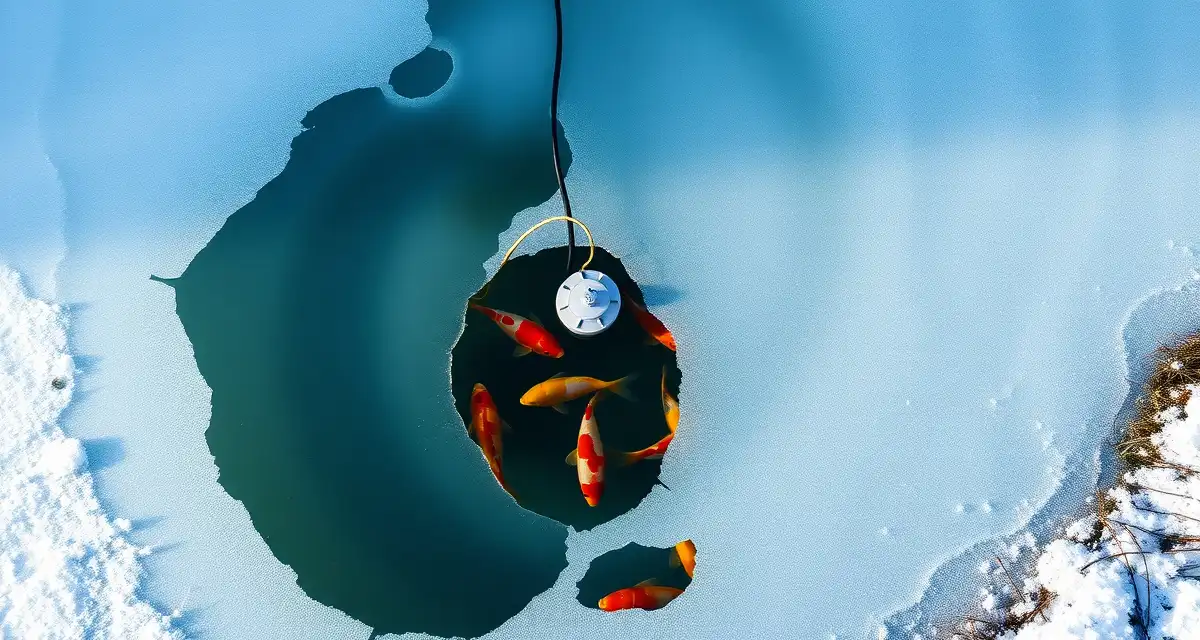
The solution is maintaining an opening in the ice. This is what de-icers and aerators accomplish during winter.
De-Icer vs. Aerator: What's the Difference
De-icers are floating electric heaters that maintain a small opening in the ice directly around themselves. They don't heat the entire pond. They simply prevent ice formation in a localized area, which creates the gas exchange opening the pond needs. They're energy-efficient for this purpose and are the standard tool for winter ice management.
Aerators are another approach. A pond air pump with air stones at the shallow end (not the deep end, where fish are resting) creates water movement that prevents ice from forming. This approach also provides aeration benefit. The key is placement: air stones at the deep end of the pond create cold water upwelling that can disturb fish in dormancy and cause excessive energy expenditure. Air stones positioned in the shallows create surface agitation without disturbing deep water.
KoiQuanta's winter mode includes de-icer and aerator monitoring prompts. You log whether your ice management system is functioning at each check-in, along with the size of the open water area being maintained.
What Not to Do Under Winter Ice
Don't break ice with force. Smashing ice with a hammer creates shockwaves that travel through the water and can cause internal injury to dormant fish. It also distributes ice shards that can physically injure koi as they sink. If you need to create an opening, use hot water poured gently on the ice surface to melt a hole. Let it melt through naturally rather than forcing it.
Don't drain the pond. Some hobbyists consider draining a partially iced pond as a solution to ice management problems. Don't do this in winter. The stress of pond draining and handling fish at low water temperatures is dangerous, and the energy expenditure required to re-establish a pond in winter is far greater than managing the existing one properly.
Don't feed. There should be no feeding below 10 degrees Celsius, and absolutely none when fish are in deep dormancy below 4 degrees Celsius. Offering food to dormant fish is at best useless, as they won't eat, and at worst harmful if any food enters the water and adds to organic load.
Don't turn off all aeration. Some hobbyists shut down pumps and aeration in winter to reduce electricity costs. This is a false economy in cold climates. Maintaining basic aeration costs relatively little but is critical for gas exchange. The cost of losing fish to winter oxygen depletion or toxic gas buildup far exceeds the cost of running an air pump.
Don't clean the filter aggressively in winter. If you're running a filter over winter, don't do any major filter media cleaning or disruption. Beneficial bacteria are barely viable at cold temperatures. Cleaning filter media removes what little biological capacity remains and can trigger an ammonia spike when fish become active again in spring.
KoiQuanta's Winter Monitoring Schedule
KoiQuanta's winter mode provides a scheduled check-in system that prompts you at appropriate intervals. Checking too frequently disturbs fish dormancy by causing noise and vibration near the pond. Checking too infrequently risks missing gas exchange problems before they become lethal.
The recommended winter monitoring schedule:
Weekly visual check: Walk to the pond and confirm the de-icer or aerator is maintaining an open area of water surface. Check that the equipment is running. Note approximate size of the open water area in KoiQuanta.
Weekly temperature log: Log water temperature. You don't need to insert probes repeatedly. An inexpensive digital aquarium thermometer left in the pond gives a reading without disturbance.
Every two weeks: gas exchange assessment. If you can safely access the pond, check that there's no unusual odor near the ice opening (hydrogen sulfide has a distinct rotten egg smell and should trigger immediate intervention). Log your assessment in KoiQuanta.
Monthly: In regions with severe winters where ice may be thick, check that the ice hasn't grown over your de-icer or air stone position. Heavy snow on ice can insulate it and allow it to thicken. Confirm your equipment is still maintaining adequate surface opening.
Log every check-in in KoiQuanta's winter mode dashboard. The scheduled reminder system ensures you don't go more than a week without confirming your gas exchange setup is functioning.
What KoiQuanta Monitors in Winter Mode
KoiQuanta's winter mode differs from the active season interface in several specific ways:
Feeding prompts are suppressed. You don't get feeding reminders below 10 degrees Celsius. The system knows your fish are in dormancy and aren't being fed.
Gas exchange monitoring is elevated. The winter check-in prompts focus on ice management and gas exchange rather than feeding and treatment.
Alert thresholds adjust. Temperature alerts calibrate for dormancy conditions. A temperature of 2 degrees Celsius in December is not an alert condition. The same temperature reading in April would be.
Treatment prompts are reduced. Active disease treatment is generally contraindicated during deep dormancy. The system reduces treatment-related prompts while maintaining observation prompts so you'll catch any unusual fish condition.
Connecting to the Fall Koi Prep Guide
Everything you did in fall, completing disease treatments, reducing feeding gradually, cleaning organic debris from the pond, and installing winter equipment, determines how safely your fish enter and maintain dormancy. Fish that entered winter healthy, with clean water and working gas exchange equipment, require monitoring but not intervention through most of the dormant season.
Fish that entered winter with unresolved health issues, or ponds that haven't had organic material removed, are at higher risk of spring losses.
Signs of Winter Emergency
Despite all precautions, sometimes problems develop over winter that require action. Signs to watch for during your weekly checks:
Complete ice-over with no open water area. This is an immediate emergency. Your de-icer or aerator has failed. Use hot water to open a hole as quickly as possible. Do not break ice.
Rotten egg smell near the ice opening. Hydrogen sulfide gas is escaping through your opening. This means it's also concentrating in the water. This is a serious emergency. The source is usually organic material decomposing on the pond bottom. You may need to open additional surface area to improve gas exchange and allow gases to dissipate.
Unusual fish activity. If any fish are visible and moving actively during mid-winter when they should be dormant at the pond bottom, it may indicate a water quality problem forcing them toward the surface. Check temperature (is it warmer than expected?), check for open water, and check DO if you have a meter.
For guidance on what comes after winter, the spring koi pond startup guide covers the transition back to active season management.
Frequently Asked Questions
How do I keep my koi safe under winter ice?
Maintain at least one open area of water surface throughout winter using a de-icer or surface aeration. This allows gas exchange that prevents toxic gas buildup and oxygen depletion under the ice. Use hot water (never force) to open the ice if your equipment fails. Log weekly check-ins in KoiQuanta to confirm your ice management system is working.
Should I run my pond pump in winter?
It depends on your climate and setup. In regions with mild winters where the pond doesn't fully freeze, running a pump at reduced flow is fine. In regions with hard freezes, running a pump can draw cold surface water into deep zones where fish are resting and disturb dormancy. A separate air pump and de-icer is often a better winter approach than a full circulation pump. KoiQuanta's winter mode supports both configurations.
What is the coldest water temperature koi can survive?
Koi can survive water temperatures approaching 0 degrees Celsius, provided they have access to the slightly warmer water at the pond bottom (water is densest at 4 degrees Celsius and stratifies in winter). The real threat in cold winters isn't temperature itself but inadequate gas exchange under complete ice cover. Ponds with proper depth (minimum 3 to 4 feet in cold climates) and working gas exchange can sustain koi at near-freezing temperatures safely.
How large does the open water area need to be during winter?
Any open area is significantly better than none. A single de-icer or air stone in the shallows maintaining a hole 12-18 inches in diameter provides meaningful gas exchange for most garden ponds. Larger ponds with heavy organic debris on the bottom benefit from larger open areas or multiple exchange points. The key measure is that the opening stays open continuously through the coldest nights, which means confirming your equipment is functional at each weekly check-in.
Should I run my koi pond filter over winter?
In mild climates where the pond does not freeze, running a pump at reduced flow maintains beneficial bacteria and avoids the need to re-cycle the filter in spring. In climates with hard freezes, running a pump can pull cold surface water into the deep zone where fish are resting and disturb dormancy. A separate air pump and de-icer is a better winter configuration for cold climates. Check filter media gently in winter and avoid aggressive cleaning that would destroy the limited bacterial population viable at cold temperatures.
When should I start feeding my koi again after winter?
Begin feeding again when water temperature consistently reaches and holds above 10 degrees Celsius for several days. Start with wheat germ-based food at this transitional temperature as it is easier to digest than high-protein growth food. Increase feeding frequency and switch to growth diet as water temperature climbs above 15-18 degrees Celsius. The spring startup guide in KoiQuanta provides temperature-triggered reminders for transitioning back to the active season schedule.
What is Winter Koi Dormancy: Monitoring, Safety, and What Not to Do?
[FAQ_ANSWER_PLACEHOLDER: This answer needs to be generated by AI with specific data, examples, and actionable advice relevant to Winter Koi Dormancy: Monitoring, Safety, and What Not to Do. Target 50-150 words.]
How much does Winter Koi Dormancy: Monitoring, Safety, and What Not to Do cost?
[FAQ_ANSWER_PLACEHOLDER: This answer needs to be generated by AI with specific data, examples, and actionable advice relevant to Winter Koi Dormancy: Monitoring, Safety, and What Not to Do. Target 50-150 words.]
How does Winter Koi Dormancy: Monitoring, Safety, and What Not to Do work?
[FAQ_ANSWER_PLACEHOLDER: This answer needs to be generated by AI with specific data, examples, and actionable advice relevant to Winter Koi Dormancy: Monitoring, Safety, and What Not to Do. Target 50-150 words.]
What are the benefits of Winter Koi Dormancy: Monitoring, Safety, and What Not to Do?
[FAQ_ANSWER_PLACEHOLDER: This answer needs to be generated by AI with specific data, examples, and actionable advice relevant to Winter Koi Dormancy: Monitoring, Safety, and What Not to Do. Target 50-150 words.]
Who needs Winter Koi Dormancy: Monitoring, Safety, and What Not to Do?
[FAQ_ANSWER_PLACEHOLDER: This answer needs to be generated by AI with specific data, examples, and actionable advice relevant to Winter Koi Dormancy: Monitoring, Safety, and What Not to Do. Target 50-150 words.]
Related Articles
Sources
- Associated Koi Clubs of America (AKCA)
- University of Florida IFAS Extension Aquaculture Program
- Fish Vet Group
- Koi Organisation International (KOI)
Get Started with KoiQuanta
Winter management is mostly about consistent, low-frequency monitoring of the things that matter: gas exchange, equipment function, and temperature. KoiQuanta's winter mode gives you a check-in schedule calibrated to what koi actually need during dormancy, without the unnecessary prompts of an active-season interface. Set up winter mode before temperatures drop and stay confident through the coldest months.