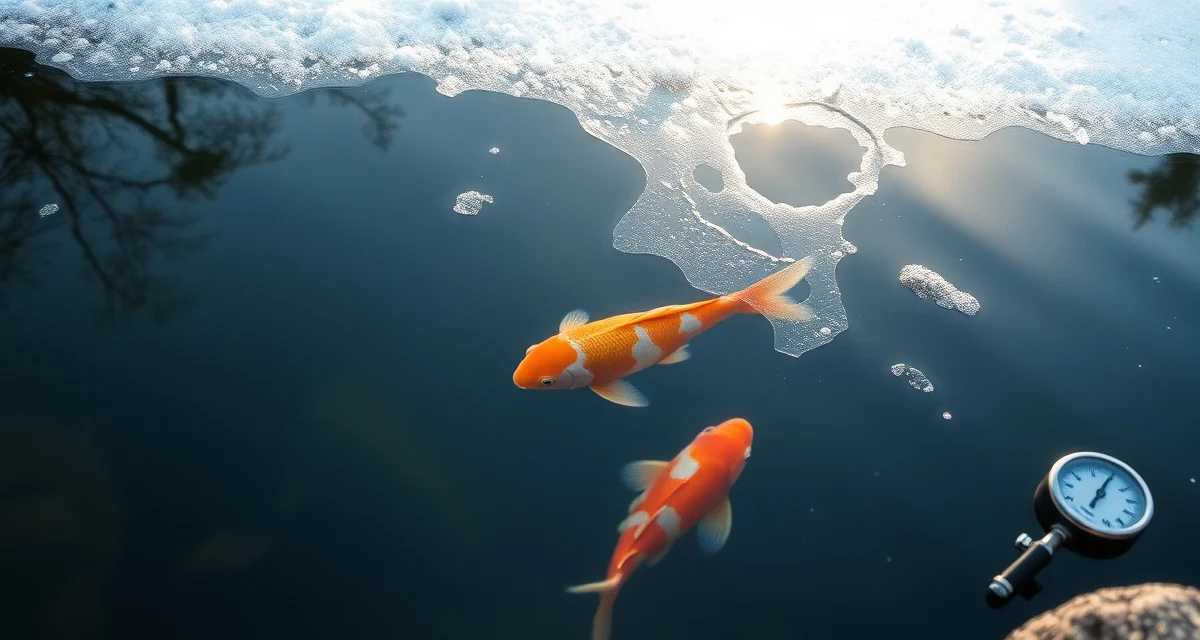
Winter Koi Hibernation Monitoring: What to Check and When to Act
Checking on koi too frequently in winter disrupts their dormancy metabolism and can increase the risk of starvation during cold months. This surprises many hobbyists who assume that more attention is always better. But dormant koi are drawing on stored energy reserves at a precisely calibrated rate. Repeated disturbances, particularly water movement and vibration near the pond, cause koi to swim and respond, burning energy they need to sustain themselves until spring.
KoiQuanta's scheduled winter check-in system prompts hobbyists at optimal intervals to monitor ice cover and gas exchange without disturbing fish. This guide explains what to look for, when to look for it, and when findings require action.
TL;DR
- Check these and nothing else at each winter visit: **1.
- A good de-icer in normal winter conditions typically maintains an opening of 1 to 2 square feet.
- Feeding below 10 degrees Celsius is harmful.
- When you log temperatures consistently above 10 degrees Celsius, the system activates spring disease risk monitoring and feeding reminders.
- Stop feeding entirely when water temperature drops below 10 degrees Celsius, and don't resume until temperature is consistently above 10 degrees Celsius in spring.
What Koi Are Doing in Winter
True winter dormancy in koi occurs when water temperature drops below 4 degrees Celsius. At this point, fish have essentially stopped all active processes:
- Digestive system: completely inactive
- Immune system: minimal function
- Metabolism: extremely slow, drawing on liver glycogen stores
- Movement: minimal, fish rest on or near the pond bottom
- Response to stimuli: very slow and sluggish
Fish in this state are conserving energy at a remarkable level. A healthy koi entering winter dormancy with adequate liver glycogen can sustain itself for the entire winter without feeding. The caloric demands of dormancy are small but real, and unnecessary energy expenditure, from disturbance, handling, or stress, adds to the depletion rate.
KoiQuanta's winter mode suppresses feeding prompts and reduces observation frequency prompts to match the lower activity level and care requirements of dormancy. You're not being inattentive. You're respecting the fish's physiology.
The Critical Monitoring Priorities
Three things matter most during winter hibernation monitoring. Check these and nothing else at each winter visit:
1. Gas exchange opening
Is there an open area of water surface? This is the most critical check. Without an opening in the ice, toxic gases accumulate and oxygen depletes. At every weekly winter visit, confirm that your de-icer or surface aerator is maintaining an opening. Log the estimated size of the opening in KoiQuanta.
A good de-icer in normal winter conditions typically maintains an opening of 1 to 2 square feet. If the opening looks smaller than usual, check whether the de-icer is fully functional or whether ice has partially grown over it. If the opening has closed completely, treat this as an emergency (see emergency section below).
2. Equipment operation
Is your de-icer running? Is your air pump running? These are your life support systems. Confirm operation visually at every visit. A de-icer with a small indicator light, or an aerator with visible bubbles at the ice opening, makes this check fast and non-invasive.
Log equipment status in KoiQuanta at every check-in. This creates a record that's useful if you ever need to review events leading up to a problem.
3. Visual fish check (monthly only)
A full visual fish check, looking at each fish's condition, should only be done monthly, not weekly. During a visual check, approach the pond slowly and quietly. Look through the ice opening or from the pond edge without tapping on the ice. You're checking that fish are present and appear to be in normal dormancy position, resting near the bottom. You're not looking for active behavior. Dormant fish may not move at all during your observation.
If you can see any fish from the pond edge without disturbing the water, note their appearance. Any fish that look visibly lesioned, are floating rather than resting near the bottom, or appear discolored should be logged as an observation concern in KoiQuanta.
KoiQuanta's Winter Check-in Schedule
The scheduled check-in system in KoiQuanta's winter mode is calibrated for typical winter dormancy conditions. Notifications appear at:
- Weekly: Gas exchange check and equipment confirmation
- Monthly: Full visual fish condition assessment
- Event-triggered: After any major weather event (blizzard, thaw-refreeze, extreme cold spell)
Event-triggered checks account for the fact that winter weather events can affect your gas exchange equipment in ways that don't happen during normal cold conditions. A major snowfall that deposits several inches of snow on pond ice can insulate it and cause ice thickening over your de-icer. A mid-winter thaw followed by rapid refreeze can trap your de-icer float under new ice. These scenarios require a prompt check rather than waiting for the scheduled weekly visit.
Log every check in KoiQuanta, whether or not you find anything requiring action. The log history becomes valuable context if problems develop.
What Not to Do at Winter Check-Ins
Don't tap or knock on the ice. Ice transmits vibration efficiently. Tapping on pond ice creates a shockwave that travels through the water and reaches the fish. At normal activity levels, this is annoying. In deep dormancy, when fish are conserving every calorie, the startle response and energy expenditure from repeated disturbance adds up.
Don't remove the ice for a better look. Breaking or removing ice exposes the water surface to cold air and can cause rapid temperature drop in shallow ponds. This is unnecessarily stressful.
Don't feed. If you see fish near the surface or moving around, the instinct is to feed them. Don't. Fish in winter dormancy that appear active are usually responding to disturbance, not hunger. Feeding below 10 degrees Celsius is harmful.
Don't run the circulation pump at full speed. If you're maintaining a filter or pump over winter, run it at very low flow. High-speed circulation in winter draws cold surface water to deeper zones and can disrupt the natural thermal stratification that keeps koi in the warmest available water.
Emergency Situations: When to Act Immediately
Complete ice-over: If your gas exchange opening has closed completely, act immediately. Pour hot water slowly over the ice to melt a hole. Do not strike the ice. Restore gas exchange as quickly as possible. Check your equipment and fix or replace any failed hardware. Log the event in KoiQuanta with the duration of complete ice-over (estimated if you don't know exactly) and the intervention taken.
Visible dead fish: If you can see a dead fish during your observation, you need to assess the situation. A single winter mortality may be an unrelated event. Multiple fish deaths suggest a systemic problem, most likely gas exchange failure. If you suspect gas exchange failure, treat it as an emergency and act on the gas exchange situation first.
Strong sulfur smell near the opening: Hydrogen sulfide gas is a distinctive rotten egg smell. If you detect it near your ice opening, it's coming from the water, meaning it's also in the water at potentially toxic concentrations. The source is anaerobic decomposition of organic material on the pond bottom. Increasing surface agitation to improve gas exchange is the immediate response. If you have a way to vacuum the pond bottom while maintaining fish, do so. This is rare but serious.
Post-Winter Assessment Timing
The end of winter monitoring leads directly into spring startup, which is covered in the spring koi pond startup guide. The transition from winter mode to spring mode in KoiQuanta happens automatically based on logged water temperature. When you log temperatures consistently above 10 degrees Celsius, the system activates spring disease risk monitoring and feeding reminders.
For context on the autumn preparation that precedes winter, the fall koi prep guide covers everything that should be completed before fish enter dormancy.
Frequently Asked Questions
How often should I check on koi in winter?
Check your gas exchange opening and equipment weekly. Do a full visual fish condition assessment monthly. More frequent visits, particularly any that involve disturbing the pond or ice, add energy expenditure burden to dormant fish. KoiQuanta's winter check-in scheduler sends reminders at these optimal intervals so you stay on schedule without over-checking.
What is the danger of ice covering my entire koi pond?
Complete ice cover prevents gas exchange, allowing toxic gases (primarily carbon dioxide, methane, and hydrogen sulfide from decomposing organic matter) to accumulate under the ice while dissolved oxygen depletes. This is the leading cause of winter koi mortality. Maintain a gas exchange opening using a de-icer or surface aerator throughout winter, and check it weekly.
Should I feed koi at all during winter?
No. Stop feeding entirely when water temperature drops below 10 degrees Celsius, and don't resume until temperature is consistently above 10 degrees Celsius in spring. Koi in winter dormancy draw on stored glycogen for energy and don't need food. Feeding in cold water can cause undigested food to rot in the digestive tract, creating serious internal health problems.
What is Winter Koi Hibernation Monitoring: What to Check and When to Act?
Winter koi hibernation monitoring is the practice of checking on dormant koi at carefully spaced intervals during cold months. Rather than checking daily, hobbyists monitor key indicators like ice cover, gas exchange openings, and water temperature on a scheduled basis. The goal is to ensure fish safety without disturbing their dormancy, which would cause them to burn critical energy reserves they need to survive until spring.
How much does Winter Koi Hibernation Monitoring: What to Check and When to Act cost?
Winter koi hibernation monitoring requires no purchase — it is a free practice any pond keeper can follow. KoiQuanta's scheduled check-in system, which prompts hobbyists at optimal monitoring intervals, is available on the site at no cost. The only expenses involved are practical pond maintenance items like a de-icer, which maintains a 1–2 square foot opening in ice for gas exchange.
How does Winter Koi Hibernation Monitoring: What to Check and When to Act work?
The process works by replacing instinctive over-monitoring with timed, purposeful check-ins. At each visit, you assess a short checklist: ice cover status, the de-icer opening, and water temperature. You avoid stirring the water or creating vibrations near the pond. KoiQuanta's system logs your temperature readings and automatically activates spring protocols, including disease risk alerts and feeding reminders, once temperatures consistently exceed 10°C.
What are the benefits of Winter Koi Hibernation Monitoring: What to Check and When to Act?
Proper hibernation monitoring protects koi from two key risks: energy depletion from unnecessary disturbance, and silent pond emergencies like full ice-over that block gas exchange. Koi draw on stored fat reserves at a calibrated rate during dormancy. Infrequent, targeted checks preserve that balance while still catching dangerous conditions early. It also eliminates the stress and guesswork of winter pond keeping for hobbyists.
Who needs Winter Koi Hibernation Monitoring: What to Check and When to Act?
Any koi pond keeper who overwinters fish outdoors needs this knowledge. It is especially relevant for hobbyists who have previously checked their pond daily out of concern, not realizing that frequent disturbance harms dormant fish. Keepers new to koi, those in climates with hard freezes, and anyone who has lost fish over winter will benefit most from adopting a structured monitoring schedule.
How long does Winter Koi Hibernation Monitoring: What to Check and When to Act take?
Each individual check-in takes only a few minutes. You are looking at a short, fixed checklist — ice cover, de-icer opening, temperature — not performing maintenance or water treatments. The broader commitment spans the winter season, roughly from when water drops below 10°C in autumn until it consistently exceeds 10°C in spring. KoiQuanta's system paces your visits so you are never checking more than necessary.
What should I look for when choosing Winter Koi Hibernation Monitoring: What to Check and When to Act?
Look for a clear, actionable checklist rather than vague advice. Good monitoring guidance specifies exact temperature thresholds (feeding stops below 10°C), defines what a healthy de-icer opening looks like (1–2 square feet), and tells you when findings require intervention versus observation. Avoid approaches that encourage daily checking or water disturbance. KoiQuanta's system stands out by scheduling prompts at biologically appropriate intervals rather than leaving cadence to guesswork.
Is Winter Koi Hibernation Monitoring: What to Check and When to Act worth it?
Yes. Koi that are disturbed repeatedly during winter burn energy reserves they cannot replace, since feeding below 10°C is harmful. Fish lost to winter starvation or full ice-over are expensive and emotionally costly to replace. A structured monitoring approach takes minutes per visit, costs nothing beyond basic equipment, and meaningfully improves overwinter survival rates. For any outdoor pond keeper, it is one of the highest-return habits to adopt.
Related Articles
- Koi Keeping in Cold Climates: Winter Management Guide
- Koi Keeping in New England: Winter Survival Guide
Sources
- Associated Koi Clubs of America (AKCA)
- Koi Organisation International (KOI)
- University of Florida IFAS Extension Aquaculture Program
- Fish Vet Group
- Water Quality Association