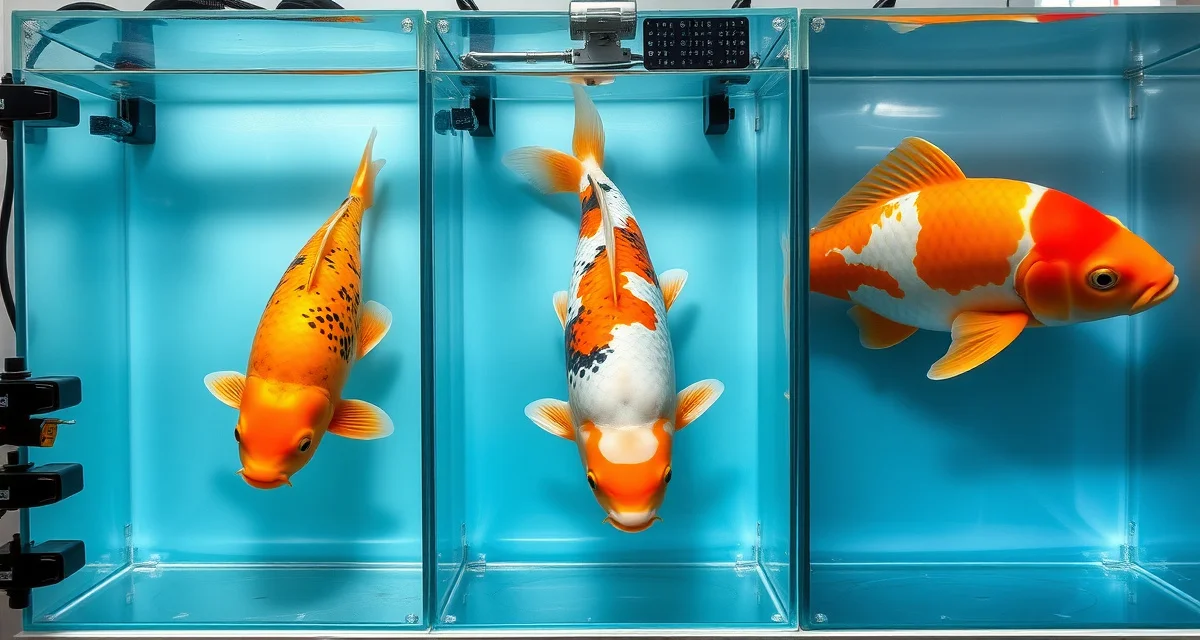
Quarantine Protocols for Koi by Fish Size
Dosing errors are proportionally more dangerous in smaller fish. A 10% overdose of formalin in a tank of 30-inch jumbo koi is uncomfortable. The same error in a tank of 4-inch tosai can be fatal. Fish size changes everything in quarantine - stocking density, dosing, handling, and observation approach all need to be scaled accordingly.
Here's how to run quarantine correctly at each stage of development.
TL;DR
- A 10% overdose of formalin in a tank of 30-inch jumbo koi is uncomfortable.
- The same error in a tank of 4-inch tosai can be fatal.
- For a group of 10 tosai averaging 6 inches each, that's 60 inches of fish - you need at least 600 gallons.
- Watch the fish for 30-60 minutes after each treatment dose.
- A group that won't eat on day 2 is telling you something.
- At 12-14 inches, these fish are producing significant bioload and need room to move normally - abnormal movement is a key observation indicator.
- A group of 6 fish averaging 12 inches each is 72 inches of fish - needs 600-900 gallons.
Tosai (Under 8 Inches)
Tosai are the most common purchase category for hobbyists and the most challenging for quarantine management. They're small, produce a lot of waste relative to their body size, and are more susceptible to dosing errors and koi pond water quality tracker swings.
Tank size: 150-250 gallons minimum for a group of 10-15 tosai. You want ample space because small fish crowd-stress easily and the behavioral signs of disease (darting, flashing, isolation) are harder to read in a crowded tank.
Stocking density: No more than 1 inch of fish per 10 gallons in quarantine. For a group of 10 tosai averaging 6 inches each, that's 60 inches of fish - you need at least 600 gallons. Yes, that seems like a lot for small fish. Ammonia spikes in quarantine are more dangerous than people expect.
Salt treatment dosing for tosai:
- 0.1% starting concentration (1 lb per 100 gallons)
- Build to 0.3% over 48 hours
- Don't jump straight to 0.5% for tosai - they're more sensitive to rapid osmotic change than larger fish
Formalin and praziquantel: Halve the observation time before dosing any concentrated treatment. Watch the fish for 30-60 minutes after each treatment dose. Tosai can decline quickly if a treatment causes oxygen depletion or an allergic-type reaction. Have aeration at full blast during any chemical treatment.
Observation focus: Look closely at fins. Clamped pectorals and dorsal are early stress indicators. Check for white spots or dust-like coating (ich or velvet), both of which show up early and clearly against the skin of small fish.
Feeding: Tosai should be eating within 24-48 hours of arrival if they're healthy. A group that won't eat on day 2 is telling you something. Don't force feed - just note the refusal and watch closely.
Nisai (8-16 Inches)
Nisai are the most commonly imported size class from Japan. Most Gosanke (Kohaku, Sanke, Showa) come over as nisai from legitimate breeders like Sakai, Dainichi, or Marudo. This is the size class where disease screening is most critical, because these fish are now worth real money and you're introducing them to a collection that may include even more valuable fish.
Tank size: 300-500 gallons for a group of 5-8 nisai. At 12-14 inches, these fish are producing significant bioload and need room to move normally - abnormal movement is a key observation indicator.
Stocking density: 1 inch of fish per 8-10 gallons in quarantine. A group of 6 fish averaging 12 inches each is 72 inches of fish - needs 600-900 gallons. Don't crowd nisai quarantine tanks.
KHV observation: This is especially important for nisai imports. Maintain the tank at 65-68°F for the full quarantine period. If you've paid $500-5,000+ per fish, PCR testing at $35-50 per fish is cheap insurance before introducing to an established pond.
Salt treatment dosing for nisai:
- Build to 0.3% over 24 hours (faster than tosai)
- 0.5% is appropriate for parasite treatment
- Maintain for 14-21 days as a prophylactic measure
Handling: Nisai need nets at least 18 inches wide and deep enough to contain a 14-inch fish without bending the body. Bent koi experience spinal stress. Use smooth-mesh koi socks for transport within the quarantine system. Minimize handling - every net-out is a stress event.
Observation focus: At this size, you can see skin lesions, fin erosion, and behavioral abnormalities much more clearly than with tosai. Check the gill plates for symmetrical movement - uneven gilling suggests gill damage or parasites. Check the lateral line for raised scales or swelling. Look along the belly and under the pectoral fins for early ulceration.
Jumbo Koi (16+ Inches)
Large koi - anything over 16 inches, including mature sanke, tategoi being grown on, or Japanese-sourced breeding stock - need a fundamentally different quarantine approach.
Tank size: 500-1500 gallons depending on fish count and size. A single 28-inch jumbo kohaku needs 300+ gallons to turn around comfortably. A group of four 24-inch fish needs 1000+ gallons in quarantine.
Stocking density: This size class is expensive, and the tendency is to cram them into inadequate quarantine space because you don't have a better option. Don't. If you don't have adequate quarantine infrastructure for jumbo fish, either build it before buying the fish or don't buy the fish yet.
Treatment dosing: Dosing by volume still applies, but you need to account for fish biomass. A 30-inch jumbo koi can weigh 15-20 lbs. Heavy fish in a relatively small tank means the fish's body weight represents a larger proportion of the water treatment effectiveness. This is where biomass-based dosing calculators (built into KoiQuanta) become genuinely useful rather than just nice to have.
Salt treatment for jumbo: Build to 0.3% over 24 hours. At 0.5%, watch large fish carefully for buoyancy issues - some large koi show early swim bladder stress at higher salt concentrations.
Handling: You probably can't net a 30-inch koi safely without a very large net and help from a second person, or without using a koi sock. Plan quarantine tank access so you can observe fish from the side (clear tank walls or viewing panels) rather than needing to reach in. Each unnecessary handling event is a stress event, and large koi are harder to manage safely when stressed.
Feeding: Large koi are often reluctant eaters in quarantine. Don't overfeed trying to coax them - uneaten food in a quarantine tank spikes ammonia fast. Feed a small amount, note how much is eaten, and remove uneaten food after 15-20 minutes.
Treatment Dose Scaling
The critical rule: always dose by water volume, not by fish count or fish size. But know that fish biomass affects how quickly medications are metabolized and whether effective concentrations are maintained.
KoiQuanta's treatment dose calculator auto-scales recommended doses to the tank volume you've entered. For dealers running multiple tanks with different populations, this removes one of the most common sources of error.
Quick reference salt dosing:
| Target salinity | Dose (non-iodized salt) |
|----------------|------------------------|
| 0.1% | 1.0 lb per 100 gallons |
| 0.2% | 2.0 lbs per 100 gallons |
| 0.3% | 2.5 lbs per 100 gallons |
| 0.5% | 4.2 lbs per 100 gallons |
Build concentration gradually over 24-48 hours regardless of fish size. Rapid osmotic changes stress koi of all sizes.
Related Articles
- Case Study: How One Hobbyist Stopped Losing Fish by Adding Quarantine
- Koi Quarantine for Breeding Operations: Managing High-Volume Fish Flow
FAQ
How do I dose treatments for small tosai?
Always dose by water volume, not fish size. But be conservative with small fish - start at the lower end of recommended ranges, have aeration at maximum during treatment, and observe continuously for the first 30-60 minutes after dosing any concentrated chemical. Tosai crash faster than large fish when a treatment goes wrong, and you have less time to react.
What stocking density is safe in a quarantine tank?
No more than 1 inch of fish per 8-10 gallons in quarantine, and ideally less. This is half or less of what most people run in their display systems. The combination of transport stress, potential disease, and the need to observe individuals clearly all argue for lower density in quarantine. If you can't fit all your new fish at proper density, run two separate quarantine systems.
Do large jumbo koi need longer quarantine?
Not necessarily longer, but they do need more infrastructure. The core 21-42 day protocol applies to all sizes. What changes is tank volume, handling approach, and treatment monitoring. Large koi in inadequate space will show chronic stress, which suppresses immunity and complicates disease observation. Get the infrastructure right first.
What is Quarantine Protocols for Koi by Fish Size?
[FAQ_ANSWER_PLACEHOLDER: This answer needs to be generated by AI with specific data, examples, and actionable advice relevant to Quarantine Protocols for Koi by Fish Size. Target 50-150 words.]
How much does Quarantine Protocols for Koi by Fish Size cost?
[FAQ_ANSWER_PLACEHOLDER: This answer needs to be generated by AI with specific data, examples, and actionable advice relevant to Quarantine Protocols for Koi by Fish Size. Target 50-150 words.]
How does Quarantine Protocols for Koi by Fish Size work?
[FAQ_ANSWER_PLACEHOLDER: This answer needs to be generated by AI with specific data, examples, and actionable advice relevant to Quarantine Protocols for Koi by Fish Size. Target 50-150 words.]
What are the benefits of Quarantine Protocols for Koi by Fish Size?
[FAQ_ANSWER_PLACEHOLDER: This answer needs to be generated by AI with specific data, examples, and actionable advice relevant to Quarantine Protocols for Koi by Fish Size. Target 50-150 words.]
Who needs Quarantine Protocols for Koi by Fish Size?
[FAQ_ANSWER_PLACEHOLDER: This answer needs to be generated by AI with specific data, examples, and actionable advice relevant to Quarantine Protocols for Koi by Fish Size. Target 50-150 words.]
Sources
- Associated Koi Clubs of America (AKCA)
- Koi Organisation International (KOI)
- University of Florida IFAS Extension Aquaculture Program
- Fish Vet Group
- Water Quality Association