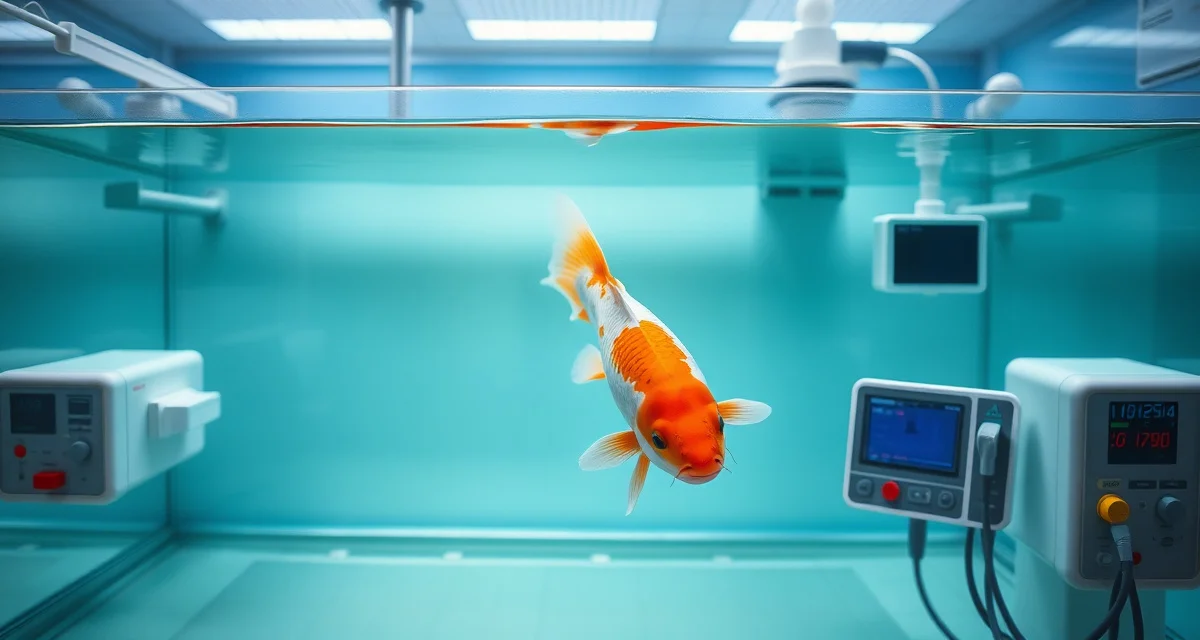
Emergency Koi Quarantine: When Fish Are Sick
Delayed isolation increases whole-pond mortality risk exponentially. One sick fish in your display pond is a disease event waiting to become a disease outbreak. The window between "something looks off with that kohaku" and "multiple fish are showing symptoms" can be as short as 24-48 hours with fast-moving pathogens like KHV or highly infectious parasites like ich.
You need to move fast. Here's how.
TL;DR
- The window between "something looks off with that kohaku" and "multiple fish are showing symptoms" can be as short as 24-48 hours with fast-moving pathogens like KHV or highly infectious parasites like ich.
- Even a 100-gallon storage tote works for emergency isolation of a single fish.
- Clean it thoroughly with diluted bleach (1:10), rinse multiple times, and fill with fresh dechlorinated water.
- For a 12-18 inch nisai, you need 150 gallons minimum.
- Change 25-30% of the volume daily and test ammonia every 12 hours.
- Build concentration over 12-24 hours rather than all at once.
- For a confirmed parasite case, move to 0.5% over 48 hours.
Recognizing When You Need Emergency Quarantine
Not every behavioral change requires emergency action. But these signs mean you isolate today:
Isolate immediately:
- Fish hovering near the surface with rapid gilling (hypoxia or gill damage)
- Fish isolating themselves from the group and not responding to food
- Visible lesions, open wounds, or ulcers
- Raised scales in a pinecone pattern (dropsy - serious prognosis)
- Fish swimming sideways, tail-down, or unable to maintain orientation
- White or gray coating that doesn't look like normal mucus
- Gill necrosis or pale, swollen gills
- More than one fish showing any of the above signs simultaneously
Watch closely, isolate within 24 hours if persists:
- Single fish flashing or scratching
- One fish not eating when others are eating normally
- Slightly clamped fins in an otherwise active fish
- Minor fin erosion in a single fish
When in doubt, isolate. You can always return a healthy fish to the display pond after a clean quarantine. You can't undo the spread of disease through an established collection.
Emergency Setup: Getting a Tank Ready Fast
You don't always have a quarantine tank pre-established when you need it. Here's how to set one up quickly.
Step 1: Container
Use whatever you have: a large plastic Rubbermaid stock tank, an IBC tote, a fiberglass vat. Even a 100-gallon storage tote works for emergency isolation of a single fish. Clean it thoroughly with diluted bleach (1:10), rinse multiple times, and fill with fresh dechlorinated water.
For a 12-18 inch nisai, you need 150 gallons minimum. Smaller tanks will work for very short-term emergency holds, but ammonia will become a problem fast.
Step 2: Aeration
Add an air stone and air pump immediately. Emergency fish are often oxygen-stressed to begin with. More aeration is better. If you have a spare air pump, run two.
Step 3: Filtration
If you don't have time to establish filtration, you can manage an emergency quarantine through water changes. Change 25-30% of the volume daily and test ammonia every 12 hours. You're not running a conventional filtered system - you're using water changes to control ammonia while you deal with the disease.
If you can grab filter media from your established system, do it - drop a seeded sponge or a handful of bio-media in the emergency tank. This will immediately provide some ammonia processing capacity.
Step 4: Temperature
Match the temperature in your emergency tank to the display pond temperature. Rapid temperature change on top of disease stress can be fatal. You can adjust temperature gradually over the following days if needed.
Step 5: Transfer
Net the affected fish as gently as possible. Minimize time in the net. Transfer directly to the emergency tank. Record the time and the reason for isolation.
First Response Assessment
Once the fish is isolated, do a systematic assessment before reaching for medications.
What do you see?
- Check both sides of the fish (get in close, use good lighting)
- Look at every fin, the lateral line, the belly, under the pectoral fins
- Look at the gill plates - are they symmetrical? Any swelling or paleness visible at the gill cover edges?
- Watch the fish for 10-15 minutes. How is it swimming? Breathing rate?
- Any visible parasites? Ich spots? Anchor worms? Lice?
Test the water - both the emergency tank and the display pond:
- Ammonia and nitrite in both systems
- pH
- Temperature
A water quality problem in the display pond may be what caused this fish to crash. If you don't fix the underlying water chemistry, isolating the fish buys you time but doesn't solve the problem.
First-Response Treatment Options
Salt
0.3% salt is the safest starting point for emergency cases. It reduces osmotic stress, gives mild antiparasitic action, and doesn't require diagnosis. Build concentration over 12-24 hours rather than all at once.
For a confirmed parasite case, move to 0.5% over 48 hours.
Potassium Permanganate
PP is a powerful oxidant that handles external bacteria, fungi, and many parasites. Standard dose is 2 ppm as a prolonged bath (4-6 hours) or higher concentration for a short dip. Watch the fish continuously - PP at effective doses is close to a stressful dose for ill fish. Have a bucket of dechlorinated water ready as a rinse if the fish shows extreme distress.
Methylene Blue
Useful for fungal infections and as a general supportive treatment in emergency situations. Works well in the short-term hold before you've confirmed a diagnosis.
What to Avoid Without a Diagnosis
Don't use antibiotics without a confirmed or strongly suspected bacterial infection. Antibiotic misuse contributes to resistance, and most emergency koi cases don't initially require antibiotics. Treat what you can see first.
Documentation During Emergency Quarantine
This is not the time to skip the log. If this fish dies, or if it turns out to be KHV, or if you need to defend your isolation protocol to a customer, you want records.
For each observation (minimum twice daily):
- Date and time
- Fish ID or description
- Symptoms present
- Behavior notes
- Water temperature, ammonia, nitrite, pH
- Any treatment administered, dose, and method
KoiQuanta's emergency protocol mode pre-populates observation fields with the clinical signs you should be checking and automatically flags observations that suggest escalation is needed. It also timestamps everything - which matters if this case becomes a legal or compliance issue.
When to Call a Fish Veterinarian
If you're seeing:
- Multiple fish dying rapidly
- Signs consistent with KHV (mass respiratory distress, gill necrosis)
- A case that isn't responding to initial treatment
- Anything that looks like a reportable disease (KHV, SVC, VHS)
Find a fish veterinarian or an aquaculture extension specialist. In the US, your state veterinarian's office should have a fish health contact. For KHV, you have reporting obligations - don't try to handle it yourself.
Related Articles
- Koi Quarantine for Breeding Operations: Managing High-Volume Fish Flow
- Quarantine Protocols for Koi by Fish Size
- What to Do When a Koi Dies: Removal, Testing, and Pond Protection
FAQ
How quickly do I need to isolate a sick koi?
Immediately - the same day you notice signs. With fast-moving diseases like KHV, ich, or virulent Aeromonas strains, a delay of even 24 hours can mean multiple fish are now infected. The risk of acting too quickly is that you isolated a fish that was just having a bad day. The risk of acting too slowly is disease spreading through your whole collection.
What do I treat a sick koi with immediately?
Before you know what you're dealing with: salt to 0.3%, maximum aeration, and observation. Salt is broadly safe, reduces osmotic stress, and provides mild antiparasitic action. Once you've assessed the fish properly and have a working diagnosis, you can add targeted treatment. Don't mix multiple medications without understanding their interactions.
How do I set up an emergency quarantine tank fast?
A clean container, fresh dechlorinated water, an air stone, and daily water changes. That's the minimum viable emergency isolation setup. You don't need a full filtered, heated, established system for emergency holds - you can manage ammonia through daily water changes in the short term. The priority is isolation. Optimize the setup once the fish is safe.
What is Emergency Koi Quarantine: When Fish Are Sick?
Emergency koi quarantine is the immediate isolation of a sick or compromised koi fish from your main display pond. It involves setting up a separate holding tank—even a 100-gallon storage tote works—filled with dechlorinated water, then moving the affected fish before disease spreads. Acting within hours of noticing symptoms like surface hovering, rapid gilling, or unusual behavior can mean the difference between saving one fish and losing your entire pond population.
How much does Emergency Koi Quarantine: When Fish Are Sick cost?
Emergency koi quarantine has no fixed cost—it depends on what you already own. A basic setup using a storage tote, an air pump, and a sponge filter can cost under $50. If you need to purchase a dedicated quarantine tank, heater, and water testing supplies, budget $150–$300. The real cost of not quarantining is far higher: losing a prized kohaku or an entire pond to KHV or ich can represent thousands of dollars in losses.
How does Emergency Koi Quarantine: When Fish Are Sick work?
Emergency koi quarantine works by isolating a sick fish in a separate, clean tank to stop pathogens from spreading to healthy pond mates. You fill the tank with dechlorinated water, maintain stable temperature, and perform 25–30% daily water changes while testing ammonia every 12 hours. Treatment—such as salt dosed to 0.5% over 48 hours for confirmed parasites—is administered in the quarantine tank, allowing targeted care without medicating or stressing your whole pond.
What are the benefits of Emergency Koi Quarantine: When Fish Are Sick?
The primary benefit of emergency koi quarantine is disease containment: isolating one fish can prevent a full pond outbreak. It also gives you a controlled environment to diagnose the problem accurately, administer targeted treatments, and monitor recovery without interference from other fish. Quarantine reduces stress on the sick fish, improves treatment effectiveness, and protects the significant investment you've made in your pond, particularly with high-value varieties like tosai, nisai, or imported jumbo koi.
Who needs Emergency Koi Quarantine: When Fish Are Sick?
Any koi keeper needs to understand emergency quarantine—from beginners with a backyard pond to experienced hobbyists with large display collections. If you keep more than one koi, you're at risk of disease transmission. The urgency is highest for keepers who add new fish regularly, attend koi shows, or live in regions where KHV or parasites like ich are known risks. Having a quarantine plan before an emergency strikes is essential; waiting until a fish looks sick is often too late.
Sources
- Associated Koi Clubs of America (AKCA)
- Koi Organisation International (KOI)
- University of Florida IFAS Extension Aquaculture Program
- Fish Vet Group
- Water Quality Association