Velvet Disease in Koi: Treatment and Prevention
Velvet is one of the faster-progressing parasitic diseases in koi keeping. Unlike ich, which is often caught at the obvious white-spot stage, velvet's early signs are subtle - a slight gold or rust-colored dust on the skin that might be mistaken for nothing until the fish is in genuine distress.
The disease is caused by Oodinium dinoflagellates (primarily Oodinium pillularis in freshwater koi). The parasites attach to the skin and gills, feeding on the fish's mucus and skin cells. A heavy infestation can kill within days.
TL;DR
- At 77°F (25°C), the complete cycle may be as short as 7–10 days.
- At 0.5%, osmotic stress on the parasite is meaningful.
- For light infestations caught early, 0.5% salt for 14 days, with continued observation, may resolve the issue.
- If the fish isn't clearly improving within 5–7 days, escalate to chemical treatment.
- It may be harder to source than formalin or KMnO4 depending on your region.
- Minimum two treatment cycles, timed at 5–7 day intervals, to catch the dinospores from the previous tomont generation.
- Salt at 0.3% is insufficient for established velvet infestations.
Identifying Velvet
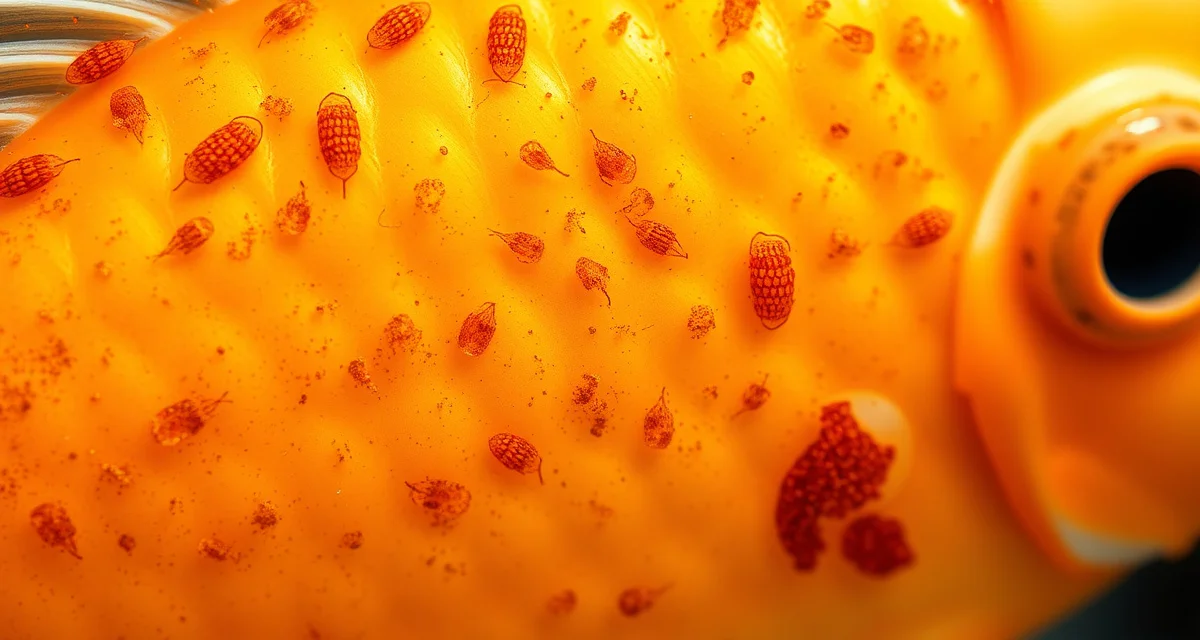
Early stage: A fine gold, rust, or yellowish dust coating the skin - most visible on darker-colored fish or under a strong flashlight beam at an angle. The fish may look slightly "velvet-covered" or have an iridescent dusty appearance. Many keepers miss this stage.
Behavioral signs before visible presentation:
- Flashing and rubbing against surfaces
- Clamped fins
- Increased mucus production (the fish looks slightly cloudy)
- Respiratory stress (rapid gill movement, surface-seeking)
- Reduced feeding
Developed infestation:
- Visible yellowish to rust-brown coating visible in normal light
- Skin may look rough or textured
- Lethargy
- In severe cases, skin ulceration from tissue damage
Gill involvement: Velvet frequently infects the gills before it's visible on the body. Gill involvement causes respiratory distress without obvious external signs - a fish with heavy gill velvet may be gasping before you see any visible coating on the body.
The Life Cycle (Why Timing Matters)
Oodinium has three life stages:
- Trophont: The attached feeding stage on the fish - what you see as the "velvet" coating
- Tomont: The fish-attached stage detaches, sinks to the bottom, and forms a cyst. Inside the cyst, it divides to produce hundreds of dinospores. This stage is resistant to most treatments.
- Dinospores: Free-swimming, infectious stage that seeks a host. This is the stage that's susceptible to chemical treatment.
The problem: the trophont stage on the fish is partly protected by the mucus layer. Most treatments are more effective against the dinospore stage. This is why treatment timing relative to the lifecycle is important, and why repeat treatments are necessary.
The lifecycle duration is temperature-dependent - shorter (faster) in warm water. At 77°F (25°C), the complete cycle may be as short as 7–10 days. At 65°F (18°C), 14–21 days.
Treatment Protocol
Isolation First
Any fish showing velvet signs should be isolated from the rest of the pond or from other quarantine tanks. The dinospores are in the water and will reinfect tank companions.
Salt Treatment
Salt at 0.3–0.5% has antifungal and antiparasitic activity that provides some control of Oodinium. At 0.5%, osmotic stress on the parasite is meaningful. Salt alone may not be sufficient to clear a moderate to heavy infestation, but it's an appropriate supportive measure and can be effective for mild cases.
Build salt gradually: Don't go from 0% to 0.5% in one addition. Increase 0.1% per 24 hours.
For light infestations caught early, 0.5% salt for 14 days, with continued observation, may resolve the issue. If the fish isn't clearly improving within 5–7 days, escalate to chemical treatment.
Formalin
Formalin at 15–25 mg/L is effective against Oodinium dinospores (the free-swimming stage). For quarantine tank treatment:
- Dose by tank volume
- Maximum aeration during treatment (formalin consumes dissolved oxygen)
- Reduce dose by 25–50% in warm water above 70°F (21°C)
- Repeat at 5–7 day intervals to catch dinospores from the previous generation
Warning: Formalin at therapeutic doses depletes dissolved oxygen. DO monitoring during treatment is mandatory.
Potassium Permanganate
KMnO4 at 2–4 mg/L pond treatment is effective against external parasites including Oodinium. For velvet:
- Standard KMnO4 bath or pond treatment as appropriate
- Maximum aeration
- Repeat treatment at 5–7 day intervals
Acriflavine
Acriflavine (at 10 mg/L) is specifically useful for Oodinium and has been traditionally used for velvet treatment. It may be harder to source than formalin or KMnO4 depending on your region.
Note: Acriflavine inhibits nitrifying bacteria - remove or protect biofilter media before treatment.
Darkness
Oodinium dinoflagellates are photosynthetic - they contain chloroplasts and need light. Reducing or eliminating light in the quarantine or treatment tank during treatment reduces the dinospores' viability. This is a supportive measure (cover the tank) not a standalone treatment.
How Many Treatments?
Minimum two treatment cycles, timed at 5–7 day intervals, to catch the dinospores from the previous tomont generation. Three treatment cycles are better.
Treatment timeline:
- Day 1: First treatment (kills free-swimming dinospores, reduces trophont load)
- Day 5–7: Second treatment (catches dinospores that hatched from tomonts after first treatment)
- Day 12–14: Third treatment (catches any remaining generation)
- Day 21+: Observation period with clean parameters before discharge
KoiQuanta's Oodinium protocol automatically schedules retreat timing based on the temperature you enter - warmer water means shorter intervals because the lifecycle is faster.
Does Salt Treat Velvet in Koi?
Salt at 0.3% is insufficient for established velvet infestations. Salt at 0.5% may manage mild cases and is appropriate as a supportive measure throughout velvet treatment.
Don't rely on salt alone for velvet. If you're seeing visible velvet (not just behavioral signs), salt is adjunctive and chemical treatment is the primary intervention.
Prevention
Velvet is introduced into ponds via new fish purchases - a fish carrying Oodinium in its early trophont stage may look healthy at purchase and show clinical disease within a week of arrival.
Prophylactic treatment during quarantine: If you're not already running formalin or KMnO4 as part of your standard quarantine protocol, adding at least one early treatment at day 3–5 post-arrival addresses Oodinium alongside other external parasites.
Daily observation prompts in KoiQuanta include the early velvet signs (gold dust appearance, flashing, excess mucus) specifically because this is a disease that rewards early detection and fast response.
Related Articles
- How to Prevent Koi Disease: The 5 Most Important Steps
- Does Water Temperature Affect Koi Disease Treatment Efficacy?
- Quarantine After Whole-Pond Disease Treatment-after-pond-treatment)
- Columnaris (Saddleback Disease) in Koi: Treatment Guide
FAQ
How do I identify velvet disease on koi?
Velvet (Oodinium) first appears as a fine gold, rust, or yellowish dust coating on the fish's skin - most visible under a flashlight at an angle or on dark-colored fish. Early behavioral signs include flashing, fin clamping, and respiratory stress. By the time the coating is clearly visible in normal light, the infestation is moderate to heavy. Regular close observation with good lighting is the key to early detection.
What treats velvet in a koi pond?
Formalin at 15–25 mg/L is the primary chemical treatment for Oodinium in a quarantine tank setting. Potassium permanganate at 2–4 mg/L is also effective. Either treatment requires maximum aeration and should be repeated at 5–7 day intervals (2–3 times total) to address all stages of the parasite lifecycle. Reducing light in the treatment tank (Oodinium is photosynthetic) and maintaining 0.3–0.5% salt support the treatment protocol.
Does salt treat velvet in koi?
Salt at 0.5% has meaningful antiparasitic activity against Oodinium and may be sufficient for very mild, early-stage infestations. For established infestations with visible coating, salt alone is inadequate. Use salt as a supportive measure (and for osmotic stress reduction) alongside chemical treatment - formalin or potassium permanganate - rather than as the primary treatment for anything beyond the most minor early-stage velvet.
What is Velvet Disease in Koi: Treatment and Prevention?
Velvet disease is a fast-progressing parasitic infection in koi caused by Oodinium dinoflagellates, primarily Oodinium pillularis. The parasites attach to the skin and gills, feeding on mucus and skin cells. It appears as a fine gold, rust, or yellowish dust on the fish's surface. Unlike ich, early signs are subtle and easily missed. A heavy infestation can prove fatal within days, making early detection and prompt treatment essential for survival.
How much does Velvet Disease in Koi: Treatment and Prevention cost?
Treatment costs vary depending on the method chosen. Salt (sodium chloride) is the most affordable option, requiring 0.5% concentration sustained over 14 days. Chemical treatments such as formalin or potassium permanganate (KMnO4) cost more but may be necessary for moderate to severe cases. Copper-based treatments are another option but can be harder to source regionally. Overall, early intervention with salt is the most cost-effective approach when infestations are caught at the first signs.
How does Velvet Disease in Koi: Treatment and Prevention work?
Effective velvet treatment works by disrupting the parasite's life cycle across multiple stages. Salt at 0.5% creates osmotic stress that inhibits the parasite. Chemical treatments like formalin or KMnO4 target active dinospores and attached trophonts. A minimum of two treatment cycles spaced 5–7 days apart is required to catch newly released dinospores from previous tomont generations. At 77°F, the full cycle completes in 7–10 days, so timing treatments correctly is critical to breaking the infestation.
What are the benefits of Velvet Disease in Koi: Treatment and Prevention?
Treating velvet disease early prevents rapid escalation to life-threatening gill damage and mass fish loss. Catching the infection at the gold-dust stage allows for lower-intervention options like salt treatment, avoiding the stress of harsher chemicals on your koi. Successful treatment preserves pond population health, prevents secondary infections through damaged skin, and reduces the risk of the parasite spreading to other fish. Prevention protocols also protect new fish from introducing Oodinium into an established, healthy pond.
Who needs Velvet Disease in Koi: Treatment and Prevention?
Any koi keeper with an active pond is a candidate for understanding velvet disease treatment and prevention. It is especially relevant for hobbyists who introduce new fish, those keeping koi in warmer water temperatures where the parasite cycles faster, and anyone who has noticed unexplained lethargy, flashing, or a dusty sheen on their fish. Breeders and pond owners with dense fish populations face higher transmission risk and benefit most from having a clear treatment protocol ready before an outbreak occurs.
Sources
- Associated Koi Clubs of America (AKCA)
- Koi Organisation International (KOI)
- University of Florida IFAS Extension Aquaculture Program
- Fish Vet Group
- Water Quality Association