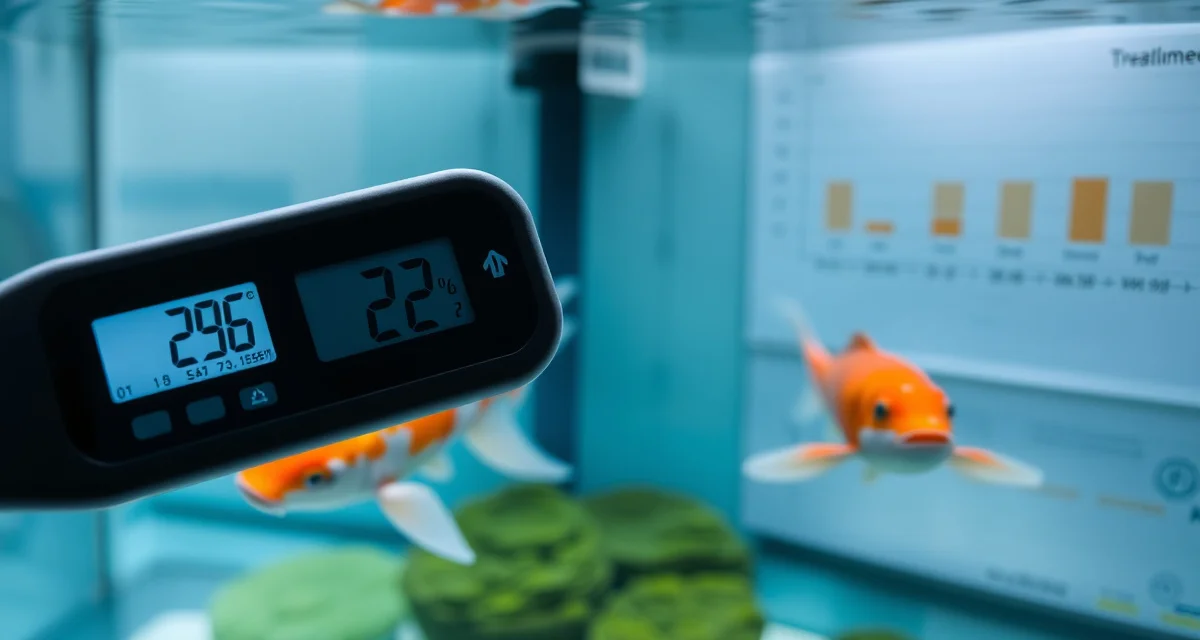
Does Water Temperature Affect Koi Disease Treatment Efficacy?
Praziquantel efficacy against flukes decreases by approximately 30% at water temperatures below 15 degrees Celsius. That single data point explains why so many cold-water fluke treatments fail. The hobbyist doses correctly, treats at the right interval by the calendar, and still sees flukes on a follow-up scrape. The medication worked less effectively than expected because the water temperature was low and nobody adjusted for it.
Water temperature affects koi disease treatment in two separate ways: it changes how fast parasites reproduce (altering how often you need to retreat), and it changes how effectively individual medications work (altering the dose or treatment duration needed). KoiQuanta's real-time temperature-adjusted treatment protocol recalculates retreatment intervals and dose effectiveness whenever temperature changes, so your treatment plan reflects your actual pond conditions rather than a generic chart.
TL;DR
- Praziquantel efficacy against flukes decreases by approximately 30% at water temperatures below 15 degrees Celsius.
- At temperatures below 10 degrees Celsius, praziquantel treatment should be considered minimally effective.
- The oxygen depletion risk from formalin increases dramatically above 22 degrees Celsius.
- Treatment courses that would work in 10 days at 20 degrees Celsius may require 14 to 21 days at 10 degrees Celsius.
- A warm spell can compress what was a 7-day interval to a 4-day interval.
- Spring disease outbreaks at 14 to 16 degrees Celsius require dose or duration adjustments for temperature-sensitive medications like praziquantel.
- Summer treatments above 25 degrees Celsius require careful oxygen management.
How Temperature Changes Medication Efficacy
Different medications respond to temperature differently, but the general pattern is that chemical reactions slow in cold water.
Praziquantel (fluke and tapeworm treatment): Markedly less effective below 15 degrees Celsius. The medication requires metabolic activity in the parasite to be absorbed and work. In cold water, parasites are metabolically sluggish, and praziquantel penetration is reduced. At temperatures below 10 degrees Celsius, praziquantel treatment should be considered minimally effective. Treatment is better delayed until water warms, or the dose duration should be extended significantly under veterinary guidance.
Formalin (broad-spectrum parasite treatment): More effective in warm water, but also more dangerous. The oxygen depletion risk from formalin increases dramatically above 22 degrees Celsius. Formalin treatment in cold water is safer from an oxygen perspective but requires longer exposure time for equivalent efficacy.
Potassium permanganate (protozoan and ectoparasite treatment): Reacts faster in warm water with higher organic loads. Cold water slows the PP oxidation reactions, potentially extending the effective treatment window but also slowing parasite contact. Organic load correction is still critical regardless of temperature.
Salt: Salt works through osmotic pressure on parasites, which is a physical mechanism less affected by temperature. Salt is one of the more temperature-stable treatments, which is part of its value at lower temperatures where other medications underperform.
Antibiotics (bacterial infections): Koi metabolism slows considerably in cold water. Fish absorb and process antibiotics more slowly at low temperatures. Treatment courses that would work in 10 days at 20 degrees Celsius may require 14 to 21 days at 10 degrees Celsius. Cold-water bacterial infections often need extended treatment.
How Temperature Changes Retreatment Timing
Most parasites have life cycles with temperature-dependent stages. The free-swimming or larval stage is typically the stage vulnerable to chemical treatment. How quickly parasites progress through life cycle stages determines how often you need to treat.
Ich (Ichthyophthirius multifiliis):
- At 15 degrees Celsius: tomite hatch in 5 to 7 days, treat every 5 to 7 days
- At 20 degrees Celsius: tomite hatch in 3 to 5 days, treat every 3 to 5 days
- At 25 degrees Celsius: tomite hatch in 2 to 3 days, treat every 2 to 3 days
- At 30 degrees Celsius: tomite hatch in 24 to 48 hours, treat daily or every other day
Using a fixed 7-day retreat interval at 25 degrees Celsius means you're treating every 7 days when the vulnerable stage hatches every 2 to 3 days. Most of the new generation has already attached to fish before you retreat. The treatment fails not because the medication doesn't work but because the timing was wrong.
Anchor worm (Lernaea) and fish louse (Argulus): Both have egg stages that are resistant to treatment. At warm temperatures, eggs hatch faster, requiring more frequent retreatment. At cold temperatures, eggs hatch more slowly, extending the retreatment interval but also meaning the treatment course takes longer overall.
Flukes (Gyrodactylus and Dactylogyrus): Gyrodactylus is live-bearing and doesn't have an egg stage that complicates retreatment timing in the same way. Dactylogyrus lays eggs, with egg hatch time temperature-dependent. At cold temperatures, Dactylogyrus eggs can remain dormant for weeks, requiring retreatment even after you think treatment is complete.
Using Temperature Data for Treatment Planning
The practical application of temperature-based treatment planning:
Before starting treatment: Record your current water temperature. Use this temperature to determine your retreatment interval, not a calendar default.
During treatment: If temperature changes significantly (more than 3 to 4 degrees Celsius) during a multi-week treatment course, recalculate your retreatment interval. A warm spell can compress what was a 7-day interval to a 4-day interval.
In spring and fall: Temperature fluctuates most during transition seasons. Retreatment timing needs adjustment more frequently than in stable summer or winter conditions.
KoiQuanta's water temperature impact on fish health guide covers the full range of temperature-health interactions. The treatment concentration calculator in KoiQuanta applies temperature correction to dose recommendations for supported medications.
Frequently Asked Questions
What temperature is best for koi disease treatment?
Most koi treatments work most effectively between 18 and 25 degrees Celsius. This range balances medication efficacy (warm enough for full chemical activity) with safety (not so warm that oxygen depletion from formalin or other oxidizing treatments becomes extreme). Spring disease outbreaks at 14 to 16 degrees Celsius require dose or duration adjustments for temperature-sensitive medications like praziquantel. Summer treatments above 25 degrees Celsius require careful oxygen management.
Do I need a higher dose of medication in cold water?
Sometimes, but this depends on the specific medication and should always be guided by veterinary consultation for prescription medications. For praziquantel, extended treatment duration is often more appropriate than a higher dose in cold water. For salt, the target percentage is the same regardless of temperature (though temperature affects how quickly osmotic effects occur). For formalin and potassium permanganate, adjusting dose based on temperature is important, and KoiQuanta's calculators apply these adjustments.
How does temperature affect koi parasite life cycles?
Every parasite with a multi-stage life cycle progresses through those stages faster in warm water and slower in cold water. At 30 degrees Celsius, Ich can complete a full life cycle in 3 to 5 days. At 15 degrees Celsius, the same cycle takes 2 to 3 weeks. This matters for treatment because you can only kill certain life stages with medication. If you retreat too slowly in warm water, the next generation of parasites has already attached to fish and become treatment-resistant before you apply the next dose. KoiQuanta's temperature-adjusted retreatment scheduler calculates the correct interval for your specific water temperature.
What is Does Water Temperature Affect Koi Disease Treatment Efficacy??
Water temperature directly affects how well koi disease treatments work. Cold water slows parasite metabolism but also reduces medication absorption and effectiveness. Praziquantel loses roughly 30% of its efficacy against flukes below 15°C, and drops to near-minimal effectiveness below 10°C. Formalin becomes dangerously oxygen-depleting above 22°C. Understanding this relationship means the difference between a treatment that clears an infection and one that appears to work but leaves parasites to rebound.
How much does Does Water Temperature Affect Koi Disease Treatment Efficacy? cost?
Adjusting treatment for water temperature costs nothing beyond awareness and timing. The medications themselves—praziquantel, formalin, salt—are inexpensive. The real cost of ignoring temperature is wasted product, extended disease cycles, stressed fish, and repeat treatments. A temperature-aware protocol like KoiQuanta's free real-time calculator helps you spend less overall by treating correctly the first time rather than retreating multiple times due to miscalculated dosing intervals.
How does Does Water Temperature Affect Koi Disease Treatment Efficacy? work?
Temperature affects treatment in two ways: it changes parasite reproduction speed and it changes how effectively medications are absorbed and act. Warmer water accelerates fluke life cycles, requiring shorter retreatment intervals. Cooler water reduces drug uptake. KoiQuanta's temperature-adjusted protocol recalculates both variables automatically—retreatment timing and dose effectiveness—whenever your pond temperature changes, replacing a static chart with a dynamic plan matched to real conditions.
What are the benefits of Does Water Temperature Affect Koi Disease Treatment Efficacy??
The primary benefit is treatment success. Fish recover faster, reinfection is prevented by correctly timed retreatments, and medication is not wasted on doses too weak or intervals too long for the actual water temperature. Secondary benefits include reduced fish stress from fewer failed treatment rounds, lower chemical exposure overall, and clearer insight into why previous treatments may have underperformed during cold or warm seasonal transitions.
Who needs Does Water Temperature Affect Koi Disease Treatment Efficacy??
Any koi keeper who treats their pond for parasites, bacterial infections, or fungal disease needs to understand this. It is especially critical for hobbyists treating flukes or ich in spring and autumn when temperatures fluctuate significantly. Breeders running quarantine tanks, pond owners entering or leaving winter, and anyone who has experienced repeated treatment failure without an obvious cause should audit whether temperature was the hidden variable undermining their protocol.
How long does Does Water Temperature Affect Koi Disease Treatment Efficacy? take?
Treatment duration must be extended in cold water and retreatment intervals shortened in warm water. A fluke treatment course completed in 10 days at 20°C may require 14 to 18 days below 12°C to achieve the same parasite kill rate across egg and larval cycles. There is no single fixed answer because temperature changes the calculation. Using a real-time adjusted schedule rather than a calendar-based one ensures the full life cycle is covered before you stop treating.
What should I look for when choosing Does Water Temperature Affect Koi Disease Treatment Efficacy??
Look for protocols that account for both retreatment interval and dose effectiveness separately—not just a single temperature modifier. Confirm the medication is appropriate for your temperature range before purchasing; some treatments are contraindicated outside specific ranges. Prioritize dissolved oxygen monitoring when using formalin above 20°C. A reliable digital thermometer, accurate water testing kit, and access to a temperature-adjusted calculator like KoiQuanta's are more important than premium branded medications.
Is Does Water Temperature Affect Koi Disease Treatment Efficacy? worth it?
Yes. The adjustment is simple but the impact is substantial. Treating flukes in 12°C water with a standard warm-water schedule leaves a significant percentage of parasites alive to repopulate within days. The fish suffers longer, more medication is used overall, and the keeper assumes the product failed when the protocol was the actual problem. Accounting for temperature requires no extra cost—only awareness—and it turns marginal or failed treatments into successful ones.
Related Articles
- Do I Need to Retreat After a Water Change During Koi Treatment?
- Black Spots on Koi: Healing Ulcers, Melanophore Migration, or Disease?
Sources
- Associated Koi Clubs of America (AKCA)
- Koi Organisation International (KOI)
- University of Florida IFAS Extension Aquaculture Program
- Fish Vet Group
- Water Quality Association