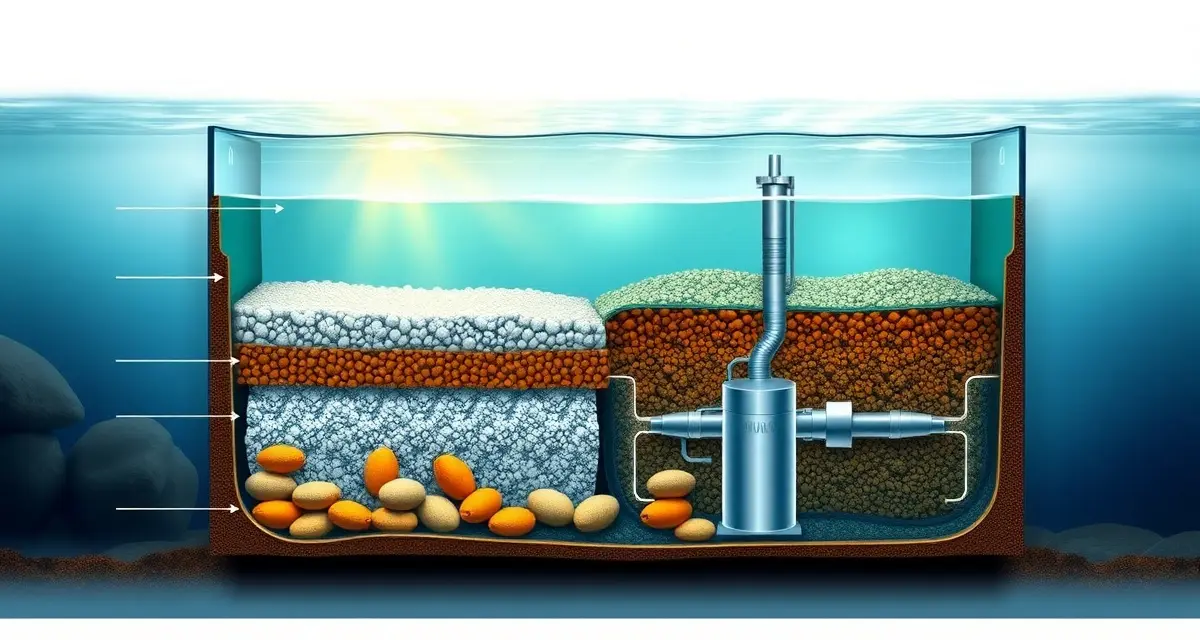
Koi Pond Sump Design: Building an External Filter Sump
A well-designed sump can increase biological filtration capacity by 200-300% for the same pump throughput. This is because a dedicated sump lets you pack far more biological media into the filtration path than is practical in a simple filter box, and because an external sump can be sized to provide extended contact time between water and media -- the key variable for biological filtration efficiency.
Sumps are more common in high-spec koi systems and dealer facilities than in casual pond setups. But for keepers who want maximum koi pond water quality tracker with a given pump size, understanding sump design opens options that standard filter configurations don't offer.
TL;DR
- A standpipe or baffle between chamber 1 and chamber 2 draws water from the top of chamber 1, leaving settled material below.
- A 5,000-gallon pond might have 500-1,000 gallons of sump media volume.
- Most designers aim for 15-30 minutes of contact time in the biological chambers.
- To calculate: if your sump has 300 gallons of media volume and your pump delivers 1,500 gallons per hour, contact time is 300/1,500 x 60 = 12 minutes.
- Aim for 15-30 minutes of contact time in the biological chambers.
What a Sump Is
A sump is an external container -- separate from the pond itself -- that functions as the biological filtration stage of your system. Water flows from the pond through mechanical pre-filtration (settling chamber, drum filter, or vortex), then into the sump where biological media converts ammonia and nitrite, then returns to the pond via the return pump.
The sump is filled with biological media through which pond water flows. The media provides surface area for beneficial bacteria colonies. Because the sump can be large and media-dense, it offers far more biological surface area than a compact filter unit.
KoiQuanta equipment profiles support sump configuration documentation, so your filtration setup is part of the complete pond record and available for troubleshooting water quality issues.
Sump Design Principles
Flow-Through vs. Up-Flow Design
Up-flow (bottom-to-top): Water enters at the bottom of the sump and flows upward through media before exiting at the top. Benefits: self-cleaning tendency (solids don't accumulate in the media as readily), uniform flow distribution through media, efficient use of media volume.
Down-flow (top-to-bottom): Water enters at the top and flows down through media. Simpler to construct. May accumulate more solids in upper media layers over time.
Most koi sump designs use up-flow or a combination approach -- water enters the sump at the bottom of the first chamber, rises through media, and exits over a weir or through an overflow into the return pump section.
Chamber Design
A sump divided into chambers provides better control over flow path and prevents short-circuiting (water taking the fastest route through the sump rather than through the media):
Chamber 1 -- pre-settling: A first chamber before the biological media gives any fine particles remaining after primary mechanical filtration an opportunity to settle before reaching biological media. A standpipe or baffle between chamber 1 and chamber 2 draws water from the top of chamber 1, leaving settled material below.
Chamber 2+ -- biological media: The main chamber(s) contain biological filtration media. Multiple chambers in series increase contact time. Media can be different types in different chambers -- coarser high-surface-area media in the first biological chamber, finer media in the second.
Final chamber -- pump bay: A clear chamber for the return pump, free of media. This protects the pump from media debris and gives you easy access for pump maintenance.
Sizing the Sump
Sump sizing is determined by two factors: how much media volume you need, and how much contact time you want.
Media volume: Roughly 10-20% of pond volume as sump media volume is a common target for a well-stocked koi pond. A 5,000-gallon pond might have 500-1,000 gallons of sump media volume. This is a guideline, not a precise formula -- the actual requirement depends on stocking density and media type.
Contact time: The time water spends in contact with biological media affects how much ammonia is processed per pass. Longer contact time is better, up to a point where the media becomes oxygen-depleted. Most designers aim for 15-30 minutes of contact time in the biological chambers.
To calculate: if your sump has 300 gallons of media volume and your pump delivers 1,500 gallons per hour, contact time is 300/1,500 x 60 = 12 minutes. Increasing media volume or reducing pump rate increases contact time.
Filter Media Selection
High-surface-area plastic media (K1, K3, moving bed media): Excellent biological surface area per unit volume. Moving bed media (floating in an airated section) stays clean by constant movement. Good choice for the primary biological chamber.
Japanese matting: Dense, fibrous material providing high surface area. Used in many UK and European koi pond sumps. Requires periodic cleaning but provides excellent biological surface area.
Ceramic media (bio rings, ceramic noodles): Very high surface area, heavy, doesn't move. Stays in place well but can accumulate debris over time. Good for lower-flow sections.
Plastic lava rock or pumice: Natural volcanic rock with high porosity. Very inexpensive. Heavy and bulky but effective when properly cleaned of dust initially.
Media combination: Many sump designs use different media in series -- higher-flow, more self-cleaning media first (K1 moving bed), more static high-surface-area media second (matting or ceramic). This plays to each media type's strengths.
Water Flow Through the Sump
Gravity vs. pressure fed: Sumps can be gravity-fed from the pond (water flows downhill from pond level to sump) with a return pump pushing water back to pond level, or pressure-fed with the pump before the sump. Gravity-fed is simpler and gentler on biological media.
Oxygenation: Biological filtration consumes oxygen. Injecting air into the sump -- either with air stones in the media chambers or with a venturi on the return line -- maintains oxygen levels in the sump and improves bacterial activity.
Even flow distribution: Water entering the sump should be distributed across the full width of the media chamber rather than dumping in one corner. A distribution manifold -- a pipe with holes across the width of the sump -- achieves this in an up-flow design.
Cycling a New Sump
A new sump needs to be biologically cycled before it can process the full ammonia load of your fish stock. Don't connect a new sump and expect it to handle full load immediately.
Seeding from existing filtration: Transfer media from your existing filter into the new sump. This accelerates cycling by seeding bacteria directly.
Running parallel initially: Run your existing filtration alongside the new sump during the transition. Gradually shift more flow through the sump as cycling progresses.
Monitoring during transition: Test ammonia and nitrite daily during the transition period. Any rise indicates the sump isn't yet cycled to full capacity. For the cycling process in full, the koi new pond cycling guide covers the nitrogen cycle and cycling methods.
For the overall filtration system context of which a sump is one part, the koi pond filtration guide covers the complete system design.
Frequently Asked Questions
What is a koi pond filter sump?
A sump is an external container separate from the pond that functions as the biological filtration stage. Pond water passes through primary mechanical filtration (removing solids), then through the sump where biological media converts ammonia and nitrite to less harmful compounds, then returns to the pond via a return pump. Because the sump can be large and filled with biological media, it provides far more filtration capacity than compact in-pond filter units. Sumps are common in high-spec koi systems where water quality demands exceed what simpler filter configurations can reliably deliver.
How do I size a sump for my koi pond?
Target approximately 10-20% of your pond volume as biological media volume in the sump -- a 5,000-gallon pond needs roughly 500-1,000 gallons of media space. Then check contact time: divide your media volume by your pump flow rate (in gallons per minute) to get contact time in minutes. Aim for 15-30 minutes of contact time in the biological chambers. If contact time is too short, increase media volume or reduce flow rate through the sump. Sump physical size should accommodate your media volume plus settling chamber and pump bay, with some working room for maintenance.
What filter media should I use in a koi pond sump?
Moving bed plastic media (K1, K3) is an excellent primary chamber choice -- high surface area, self-cleaning through air-driven movement, resistant to media fouling. Japanese matting or high-density foam provides different surface area characteristics and can be used in subsequent chambers. Ceramic media (bio rings, noodles) offers very high surface area but needs regular cleaning. Many effective sumps use a combination: moving bed media in an aerated primary chamber, followed by matting or ceramic in secondary chambers. Choose media that you can realistically clean and maintain -- a sump you can't service properly will decline in performance over time.
What is Koi Pond Sump Design: Building an External Filter Sump?
[FAQ_ANSWER_PLACEHOLDER: This answer needs to be generated by AI with specific data, examples, and actionable advice relevant to Koi Pond Sump Design: Building an External Filter Sump. Target 50-150 words.]
How much does Koi Pond Sump Design: Building an External Filter Sump cost?
[FAQ_ANSWER_PLACEHOLDER: This answer needs to be generated by AI with specific data, examples, and actionable advice relevant to Koi Pond Sump Design: Building an External Filter Sump. Target 50-150 words.]
How does Koi Pond Sump Design: Building an External Filter Sump work?
[FAQ_ANSWER_PLACEHOLDER: This answer needs to be generated by AI with specific data, examples, and actionable advice relevant to Koi Pond Sump Design: Building an External Filter Sump. Target 50-150 words.]
What are the benefits of Koi Pond Sump Design: Building an External Filter Sump?
[FAQ_ANSWER_PLACEHOLDER: This answer needs to be generated by AI with specific data, examples, and actionable advice relevant to Koi Pond Sump Design: Building an External Filter Sump. Target 50-150 words.]
Who needs Koi Pond Sump Design: Building an External Filter Sump?
[FAQ_ANSWER_PLACEHOLDER: This answer needs to be generated by AI with specific data, examples, and actionable advice relevant to Koi Pond Sump Design: Building an External Filter Sump. Target 50-150 words.]
How long does Koi Pond Sump Design: Building an External Filter Sump take?
[FAQ_ANSWER_PLACEHOLDER: This answer needs to be generated by AI with specific data, examples, and actionable advice relevant to Koi Pond Sump Design: Building an External Filter Sump. Target 50-150 words.]
What should I look for when choosing Koi Pond Sump Design: Building an External Filter Sump?
[FAQ_ANSWER_PLACEHOLDER: This answer needs to be generated by AI with specific data, examples, and actionable advice relevant to Koi Pond Sump Design: Building an External Filter Sump. Target 50-150 words.]
Is Koi Pond Sump Design: Building an External Filter Sump worth it?
[FAQ_ANSWER_PLACEHOLDER: This answer needs to be generated by AI with specific data, examples, and actionable advice relevant to Koi Pond Sump Design: Building an External Filter Sump. Target 50-150 words.]
Related Articles
Sources
- Associated Koi Clubs of America (AKCA)
- Koi Organisation International (KOI)
- University of Florida IFAS Extension Aquaculture Program
- Fish Vet Group
- Water Quality Association