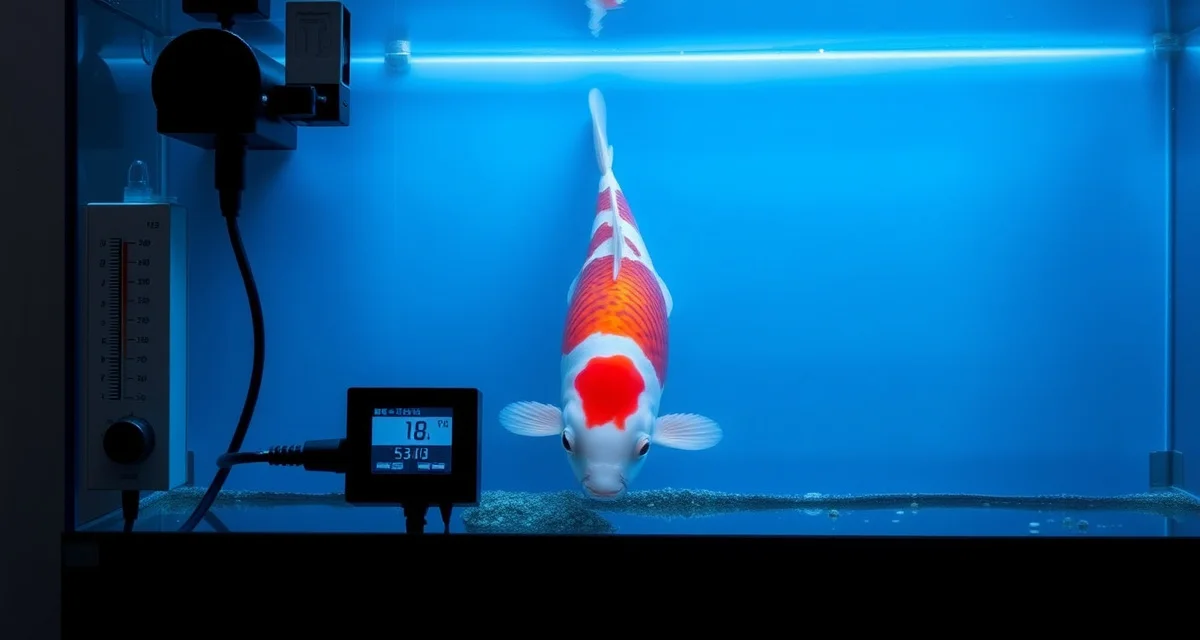
Winter Koi Quarantine: Cold Water Management
Quarantining koi in winter isn't impossible, but it's different enough from warm-season quarantine that treating it the same way will get you into trouble.
At 50°F (10°C), antibiotic uptake across fish gill membranes is dramatically reduced compared to 68°F. At 45°F, koi barely eat, move slowly, and show a variety of behaviors that look alarming to anyone who hasn't kept koi through cold seasons. And below 55°F, KHV goes latent - which means a 21-day quarantine at winter temperatures doesn't tell you whether the fish is KHV-negative.
Here's how winter changes the protocol and what you need to do differently.
TL;DR
- At 50°F (10°C), antibiotic uptake across fish gill membranes is dramatically reduced compared to 68°F.
- At 45°F, koi barely eat, move slowly, and show a variety of behaviors that look alarming to anyone who hasn't kept koi through cold seasons.
- And below 55°F, KHV goes latent - which means a 21-day quarantine at winter temperatures doesn't tell you whether the fish is KHV-negative.
- You paid $35–50 per fish on testing - heating the tank is trivial by comparison.
- For domestic fish from a trusted source with a documented clean health history, cold water quarantine (at ambient temperatures down to around 50°F) is acceptable, with the caveats below.
- Between 50–55°F, fish may eat small amounts once every few days if offered a wheat germ-based food.
- A fish sitting calmly at the bottom of a 48°F quarantine tank is almost certainly fine.
The Heating Decision
The first and most important winter quarantine decision is whether to heat the quarantine tank.
Arguments for heating to 65–68°F:
- Maintains treatment efficacy for all medications
- Keeps fish metabolically active enough to fight disease
- Puts KHV-risk fish in the expression window for detection
- Fish behavior remains normal, making observation meaningful
- Feeding response remains a valid health indicator
Arguments for allowing cold water quarantine:
- Fish imported in winter may be more stressed by heating (though usually mild)
- If you're not running treatments and fish appear healthy, cold water is not inherently dangerous
- Energy cost and equipment cost
For Japanese imports arriving in winter, I heat the quarantine tank to 65–68°F regardless of season. The KHV detection argument alone is worth it. You paid $35–50 per fish on testing - heating the tank is trivial by comparison.
For domestic fish from a trusted source with a documented clean health history, cold water quarantine (at ambient temperatures down to around 50°F) is acceptable, with the caveats below.
How Cold Water Changes What You Observe
At temperatures below 60°F, normal cold-season behavior can look like disease to the uninitiated:
Slow movement: Koi at 50°F move slowly. They're not lethargic from illness - they're cold. Their metabolism has slowed proportionally. Compare behavior to what's normal for the temperature.
Reduced or absent appetite: Below 50°F, don't feed. Between 50–55°F, fish may eat small amounts once every few days if offered a wheat germ-based food. Refusing food at cold temperatures is normal, not a disease sign.
Bottom-sitting: Fish in cold water often sit quietly near the bottom of the tank. This is cold-water torpor behavior, not necessarily disease. The distinguishing factor: fish should still respond to stimuli (your presence, movement), just more slowly than at warm temperatures.
Pale coloration: Many koi show reduced color intensity in cold water. This is normal metabolic response.
What does look like disease at cold temperatures:
- Hemorrhaging (redness at fin bases or on the body)
- Visible lesions or ulcers
- Fish floating on one side or rolling (not bottom-sitting)
- Gasping at the surface when oxygen levels are adequate
- Physical abnormalities (raised scales, belly swelling)
Keep this context when interpreting your cold-season observations. A fish sitting calmly at the bottom of a 48°F quarantine tank is almost certainly fine. A fish sitting at the bottom with blood visible at the fin base needs attention regardless of temperature.
Treatment Efficacy in Cold Water
This is where cold water quarantine creates real clinical problems.
Antibiotics
Antibiotic uptake in fish is temperature-dependent - specifically, the passive diffusion of drug molecules across gill tissue decreases as temperature drops. Studies on tetracycline suggest absorption at 10°C is roughly 30–40% of absorption at 22°C.
Practical implication: if you're treating a bacterial infection at 50°F, the standard antibiotic dose may be effectively underdosing. Options:
- Warm the tank before and during antibiotic treatment. Even bringing the temperature from 50°F to 60°F significantly improves antibiotic uptake. If heating is feasible, do it for the treatment period.
- Extend the treatment course. A 10-day antibiotic course at 68°F may need to run 14–21 days at 55°F to achieve equivalent tissue concentrations. Consult with a fish veterinarian for specific guidance on temperature-adjusted dosing.
- Use medicated feed where possible. If the fish is eating (even at reduced temperature), delivering the antibiotic through food bypasses the gill-absorption issue and provides more predictable tissue concentrations.
Praziquantel
Praziquantel is relatively temperature-independent in its mechanism of action on parasites. However, parasite metabolism also slows in cold water, so flukes may be less susceptible. At temperatures below 50°F, a longer contact time and potentially a higher dose (within safe ranges) may be needed for effective fluke treatment.
The good news: praziquantel has a good safety margin. Running a longer course at cold temperatures is unlikely to cause harm.
Salt
Salt treatment efficacy for osmoregulatory support doesn't change significantly with temperature. For parasite control, colder water slows the parasites' reproductive cycles, which reduces treatment urgency (no immediate population explosion) but also reduces treatment effectiveness since the parasites' metabolism is slowed.
Potassium Permanganate and Formalin
Both are safer at lower temperatures because the oxygen-depletion risk decreases in cold water (colder water holds more oxygen, and chemical oxygen consumption is lower at lower temperatures). However, both are also less effective at killing parasites in cold water because the parasites' metabolisms are slowed.
Extended Hold Times for Cold Water Quarantine
The standard minimum hold times assume warm water quarantine where disease will express normally.
If quarantining at temperatures below 60°F:
Add at minimum 50% to your hold time. A 21-day standard becomes 30+ days. A 42-day import hold becomes 60 days.
For KHV-risk fish at temperatures below 55°F:
You cannot use the quarantine period as a KHV exclusion window at all. The virus won't express below 55°F. Either heat the tank to the 63–77°F expression range for the quarantine period, or rely entirely on PCR testing ($35–50/fish) rather than observation-based clearance.
KHV note: Some facilities run cold quarantine and then warm the tank to 68°F for the final 2 weeks of the hold, specifically to observe for KHV expression. This is a legitimate approach if heating from the beginning isn't practical.
Planning Winter Imports
If you're receiving Japanese koi shipments in November through February, these arrive from Japan in cold weather and may have been at lower temperatures during holding and transport.
Don't receive winter imports into a cold quarantine tank if you can avoid it. Set up a heated quarantine space, even if temporary. The alternative - running a cold water quarantine that can't tell you about KHV, doesn't effectively treat bacterial infections, and produces uninterpretable behavioral observations - is not worth the energy savings.
Related Articles
- Koi Dealer Software for Florida: Tropical Climate Quarantine Management
- Koi Dealer Software for Maine: Cold-Climate Northern Koi Management
- Koi Dealer Software for Minnesota: Cold-Climate Koi Dealer Management
FAQ
How do I quarantine koi in winter?
The best approach for winter quarantine is a heated quarantine tank maintained at 65–68°F regardless of ambient temperature. This keeps treatment efficacy at normal levels, maintains behavioral indicators of health, and - for Japanese imports - keeps the fish in the KHV expression window. If heating isn't feasible, extend hold times by at least 50% and rely on PCR testing rather than observation for KHV clearance.
Do treatments work the same in cold water?
No. Antibiotic uptake across fish gill tissue drops significantly below 15°C - roughly 30–40% of the absorption rate at 22°C. This means cold-water antibiotic courses may need to be extended or the fish warmed during treatment. Praziquantel maintains reasonable efficacy but may need longer contact times. Salt's osmoregulatory benefits are temperature-independent. Potassium permanganate and formalin are safer in cold water (lower oxygen depletion risk) but less effective against cold-slowed parasites.
Should I heat my quarantine tank in winter?
Yes, for any meaningful quarantine work. Without heating, you can't: effectively treat bacterial infections, detect KHV through temperature-window observation, or use behavioral observations as reliable health indicators. The cost of a quality submersible titanium heater and the electricity to maintain 68°F is trivial compared to the cost of a disease introduction to a mature display pond.
What is Winter Koi Quarantine: Cold Water Management?
[FAQ_ANSWER_PLACEHOLDER: This answer needs to be generated by AI with specific data, examples, and actionable advice relevant to Winter Koi Quarantine: Cold Water Management. Target 50-150 words.]
How much does Winter Koi Quarantine: Cold Water Management cost?
[FAQ_ANSWER_PLACEHOLDER: This answer needs to be generated by AI with specific data, examples, and actionable advice relevant to Winter Koi Quarantine: Cold Water Management. Target 50-150 words.]
How does Winter Koi Quarantine: Cold Water Management work?
[FAQ_ANSWER_PLACEHOLDER: This answer needs to be generated by AI with specific data, examples, and actionable advice relevant to Winter Koi Quarantine: Cold Water Management. Target 50-150 words.]
What are the benefits of Winter Koi Quarantine: Cold Water Management?
[FAQ_ANSWER_PLACEHOLDER: This answer needs to be generated by AI with specific data, examples, and actionable advice relevant to Winter Koi Quarantine: Cold Water Management. Target 50-150 words.]
Who needs Winter Koi Quarantine: Cold Water Management?
[FAQ_ANSWER_PLACEHOLDER: This answer needs to be generated by AI with specific data, examples, and actionable advice relevant to Winter Koi Quarantine: Cold Water Management. Target 50-150 words.]
Sources
- Associated Koi Clubs of America (AKCA)
- Koi Organisation International (KOI)
- University of Florida IFAS Extension Aquaculture Program
- Fish Vet Group
- Water Quality Association