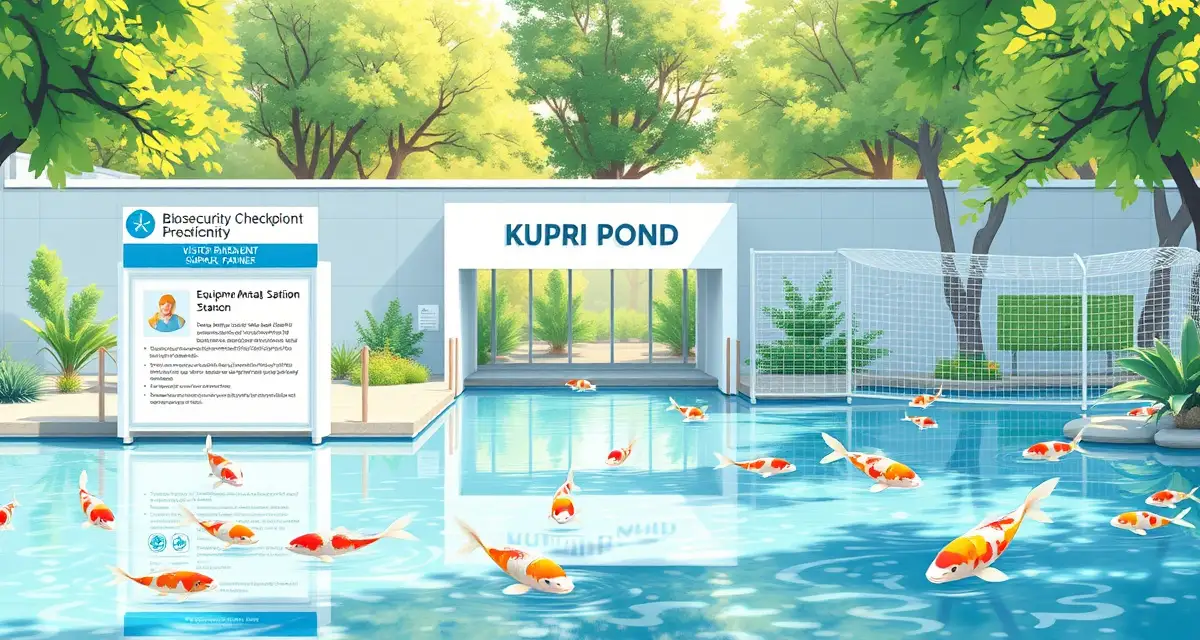
Biosecurity for Koi Collections: Preventing External Disease Introduction
Visitors to koi facilities - including pond equipment vendors - can be disease-second-opinion) vectors. This is the most frequently overlooked biosecurity risk. Most koi keepers understand that new fish require quarantine-after-pond-treatment), but the transmission pathway of a person who has recently been at an infected facility walking to your pond's edge and adjusting equipment with wet hands is real and documented.
KoiQuanta's biosecurity checklist covers all pathogen introduction vectors, not just new fish. No competitor covers biosecurity as a systematic management framework at this level.
TL;DR
- Full biosecurity addresses all pathogen introduction vectors: 1.
- KHV survives in water for up to 4 days at room temperature.
- KHV survives in water for up to 4 days at room temperature.
- Early detection based on parameter trends reduces treatment costs and fish stress.
- Seasonal changes require adjusted monitoring schedules; automated reminders help maintain consistency.
What Biosecurity Actually Means
Biosecurity is the set of practices that prevent pathogens from entering your collection. It's broader than quarantine - quarantine is one component of biosecurity, specifically the component that addresses incoming fish. Full biosecurity addresses all pathogen introduction vectors:
- New fish - the highest-risk vector (managed through quarantine)
- Visitors - people who've been at other fish facilities
- Equipment - nets, buckets, and tools brought from other facilities
- Water - external water sources introduced to your pond
- Wildlife - birds and wildlife that move between water bodies
- Shared assets - ponds or systems shared with other keepers
Each of these pathways requires its own prevention measure. Quarantining new fish while leaving all other pathways unaddressed is partial biosecurity.
Visitor Management
The risk from visitors is not hypothetical. Boots, hands, and clothing wet with pond water from an infected facility can carry viable KHV, Aeromonas, parasites, and other pathogens. KHV survives in water for up to 4 days at room temperature.
Risk categories for visitors:
- High risk: People who have recently (within the same day or previous few days) been at another koi or fish facility, particularly if they've been in contact with fish or pond water
- Medium risk: Regular visitors who keep fish but haven't been at another facility recently
- Low risk: People with no fish or pond contact who visit for non-fish reasons
Practical management for visitors:
For high-risk visitors (other koi keepers, dealers, fish vets visiting other facilities):
- Ask about their recent pond contact before bringing them to your fish
- Provide clean wellington boots or boot covers
- Provide a hand sanitiser or disinfectant wash station before pond access
- Keep them away from the water's edge if equipment access isn't needed
For any visitor:
- Don't allow personal equipment (nets, bags, bowls) brought from outside to contact your water
- Keep the number of hands in your pond water minimal
This may feel overly cautious. The cost of a KHV event puts the inconvenience in perspective.
Equipment Biosecurity
Any piece of equipment that contacts water and is moved between facilities is a potential transmission vector.
High-risk equipment:
- Nets (hold water in the mesh, contact fish directly)
- Buckets and bowls (contain water)
- Aeration equipment (contact water)
- Bags used for fish transport
- Filter equipment
Equipment biosecurity options:
Dedicated equipment: Each pond has its own net, bucket, and relevant equipment that never moves between ponds. This is the cleanest approach. Label equipment to prevent mixing.
Disinfection protocol: For equipment that must move between ponds or between facilities:
- Salt solution immersion (saturated salt, 15 minutes) for salt-tolerant equipment
- Bleach solution (1 part bleach to 9 parts water, 10-15 minutes immersion, thorough rinse) for equipment that won't be damaged by bleach
- Potassium permanganate solution for biological disinfection
- Complete air drying for at least 4-6 hours - most pathogens die on dry surfaces within this period
For equipment brought by visitors from their facilities: don't use it on your fish without disinfecting first, regardless of how clean it looks.
Water Source Biosecurity
External water sources:
- Never introduce water from another keeper's pond to your pond, even in small quantities (like the water in a transport bag)
- If purchasing fish that arrive in bags, tip the bag to acclimatise the fish to your water, then introduce the fish without the bag water
- Water from natural ponds, rivers, or streams contains wild fish parasites and pathogens. Don't use it for your koi pond.
Municipal water:
Municipal tap water is treated and presents low pathogen risk, but must be dechlorinated before use. Chlorine at tap water concentrations is lethal to koi in concentrated exposure.
Rainwater collection:
Generally low pathogen risk. Ensure collection surfaces are clean and that wild birds haven't been contaminating the collection area.
Wildlife Biosecurity
Birds present a real but manageable biosecurity risk:
Herons: Fish-eating birds are a direct predation risk and may carry parasites between water bodies (herons visit multiple ponds). Standard heron protection (netting, pond edge covers) addresses both risks.
Ducks and other waterfowl: Wild ducks can carry Aeromonas and potentially other pathogens. If ducks are landing in your pond, they're a biosecurity concern in addition to the fouling problem.
Wild birds (non-fish eating): Lower risk but not zero. Birds that drink from or bathe in your pond can deposit pathogens from other water bodies.
Amphibians: Frogs and newts use koi ponds as breeding habitat. They move between water bodies and can potentially carry parasite species. This is a low but real pathway.
Wildlife management:
Netting over the pond excludes most wildlife. This is the single measure that provides both predator protection and biosecurity against wildlife vectors simultaneously.
Can a Visiting Person Introduce Disease to My Koi Pond?
Yes, if they've been in contact with fish or pond water at another facility recently and they then contact your pond. The risk is real and has been documented in KHV transmission cases.
The practical question is whether your visitors are the kind who regularly visit other koi facilities (other hobbyists, dealers, vets, or photographers who visit multiple ponds). For a hobbyist whose only visitor is a neighbour who doesn't keep fish, the risk is low. For a dealer or hobbyist who regularly has other koi keepers visiting, the risk is meaningful.
A simple visitor biosecurity protocol - clean boots, hand wash or sanitise before pond access, no external equipment - addresses the risk without excessive burden.
Documenting Biosecurity Practices in KoiQuanta
KoiQuanta's biosecurity checklist covers the major risk vectors. Reviewing the checklist at appropriate intervals (monthly, or after any unusual event like a visitor from a fish facility or an equipment breach) ensures your biosecurity practices are consistently maintained rather than only remembered after an event.
Log any biosecurity events - an unusual visitor, equipment shared with another keeper, a wildlife incident - as notes in KoiQuanta. If a disease event occurs later, these records help identify the probable introduction pathway.
Frequently Asked Questions
How do I prevent disease being introduced to my koi collection?
Implement the full biosecurity framework: quarantine all new fish; manage visitors who've been at other fish facilities with clean boots, hand wash before pond access, and prohibition on external equipment contacting your water; maintain dedicated or disinfected equipment per pond; don't introduce external water sources; protect against wildlife access with netting; and never transfer water from another facility to your pond. Each of these pathways has produced documented disease introductions. Addressing new fish quarantine alone while leaving other pathways open creates a partial system that KHV and other pathogens can still exploit.
What biosecurity measures do professional koi facilities use?
Professional koi facilities typically use: strict visitor policies with boot dips or clean footwear requirements, disinfectant hand stations at pond access points, dedicated equipment per tank or fish room with labelling to prevent mixing, prohibition on visitors' external equipment contacting facility water, pest and wildlife exclusion through netting and physical barriers, water source controls with dechlorination and supply isolation, and biosecurity documentation reviewing what went where and when. The scale of professional biosecurity reflects the cost of a disease outbreak - losing a dealer's entire stock to KHV can represent tens of thousands in losses and reputational damage. Hobbyists with high-value fish benefit from applying similar principles.
Can a visiting person introduce disease to my koi pond?
Yes. KHV survives in water for up to 4 days at room temperature. A person who has been at an infected pond, has pond water on their boots or hands, and then stands at your pond's edge (or puts their hands in your water) is a genuine disease vector. This transmission pathway has been implicated in real-world KHV spread. The risk is proportional to how frequently other koi keepers visit your facility and how recently they've been at other fish facilities. A simple protocol - clean boots, hand wash before pond access, no external equipment contact - manages this risk without significant inconvenience. The cost of implementing it is minutes. The cost of ignoring it if it produces a KHV introduction is the entire collection.
What is Biosecurity for Koi Collections: Preventing External Disease Introduction?
[FAQ_ANSWER_PLACEHOLDER: This answer needs to be generated by AI with specific data, examples, and actionable advice relevant to Biosecurity for Koi Collections: Preventing External Disease Introduction. Target 50-150 words.]
How much does Biosecurity for Koi Collections: Preventing External Disease Introduction cost?
[FAQ_ANSWER_PLACEHOLDER: This answer needs to be generated by AI with specific data, examples, and actionable advice relevant to Biosecurity for Koi Collections: Preventing External Disease Introduction. Target 50-150 words.]
How does Biosecurity for Koi Collections: Preventing External Disease Introduction work?
[FAQ_ANSWER_PLACEHOLDER: This answer needs to be generated by AI with specific data, examples, and actionable advice relevant to Biosecurity for Koi Collections: Preventing External Disease Introduction. Target 50-150 words.]
What are the benefits of Biosecurity for Koi Collections: Preventing External Disease Introduction?
[FAQ_ANSWER_PLACEHOLDER: This answer needs to be generated by AI with specific data, examples, and actionable advice relevant to Biosecurity for Koi Collections: Preventing External Disease Introduction. Target 50-150 words.]
Who needs Biosecurity for Koi Collections: Preventing External Disease Introduction?
[FAQ_ANSWER_PLACEHOLDER: This answer needs to be generated by AI with specific data, examples, and actionable advice relevant to Biosecurity for Koi Collections: Preventing External Disease Introduction. Target 50-150 words.]
How long does Biosecurity for Koi Collections: Preventing External Disease Introduction take?
[FAQ_ANSWER_PLACEHOLDER: This answer needs to be generated by AI with specific data, examples, and actionable advice relevant to Biosecurity for Koi Collections: Preventing External Disease Introduction. Target 50-150 words.]
What should I look for when choosing Biosecurity for Koi Collections: Preventing External Disease Introduction?
[FAQ_ANSWER_PLACEHOLDER: This answer needs to be generated by AI with specific data, examples, and actionable advice relevant to Biosecurity for Koi Collections: Preventing External Disease Introduction. Target 50-150 words.]
Is Biosecurity for Koi Collections: Preventing External Disease Introduction worth it?
[FAQ_ANSWER_PLACEHOLDER: This answer needs to be generated by AI with specific data, examples, and actionable advice relevant to Biosecurity for Koi Collections: Preventing External Disease Introduction. Target 50-150 words.]
Related Articles
- Koi Quarantine Cost vs Disease Loss: Financial Analysis
- What to Do When You Find Disease During Koi Quarantine
- Quarantine Response to an Active Disease Outbreak
Sources
- Associated Koi Clubs of America (AKCA)
- Koi Organisation International (KOI)
- University of Florida IFAS Extension Aquaculture Program
- Fish Vet Group
- Water Quality Association