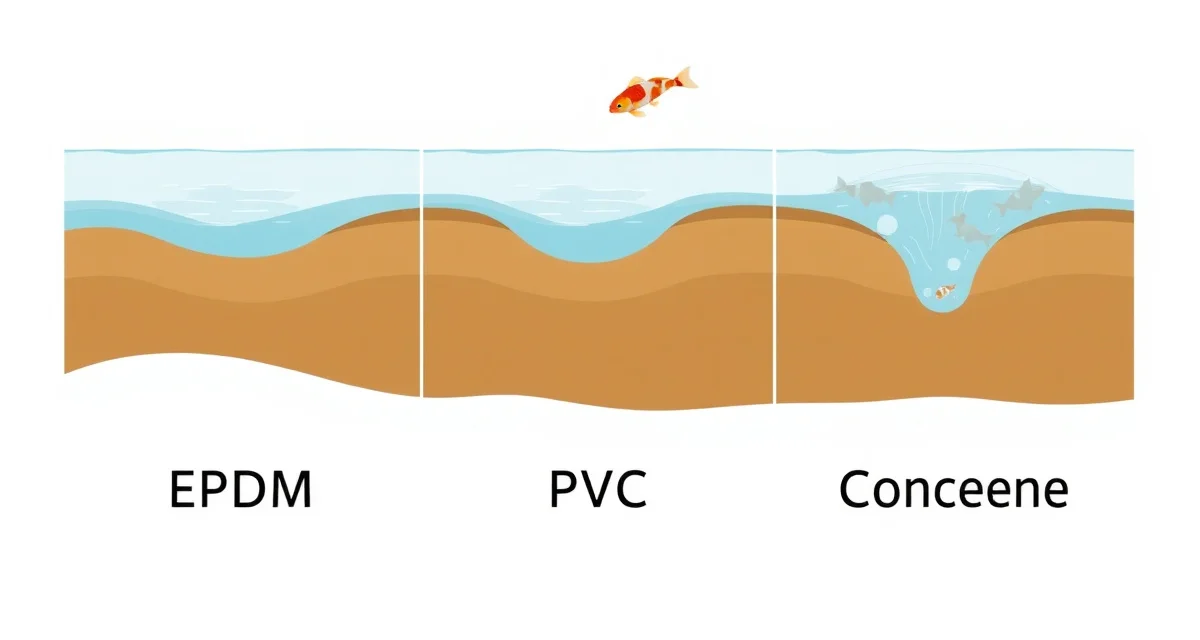
Koi Pond Liner Types: EPDM vs PVC vs Concrete
EPDM rubber liners are the most popular choice for koi ponds due to their flexibility, fish safety, and long service life. But your decision shouldn't end there. Each liner material has real implications for how your pond behaves chemically, how it ages, and how you'll manage it over time.
Your pond liner isn't just a physical barrier. It affects water temperature stability, leaching risk, biological colonization, and the difficulty of cleaning and maintenance. These factors matter enough that the liner choice belongs in your KoiQuanta pond profile as a management context variable.
TL;DR
- It's flexible enough to conform to virtually any pond shape, durable enough to last 20+ years when properly installed, and genuinely fish-safe when you select fish-grade (non-carbon-black) EPDM.
- A good practice is to fill the pond, run it for 48 hours, then do a 50% water change before introducing fish.
- Preformed ponds are available in limited sizes, and the depths available rarely meet the 4-foot minimum that serious koi keepers require for adequate temperature stability and koi comfort.
- It's flexible enough for any shape, durable enough to last 20 or more years, and genuinely safe for fish when you select the correct non-roofing grade.
- After coating, conduct the pH curing cycle: fill the pond, check pH after 48 hours, drain and refill, repeat until pH stabilizes consistently at or below 8.0 for 72+ hours before introducing fish.
EPDM Rubber Liners
EPDM (ethylene propylene diene monomer) rubber is the dominant choice for serious koi keepers. It's flexible enough to conform to virtually any pond shape, durable enough to last 20+ years when properly installed, and genuinely fish-safe when you select fish-grade (non-carbon-black) EPDM.
Key advantages:
- Fish-grade EPDM contains no toxic plasticizers or leaching compounds
- Flexibility means it conforms to irregular shapes without seams
- Remains pliable in cold weather, reducing freeze-crack risk
- Dark color reduces algae growth on liner surface
- Surface texture supports some biological growth without becoming problematic
- 45-mil thickness is standard; 60-mil offers extra durability
What to watch for:
- Must be "fish-safe" certified EPDM, as roofing EPDM contains carbon black and is not safe for koi
- Seams, if required for large ponds, need proper EPDM-specific tape and bonding
- UV exposure at the water surface can degrade liner over time; protect the waterline
EPDM new liners can sometimes cause a brief pH rise during initial fill and operation. A good practice is to fill the pond, run it for 48 hours, then do a 50% water change before introducing fish. KoiQuanta's pond setup guide covers this initial conditioning process in detail.
PVC Liners
PVC (polyvinyl chloride) liners are less expensive than EPDM and adequate for smaller or lower-budget ponds. They're widely available and easy to work with for basic shapes.
Key advantages:
- Lower upfront cost than EPDM
- Available in fish-safe formulations (look for plasticizer-free or food-grade PVC)
- Can be heat-welded for watertight seams on larger installations
- Lighter weight makes installation easier for single-person projects
Significant downsides:
- Less UV resistant than EPDM, degrades faster at the waterline
- Stiffens and becomes brittle in cold weather, increasing crack risk
- Shorter effective lifespan (typically 10-15 years versus 20+ for EPDM)
- Some PVC formulations contain plasticizers that leach into pond water
- Not recommended for ponds in climates with hard freezes
If you use PVC, verify it's fish-safe by checking with the manufacturer, not just the retailer. Cheap PVC pond liners from general hardware stores may not be formulated for aquatic applications.
HDPE Liners
High-density polyethylene (HDPE) is used extensively in commercial aquaculture and large-scale water containment. Some koi dealers and larger hobbyist ponds use HDPE for its durability and chemical inertness.
HDPE is extremely resistant to UV, chemicals, and puncture. It doesn't leach anything into the water. The downside is that it's rigid and doesn't conform to irregular shapes easily, and it requires heat fusion welding for seams, which usually means professional installation. For residential koi ponds with irregular shapes, it's rarely the first choice.
Fiberglass Liners and Preformed Ponds
Preformed fiberglass and plastic pond inserts are common for small-to-medium ponds. They're quick to install, structurally stable, and generally fish-safe.
The main limitation is size and shape. Preformed ponds are available in limited sizes, and the depths available rarely meet the 4-foot minimum that serious koi keepers require for adequate temperature stability and koi comfort. They're a reasonable choice for small feature ponds but not suited to serious collections.
Fiberglass custom-built ponds are another matter. Professional fiberglass construction produces ponds that are extremely durable and easy to clean, with smooth surfaces that don't harbor debris. The cost is significantly higher than liner-built ponds, but the longevity and ease of maintenance can justify it for permanent installations.
Concrete Ponds
Concrete koi ponds have a long history, particularly in traditional Japanese koi keeping. Done correctly, a concrete pond is exceptionally durable and can last decades without liner replacement.
The main challenge with concrete is chemistry. Fresh concrete leaches calcium hydroxide, raising pH dramatically. A new concrete pond must be cured and neutralized before it's safe for fish. The traditional method involves coating with a silicone-based or epoxy pond sealant and then conducting a series of vinegar washes followed by extended fill-and-dump cycles until pH stabilizes.
Concrete considerations:
- Requires proper curing before fish introduction (typically 4-8 weeks minimum)
- Must be sealed to prevent ongoing leaching
- Cracks from ground movement or freeze-thaw cycles can cause rapid water loss
- Cleaning is easier than with flexible liners due to smooth surface
- Excellent for ponds in stable climates without frost risk
Is concrete safe for koi ponds? Yes, once properly sealed and cured. The curing process is where many hobbyists go wrong. Rushing it causes ongoing pH problems and can stress or kill fish even after the pond appears stable.
How Liner Type Affects Water Chemistry
This is why liner type belongs in your KoiQuanta pond profile. Different liner materials create different baseline chemistry behaviors:
- New EPDM may cause brief pH elevation during initial fill
- Fresh concrete leaches aggressively until fully cured
- Old concrete ponds that lose their sealant coating can begin leaching again
- PVC degradation at the waterline can introduce plasticizers
When you record your liner type and installation date, parameter readings have better context. If pH is elevated in a new concrete pond, that's expected. If pH is suddenly elevated in a five-year-old EPDM pond, it warrants investigation.
The koi pond design guide covers how liner choice interacts with all your other pond design decisions.
Frequently Asked Questions
What is the best liner for a koi pond?
Fish-grade EPDM rubber is the most widely recommended liner for koi ponds of all sizes. It's flexible enough for any shape, durable enough to last 20 or more years, and genuinely safe for fish when you select the correct non-roofing grade. For larger ponds requiring formal seaming, HDPE is an alternative with excellent chemical inertness. PVC works for smaller ponds on a budget but degrades faster, particularly in cold climates. The key for any liner is confirming it's manufactured specifically for aquatic use rather than adapted from another application.
Is concrete safe for koi ponds?
Yes, but only after proper curing and sealing. Fresh concrete is highly alkaline and will raise pH to dangerous levels. Before introducing any fish, a concrete pond must be sealed with a fish-safe pond coating and then go through a curing process typically involving vinegar washes and multiple fill-drain cycles over four to eight weeks. Even after curing, concrete ponds should be monitored carefully for pH stability. If the sealant coating fails years later, leaching can resume. Regular pH monitoring through KoiQuanta will catch this early.
How do I seal a concrete koi pond?
Concrete ponds need a dedicated fish-safe pond sealant or epoxy coating to prevent ongoing calcium hydroxide leaching. Popular options include Drylok, Pond Shield, and similar two-part epoxy coatings. Prepare the concrete surface thoroughly by cleaning off any oils or dust, then apply the coating according to manufacturer instructions, typically two coats. After coating, conduct the pH curing cycle: fill the pond, check pH after 48 hours, drain and refill, repeat until pH stabilizes consistently at or below 8.0 for 72+ hours before introducing fish.
What is Koi Pond Liner Types: EPDM vs PVC vs Concrete?
[FAQ_ANSWER_PLACEHOLDER: This answer needs to be generated by AI with specific data, examples, and actionable advice relevant to Koi Pond Liner Types: EPDM vs PVC vs Concrete. Target 50-150 words.]
How much does Koi Pond Liner Types: EPDM vs PVC vs Concrete cost?
[FAQ_ANSWER_PLACEHOLDER: This answer needs to be generated by AI with specific data, examples, and actionable advice relevant to Koi Pond Liner Types: EPDM vs PVC vs Concrete. Target 50-150 words.]
How does Koi Pond Liner Types: EPDM vs PVC vs Concrete work?
[FAQ_ANSWER_PLACEHOLDER: This answer needs to be generated by AI with specific data, examples, and actionable advice relevant to Koi Pond Liner Types: EPDM vs PVC vs Concrete. Target 50-150 words.]
What are the benefits of Koi Pond Liner Types: EPDM vs PVC vs Concrete?
[FAQ_ANSWER_PLACEHOLDER: This answer needs to be generated by AI with specific data, examples, and actionable advice relevant to Koi Pond Liner Types: EPDM vs PVC vs Concrete. Target 50-150 words.]
Who needs Koi Pond Liner Types: EPDM vs PVC vs Concrete?
[FAQ_ANSWER_PLACEHOLDER: This answer needs to be generated by AI with specific data, examples, and actionable advice relevant to Koi Pond Liner Types: EPDM vs PVC vs Concrete. Target 50-150 words.]
How long does Koi Pond Liner Types: EPDM vs PVC vs Concrete take?
[FAQ_ANSWER_PLACEHOLDER: This answer needs to be generated by AI with specific data, examples, and actionable advice relevant to Koi Pond Liner Types: EPDM vs PVC vs Concrete. Target 50-150 words.]
What should I look for when choosing Koi Pond Liner Types: EPDM vs PVC vs Concrete?
[FAQ_ANSWER_PLACEHOLDER: This answer needs to be generated by AI with specific data, examples, and actionable advice relevant to Koi Pond Liner Types: EPDM vs PVC vs Concrete. Target 50-150 words.]
Is Koi Pond Liner Types: EPDM vs PVC vs Concrete worth it?
[FAQ_ANSWER_PLACEHOLDER: This answer needs to be generated by AI with specific data, examples, and actionable advice relevant to Koi Pond Liner Types: EPDM vs PVC vs Concrete. Target 50-150 words.]
Related Articles
- Koi Pond Aeration: How Much Do You Really Need?
- How Deep Does a Koi Pond Need to Be? Minimum Depth by Region
Sources
- Associated Koi Clubs of America (AKCA)
- Koi Organisation International (KOI)
- University of Florida IFAS Extension Aquaculture Program
- Fish Vet Group
- Water Quality Association