Koi Pond Bottom Drain: Why You Need One and How to Install
Ponds without bottom drains accumulate 3-5x more organic sediment than drained ponds. This sediment is the source of persistent water quality problems that no amount of good filtration completely solves -- it decomposes continuously, consuming oxygen and releasing ammonia, nitrate, and phosphate into the water column. A properly installed bottom drain removes waste before it accumulates, at the source, continuously.
No single design element does more for long-term water quality in a koi pond.
TL;DR
- A pond without a bottom drain requires periodic manual vacuuming to remove the sediment that accumulates -- typically 2-4 times per year for heavily stocked ponds.
- Cutting through the liner (or excavating for concrete ponds) at the drain location 3.
- Installing the drain fitting with appropriate waterproofing (liner ponds require careful sealing around the drain fitting) 4.
- Running the drain pipe to the filter system 5.
- Ponds without bottom drains accumulate 3-5x more organic sediment than drained ponds, creating persistent water quality problems that require repeated manual vacuuming.
- For ponds 5,000-10,000 gallons, two drains improve floor coverage.
- Above 10,000 gallons or in irregular-shaped ponds, two or more drains are typically needed so no area of the pond floor is more than 5-6 feet from a drain.
What a Bottom Drain Does
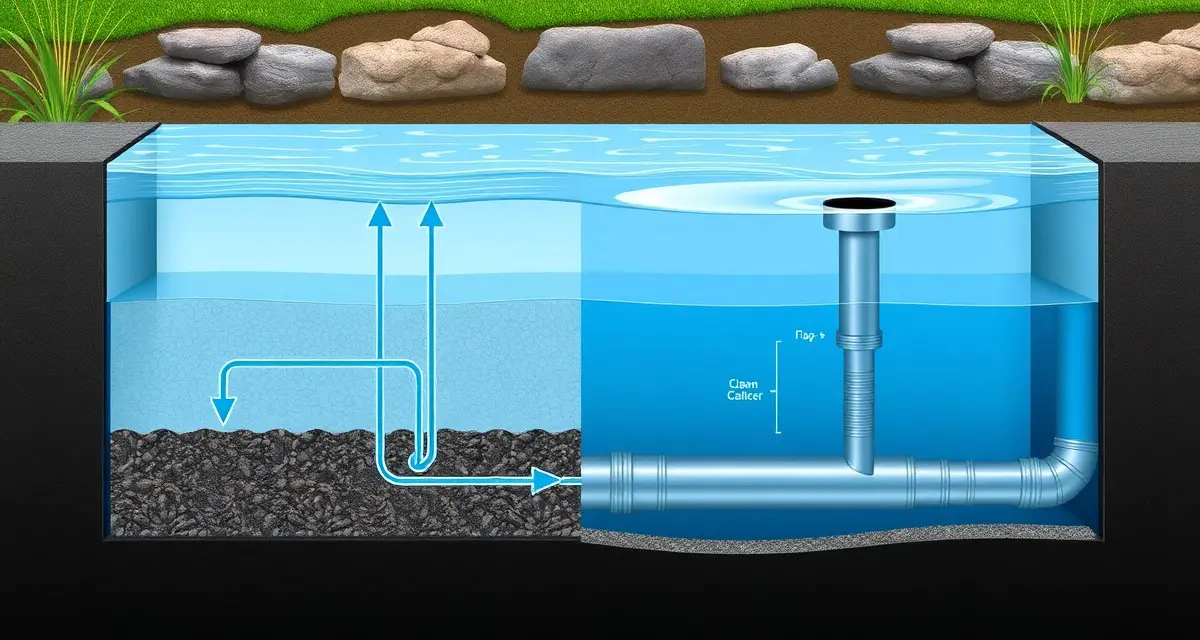
A bottom drain is a drainage point at the lowest point of the pond floor, connected to your filtration system. The principle is simple: waste sinks to the bottom, the drain removes water from the bottom, and that waste-laden water goes to your mechanical filter before it returns to the pond.
The continuous withdrawal of bottom water means:
- Organic waste is removed before it fully decomposes and releases pollutants
- The pond maintains better oxygen distribution (stratification is reduced)
- Dead spots of stagnant, anaerobic water are eliminated
- Filter media stays cleaner because coarser solids arrive at the filter in larger, easier-to-remove form
A pond with a properly positioned bottom drain and appropriate flow characteristics essentially cleans itself of bottom sediment continuously. A pond without a bottom drain requires periodic manual vacuuming to remove the sediment that accumulates -- typically 2-4 times per year for heavily stocked ponds.
KoiQuanta's pond profiles record bottom drain configuration for troubleshooting. When water quality problems arise, knowing your pond's drain setup (position, number, flow rate through the drain) helps identify whether poor drain coverage is contributing to sediment accumulation.
Why Does a Koi Pond Need a Bottom Drain?
Beyond sediment removal, the bottom drain serves several additional functions:
Stratification prevention: Without circulation from the bottom, temperature stratification can develop in deeper ponds -- a warm upper layer and a cooler, potentially anaerobic lower layer. Bottom drain circulation mixes these layers, maintaining consistent temperature and oxygen throughout.
Emergency drainage: The bottom drain provides a controlled way to drain the pond for maintenance, cleaning, or emergency situations without having to use an external pump at the surface.
Pond health documentation: KoiQuanta uses pond drain configuration when calculating effective treatment volumes and when assessing water circulation patterns in troubleshooting scenarios.
How Many Bottom Drains Do I Need?
This depends on pond size and shape. The general rule:
- Ponds up to 5,000 gallons: One properly positioned bottom drain is typically adequate
- Ponds 5,000-10,000 gallons: Two bottom drains improve coverage
- Ponds over 10,000 gallons: Two or more drains, positioned to ensure no area of the pond floor is more than 5-6 feet from a drain
Positioning matters more than quantity. A single drain centered in a round pond covers the floor well because koi activity and water circulation push waste toward the center. An offset drain in a rectangular pond may leave one end poorly serviced.
For multi-basin ponds or ponds with irregular shapes, each distinct basin should have its own drain.
Bottom Drain Types
Gravity-fed drains: The pond floor is positioned above the filtration system, and waste flows by gravity. This is the ideal arrangement if your site allows it. Gravity-fed systems are reliable, low-maintenance, and don't depend on pump operation to function.
Bottom drain with pump return: If gravity flow isn't possible because the filter is at the same level as the pond, a dedicated pump draws water from the bottom drain to the filter. Ensure the pump is sized to move adequate flow -- typically the pond volume should be turned over once per hour through the bottom drain for good sediment removal.
Anti-vortex bottom drains: Some designs include anti-vortex covers that create a smooth, even draw across the drain area without creating a strong suction point that could trap fish. These are preferred for ponds where koi might spend time near the bottom drain area.
Can I Add a Bottom Drain to an Existing Koi Pond?
Yes, though it's more work than including one in the original build. The process involves:
- Draining the pond completely
- Cutting through the liner (or excavating for concrete ponds) at the drain location
- Installing the drain fitting with appropriate waterproofing (liner ponds require careful sealing around the drain fitting)
- Running the drain pipe to the filter system
- Refilling and checking for leaks
For liner ponds, proper sealing of the liner penetration is critical -- a poor seal is a slow leak that can undermine the pond structure. Use a proper liner bonding kit and give it adequate cure time before refilling.
Rubber (EPDM) liner ponds are more amenable to retrofitting a bottom drain than rigid-shell ponds. Concrete ponds require core drilling and are best done by a professional.
For the complete pond setup framework including filtration selection and pump sizing, the koi pond setup guide covers all design elements together. For filtration system design that connects to your bottom drain, the koi pond filtration guide covers the full system.
Frequently Asked Questions
Why does a koi pond need a bottom drain?
A bottom drain continuously removes organic waste from the pond floor before it decomposes and releases ammonia, nitrate, and phosphate into the water. Ponds without bottom drains accumulate 3-5x more organic sediment than drained ponds, creating persistent water quality problems that require repeated manual vacuuming. The drain also prevents temperature stratification by maintaining circulation through the full pond depth and provides an emergency drainage point for maintenance. It's the most cost-effective water quality investment in pond design.
Can I add a bottom drain to an existing koi pond?
Yes. The process requires draining the pond, cutting through the liner at the drain location, installing the drain fitting with proper waterproofing, and running a pipe to the filter. For liner ponds, proper sealing of the liner penetration is critical to prevent leaks -- use appropriate liner bonding products and allow adequate cure time before refilling. Concrete ponds require core drilling and are more complex to retrofit. The disruption is worth it for a pond you intend to run long-term, as the ongoing water quality benefit is substantial.
How many bottom drains do I need for my koi pond?
One properly positioned drain handles most ponds up to 5,000 gallons. For ponds 5,000-10,000 gallons, two drains improve floor coverage. Above 10,000 gallons or in irregular-shaped ponds, two or more drains are typically needed so no area of the pond floor is more than 5-6 feet from a drain. Positioning matters as much as quantity -- a centered drain in a round pond is more effective than an offset drain in a rectangular pond that leaves one end unserviced.
What is Koi Pond Bottom Drain: Why You Need One and How to Install?
[FAQ_ANSWER_PLACEHOLDER: This answer needs to be generated by AI with specific data, examples, and actionable advice relevant to Koi Pond Bottom Drain: Why You Need One and How to Install. Target 50-150 words.]
How much does Koi Pond Bottom Drain: Why You Need One and How to Install cost?
[FAQ_ANSWER_PLACEHOLDER: This answer needs to be generated by AI with specific data, examples, and actionable advice relevant to Koi Pond Bottom Drain: Why You Need One and How to Install. Target 50-150 words.]
How does Koi Pond Bottom Drain: Why You Need One and How to Install work?
[FAQ_ANSWER_PLACEHOLDER: This answer needs to be generated by AI with specific data, examples, and actionable advice relevant to Koi Pond Bottom Drain: Why You Need One and How to Install. Target 50-150 words.]
What are the benefits of Koi Pond Bottom Drain: Why You Need One and How to Install?
[FAQ_ANSWER_PLACEHOLDER: This answer needs to be generated by AI with specific data, examples, and actionable advice relevant to Koi Pond Bottom Drain: Why You Need One and How to Install. Target 50-150 words.]
Who needs Koi Pond Bottom Drain: Why You Need One and How to Install?
[FAQ_ANSWER_PLACEHOLDER: This answer needs to be generated by AI with specific data, examples, and actionable advice relevant to Koi Pond Bottom Drain: Why You Need One and How to Install. Target 50-150 words.]
How long does Koi Pond Bottom Drain: Why You Need One and How to Install take?
[FAQ_ANSWER_PLACEHOLDER: This answer needs to be generated by AI with specific data, examples, and actionable advice relevant to Koi Pond Bottom Drain: Why You Need One and How to Install. Target 50-150 words.]
What should I look for when choosing Koi Pond Bottom Drain: Why You Need One and How to Install?
[FAQ_ANSWER_PLACEHOLDER: This answer needs to be generated by AI with specific data, examples, and actionable advice relevant to Koi Pond Bottom Drain: Why You Need One and How to Install. Target 50-150 words.]
Is Koi Pond Bottom Drain: Why You Need One and How to Install worth it?
[FAQ_ANSWER_PLACEHOLDER: This answer needs to be generated by AI with specific data, examples, and actionable advice relevant to Koi Pond Bottom Drain: Why You Need One and How to Install. Target 50-150 words.]
Related Articles
Sources
- Associated Koi Clubs of America (AKCA)
- Koi Organisation International (KOI)
- University of Florida IFAS Extension Aquaculture Program
- Fish Vet Group
- Water Quality Association