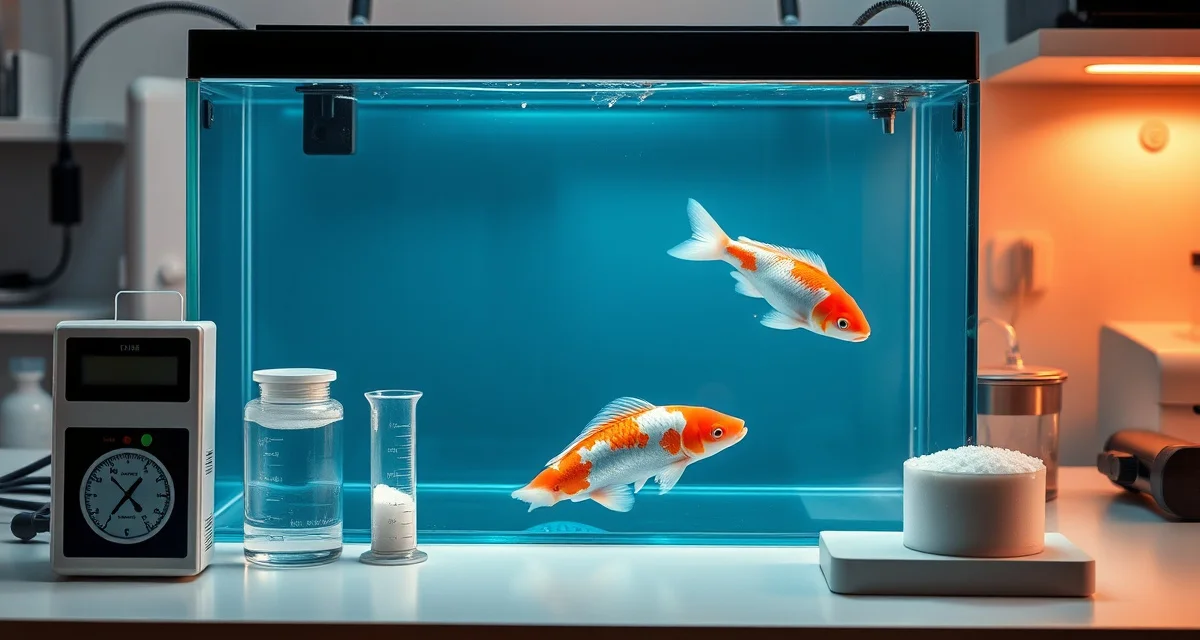
Salt Treatment During Koi Quarantine: Doses, Timing, and Safety
Incorrect salt dosing causes osmotic shock and kills more koi than the parasites it was meant to treat. This happens specifically when a keeper adds a large dose in a single addition, or when they add a "standard" dose without accounting for salt already in the water from a previous partial treatment or prior water changes. The fish were already weakened from transport, and the osmotic shock from a sudden salt concentration spike was the final insult.
Salt treatment during quarantine works. But dose, timing, and method all matter.
TL;DR
- Adding low-level salt to the water (0.1%) reduces the osmotic gradient, making it easier for the fish to maintain internal salt balance.
- If nitrite rises during quarantine (common in tanks with immature biofilters), salt at 0.1-0.3% competes with nitrite for gill uptake and reduces toxic nitrite absorption.
- Here's what goes wrong without it: Day 3: You add 0.1% salt to your quarantine tank.
- Then on day 10, you do a 20% water change but don't account for the salt removed.
- You add another 0.1% dose on top of the remaining salt.
- Your actual concentration is now 0.18%, higher than intended.
- Day 15, you decide to increase to 0.3% for parasite treatment.
Why Salt Is Used in Koi Quarantine
Salt (sodium chloride, NaCl) serves multiple functions in koi quarantine:
Osmoregulatory support: Koi lose body salts continuously through their gills to the surrounding freshwater. This is normal and they manage it through active osmoregulation. When a koi is stressed, injured, or ill, this osmoregulatory effort consumes energy that should be going toward immune function and healing. Adding low-level salt to the water (0.1%) reduces the osmotic gradient, making it easier for the fish to maintain internal salt balance. This reduces physiological load and supports recovery.
Parasite suppression: At 0.3-0.5%, salt inhibits or kills many ectoparasites by disrupting their osmotic balance. Parasites lack the osmoregulatory mechanisms that allow fish to survive saline conditions. Salt at these concentrations is toxic to many free-swimming parasite stages (theronts, free-swimming trichodinids, Costia).
Gill protection: Salt reduces the toxic uptake of nitrite at the gill surface. If nitrite rises during quarantine (common in tanks with immature biofilters), salt at 0.1-0.3% competes with nitrite for gill uptake and reduces toxic nitrite absorption.
Mucus coat support: Salt supports mucus coat integrity, which is the fish's first physical barrier against bacterial and fungal infection.
The Dose Calculator Approach
Dose calculator accounts for existing salt concentration so you never accidentally overdose stressed fish. This principle is why a salt dose calculator isn't just a convenience. It's a safety tool.
Here's what goes wrong without it:
Day 3: You add 0.1% salt to your quarantine tank. Then on day 10, you do a 20% water change but don't account for the salt removed. You add another 0.1% dose on top of the remaining salt. Your actual concentration is now 0.18%, higher than intended.
Day 15, you decide to increase to 0.3% for parasite treatment. But you're calculating from your target concentration, not your actual starting concentration, which is already 0.18%. You add a full 0.3% addition on top of 0.18%, reaching 0.48%.
Your fish are showing stress. You interpret this as the parasites getting worse. Actually, you've just delivered near-overdose osmotic shock to a compromised fish.
KoiQuanta's salt dose calculator calculates the incremental salt needed to reach your target concentration from your current level, preventing this scenario. You enter current estimated concentration, target concentration, and tank volume. It tells you exactly how much to add.
Choosing the Right Salt
Use: Non-iodized sodium chloride (NaCl). The labels "pond salt," "aquarium salt," or "kosher salt" are appropriate. Pure NaCl.
Don't use:
- Table salt with iodine (iodine is toxic to beneficial bacteria and can stress fish)
- Road salt or de-icing salt (contains additives)
- Sea salt or marine salt mixes (contain many additional minerals at concentrations that can harm freshwater fish)
- "Low sodium" salt substitutes (these contain potassium chloride, which has different and potentially harmful effects on fish)
Salt Concentration Reference
Salt concentrations are measured as percentage weight/volume: 1% = 10 grams of salt per liter of water.
In practical pond terms:
- 0.1% = 1.33 lbs of salt per 100 gallons
- 0.2% = 2.67 lbs per 100 gallons
- 0.3% = 4 lbs per 100 gallons (approximately 1 tablespoon per 5 gallons as a rough estimate)
- 0.5% = 6.67 lbs per 100 gallons
For exact additions based on your specific tank volume and starting concentration, use the koi salt dose calculator.
Quarantine Salt Protocol: Step by Step
Days 1-2: No Salt
Fish have just arrived. The immediate priority is temperature matching and minimal disturbance. Adding salt immediately adds one more variable to an already stressed fish. Wait for the fish to settle.
Day 3: Raise to 0.1%
After 48 hours of observation and once the fish are clearly alive, mobile, and not in acute distress:
- Dissolve the calculated amount of salt in a bucket of tank water (never add dry salt directly. It settles and creates a concentrated layer that osmotically burns fish that swim through it)
- Pour the dissolved salt around the perimeter of the tank slowly, over 60 minutes if possible
- If your tank doesn't have a timer system, distribute the addition over the day in 2-3 portions
Days 4-5: Raise to 0.2%
If fish are not showing osmotic stress signs (see below), raise salt to 0.2% in the same incremental manner.
Day 7 or When Needed: Raise to 0.3% for Treatment
If active parasites are confirmed, or as prophylactic protection for high-risk fish, raise to 0.3%. At this concentration, most common koi ectoparasites experience osmotic stress and die off.
This addition should be done over 24 hours. A 0.1% increase per day is the safe maximum for stressed fish.
Maintenance and Water Change Adjustment
Every water change removes salt from the tank. If you change 25% of the water in a tank at 0.3% salt:
- You've removed 25% of the salt
- You need to add 25% of the original dose back to maintain 0.3%
- For a 300-gallon tank at 0.3%: the original dose was approximately 12 lbs. A 25% water change removes 3 lbs equivalent, so add back 3 lbs of dissolved salt with the replacement water.
KoiQuanta's water change logging tracks salt adjustments automatically when you log water changes and current salt concentration.
Recognizing Osmotic Stress
If you add too much salt too fast, fish show:
- Gasping at the surface (acute osmotic stress disrupts gill function)
- Loss of balance or listing
- Sudden inactivity after previously normal behavior
- Excess mucus production (visible as slimy appearance or trailing mucus)
If you see these signs after a salt addition:
- Do an immediate 25-30% water change with unsalted dechlorinated water
- Test salt concentration if you have a refractometer or conductivity meter
- Do not add more salt until fish recover
- Re-approach the salt dosing more slowly on subsequent attempts
How Long to Maintain Salt Treatment
The standard quarantine protocol:
- Day 3 to end of quarantine: Maintain salt at the therapeutic level (0.2-0.3% for parasite suppression)
- Days 25-30: Gradually reduce salt concentration through water changes if your main pond isn't salted
- Before discharge: Ensure salt concentration matches or is close to the receiving pond
Don't abruptly zero out salt concentration before moving fish. The osmotic shift in reverse can stress fish the same way an abrupt addition does.
If your main pond runs with a permanent low-level salt (0.1-0.2%), the transition is easier. Just match the quarantine tank to the pond concentration before moving fish.
The KoiQuanta Salt Tracking System
KoiQuanta's quarantine timeline integrates with the 30-day koi quarantine program to:
- Log each salt addition with concentration, date, and amount
- Calculate cumulative concentration after each addition and each water change
- Alert when a water change would drop concentration below the therapeutic level
- Show salt treatment history on the fish's health timeline
When you log a water change, KoiQuanta asks whether you adjusted salt concentration and updates the running concentration estimate. This eliminates the manual tracking error that leads to the overdose scenarios described above.
Related Articles
FAQ
How much salt should I add to a quarantine tank?
The target quarantine concentration for parasite suppression is 0.2-0.3%. For a 300-gallon quarantine tank at 0.3%, you need approximately 12 lbs (5.4 kg) of non-iodized pond salt. Always calculate from your current concentration, not from zero. If you've already added any salt and done water changes, your starting point isn't zero. Use the KoiQuanta salt calculator or the salt dose calculator, which accounts for existing concentration, to get the correct incremental addition.
Can I use table salt for koi quarantine?
Only if it's non-iodized table salt (pure sodium chloride). Iodized table salt contains iodine in forms that are harmful to beneficial bacteria and can stress fish at aquarium salt concentrations. Check the label. Many table salts have iodine added. Non-iodized kosher salt is often a practical and pure alternative. In the UK, specifically avoid salt with anti-caking agents that contain harmful compounds. Pond salt sold specifically for fish ponds is the safest and most reliable option because it's sold in sufficient quantities for the dose sizes koi require.
How long should I maintain salt treatment?
Maintain therapeutic salt concentration (0.2-0.3%) for the duration of the active quarantine period, typically 30 days. In the final 3-5 days before discharge, gradually reduce salt concentration through water changes if the receiving pond is not salted. Don't stop suddenly. If your main pond maintains low-level permanent salt, match the quarantine tank to the pond concentration before moving fish. The key principle is gradual change. Rapid concentration shifts, up or down, cause osmotic stress.
What is Salt Treatment During Koi Quarantine: Doses, Timing, and Safety?
Salt treatment during koi quarantine involves adding sodium chloride to the quarantine tank at controlled concentrations (typically 0.1%–0.3%) to support fish health during the high-stress isolation period. It reduces the osmotic gradient across gill membranes, eases the burden on weakened fish, and helps block nitrite absorption when biofilters are immature. The key variables—dose, timing, and addition method—must be carefully managed to avoid osmotic shock, which can be fatal.
How much does Salt Treatment During Koi Quarantine: Doses, Timing, and Safety cost?
Salt treatment during koi quarantine has no direct monetary cost beyond the price of plain, non-iodized salt, which is inexpensive and widely available. The real cost is measured in precision: incorrect dosing, failure to account for salt remaining after water changes, or adding too much too quickly can cause osmotic shock and kill fish. The investment required is attention to water volume, existing salt levels, and a careful, gradual addition method.
How does Salt Treatment During Koi Quarantine: Doses, Timing, and Safety work?
Salt treatment works by raising the salinity of the quarantine tank water to reduce the osmotic difference between the fish's body fluids and its environment. Koi in freshwater constantly lose salt and must work hard to maintain internal balance. Adding salt at 0.1% eases this effort, helping stressed or transport-weakened fish conserve energy. At 0.1%–0.3%, salt also competes with nitrite at the gill surface, reducing toxic nitrite uptake during the critical early quarantine period.
What are the benefits of Salt Treatment During Koi Quarantine: Doses, Timing, and Safety?
The primary benefits of salt treatment during koi quarantine include reduced osmotic stress on newly arrived fish, improved survival rates during the vulnerable post-transport window, and lower nitrite toxicity if the biofilter is not yet fully established. When dosed and tracked correctly, salt creates a more stable internal environment for the fish, giving the immune system capacity to respond to pathogens rather than spending energy on basic osmoregulation.
Who needs Salt Treatment During Koi Quarantine: Doses, Timing, and Safety?
Any koi keeper who uses a quarantine tank—especially for newly purchased or transported fish—should understand salt treatment protocol. It is particularly important for hobbyists running quarantine tanks with immature biofilters, where nitrite spikes are common. Keepers who perform partial water changes during treatment must also track cumulative salt levels carefully. Without accounting for salt already present in the water, additional doses can push concentration dangerously high and cause osmotic shock.
Sources
- Associated Koi Clubs of America (AKCA)
- Koi Organisation International (KOI)
- University of Florida IFAS Extension Aquaculture Program
- Fish Vet Group
- Water Quality Association