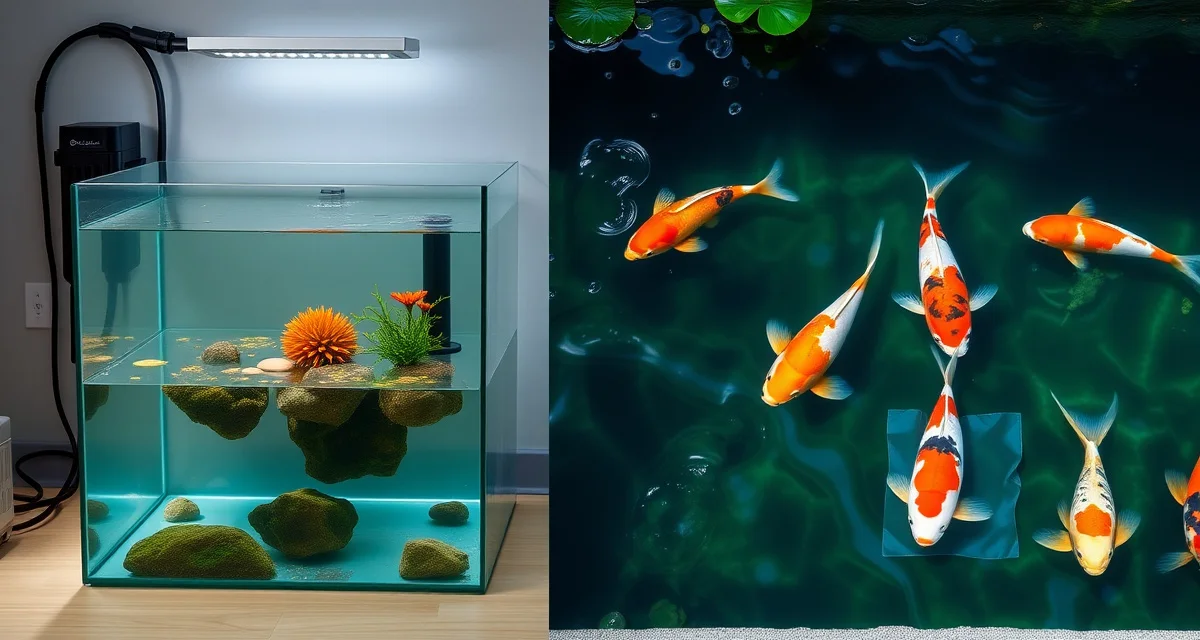
Quarantine Tank vs Display Pond: Key Differences Explained
Display ponds often buffer parameter swings that quarantine tanks cannot. It's one of the most misunderstood dynamics in koi keeping - people expect their quarantine tank to behave like their mature pond, and when it doesn't, they make decisions that compromise the fish.
These are two different tools, built for different purposes. Managing them the same way is a mistake.
TL;DR
- Your quarantine tank's filter needs to be: 1.
- Know what your filter can handle and plan accordingly 3.
- If you'd keep 10 nisai in 2,000 gallons display, keep no more than 10 nisai in 1,000 gallons quarantine - and that's still a reasonably dense quarantine setup.
- You can see a fish clearly in a 300-gallon bare-bottom tank with good lighting.
- You can't isolate new fish from your established population 2.
- Treating a display pond to address a new fish's potential parasites exposes your healthy fish to medication stress 3.
- Your display pond's large water volume makes accurate dosing very difficult 4.
The Core Difference: Purpose Drives Design
A display pond is a long-term home. It's designed for stability, aesthetic value, and the wellbeing of fish you plan to keep for years. It benefits from large water volume, mature biological filtration, established plant systems, and the chemical buffering that comes with organic load and substrate.
A quarantine tank is a controlled observation and treatment environment. It needs to be easy to medicate, easy to observe, easy to clean, and completely isolated from your main system. Stability is still important, but flexibility matters more.
When you try to use one for the other - quarantine in the display pond, or run a quarantine tank like a mini display pond - you compromise both systems.
Water Chemistry Targets: Side by Side
| Parameter | Display Pond | Quarantine Tank |
|-----------|-------------|-----------------|
| Temperature | Ambient/seasonal | 65-68°F controlled |
| pH | 7.0-8.0 | 7.2-7.6 (tighter range) |
| Ammonia | 0 ppm | 0 ppm (harder to maintain) |
| Nitrite | 0 ppm | 0 ppm |
| KH | 80-200 ppm | 100-150 ppm (minimum) |
| Salinity | Optional | 0.3-0.5% during treatment |
| Nitrate | Under 40 ppm | Under 20 ppm (lower threshold) |
Why the quarantine tank needs tighter management:
A 5,000-gallon display pond with mature substrate and plant filtration has enormous buffering capacity. A 300-gallon quarantine tank does not. A missed water change or a spike in feeding in a quarantine tank can produce an ammonia spike that you'd never see in a large display system. And ammonia in quarantine - at the exact moment fish are already stressed from transport - is genuinely dangerous.
The lower nitrate threshold in quarantine matters too. Chronically elevated nitrate suppresses immune function. Fish in quarantine are already immunologically challenged from transport stress. Keep koi pond water quality tracker higher than you'd tolerate in a display system.
Filtration Approach
Your display pond likely runs a substantial filter system - multi-chamber, bead filter or drum filter, UV sterilizer, large biological load. That filter handles continuous bioload from established fish over years.
Your quarantine tank's filter needs to be:
- Established but not permanent - you want biological filtration, but the filter should be something you can sanitize between batches, not a fixed plumbed system
- Treatment-tolerant - salt treatment, and some medications, will kill nitrifying bacteria. Know what your filter can handle and plan accordingly
- Seeded from your established pond - take filter media from your display system to jump-start the quarantine tank's nitrogen cycle
UV sterilizers in quarantine tanks are optional but useful. They reduce ambient pathogen load between treatments. Turn off the UV before adding any dye-based treatments (malachite green, methylene blue) - UV will degrade them before they work.
Stocking Density
Display ponds can handle higher stocking densities because of their water volume, mature filtration, and stable chemistry.
In quarantine, cut your stocking density in half. If you'd keep 10 nisai in 2,000 gallons display, keep no more than 10 nisai in 1,000 gallons quarantine - and that's still a reasonably dense quarantine setup.
The reasons: overcrowded quarantine tanks spike ammonia faster, stressed fish compete more, and disease spreads faster in dense groups.
Treatment Protocols
This is where the differences are most critical.
In a display pond:
- Treating is harder because of water volume and the presence of plants, substrate, and non-target organisms
- Many medications (copper, formalin at standard doses, potassium permanganate) can affect plants, invertebrates, and filter bacteria
- Residue removal after treatment is difficult
- You're treating the whole pond even if only one fish is sick
In a quarantine tank:
- You can dose precisely and consistently
- You can remove and replace the entire water volume if needed
- You're not risking your display fish or your established ecosystem
- You can restart after a treatment failure without contaminating your main system
Never treat display ponds unless you have no other option. The quarantine tank is where treatment happens. That's the whole point.
Observation Quality
You can't see a 30-inch kohaku clearly in a 6,000-gallon pond with three feet of depth and green water. You can see a fish clearly in a 300-gallon bare-bottom tank with good lighting.
Quarantine tanks give you observation quality you can't replicate in a display setting. You can check for lesions, watch swimming posture, observe fin position, see if a fish is eating - all the things that tell you whether a quarantine is going well or whether a fish needs intervention.
Keep the quarantine tank bare-bottom and well-lit specifically for this reason.
Can You Use a Display Pond as Quarantine Space?
No, for several reasons:
- You can't isolate new fish from your established population
- Treating a display pond to address a new fish's potential parasites exposes your healthy fish to medication stress
- Your display pond's large water volume makes accurate dosing very difficult
- If a new fish introduces disease, you've infected your whole system
A quarantine tank doesn't need to be elaborate or expensive. An IBC tote, a 300-gallon stock tank, or a purpose-built fiberglass vat all work. The key is that it's completely separate from your display system.
Related Articles
- Quarantine After Whole-Pond Disease Treatment-after-pond-treatment)
- New Koi Pond Cycling: The Nitrogen Cycle Explained
FAQ
What is Quarantine Tank vs Display Pond: Key Differences Explained?
[FAQ_ANSWER_PLACEHOLDER: This answer needs to be generated by AI with specific data, examples, and actionable advice relevant to Quarantine Tank vs Display Pond: Key Differences Explained. Target 50-150 words.]
How much does Quarantine Tank vs Display Pond: Key Differences Explained cost?
[FAQ_ANSWER_PLACEHOLDER: This answer needs to be generated by AI with specific data, examples, and actionable advice relevant to Quarantine Tank vs Display Pond: Key Differences Explained. Target 50-150 words.]
How does Quarantine Tank vs Display Pond: Key Differences Explained work?
[FAQ_ANSWER_PLACEHOLDER: This answer needs to be generated by AI with specific data, examples, and actionable advice relevant to Quarantine Tank vs Display Pond: Key Differences Explained. Target 50-150 words.]
What are the benefits of Quarantine Tank vs Display Pond: Key Differences Explained?
[FAQ_ANSWER_PLACEHOLDER: This answer needs to be generated by AI with specific data, examples, and actionable advice relevant to Quarantine Tank vs Display Pond: Key Differences Explained. Target 50-150 words.]
Who needs Quarantine Tank vs Display Pond: Key Differences Explained?
[FAQ_ANSWER_PLACEHOLDER: This answer needs to be generated by AI with specific data, examples, and actionable advice relevant to Quarantine Tank vs Display Pond: Key Differences Explained. Target 50-150 words.]
How long does Quarantine Tank vs Display Pond: Key Differences Explained take?
[FAQ_ANSWER_PLACEHOLDER: This answer needs to be generated by AI with specific data, examples, and actionable advice relevant to Quarantine Tank vs Display Pond: Key Differences Explained. Target 50-150 words.]
What should I look for when choosing Quarantine Tank vs Display Pond: Key Differences Explained?
[FAQ_ANSWER_PLACEHOLDER: This answer needs to be generated by AI with specific data, examples, and actionable advice relevant to Quarantine Tank vs Display Pond: Key Differences Explained. Target 50-150 words.]
Is Quarantine Tank vs Display Pond: Key Differences Explained worth it?
[FAQ_ANSWER_PLACEHOLDER: This answer needs to be generated by AI with specific data, examples, and actionable advice relevant to Quarantine Tank vs Display Pond: Key Differences Explained. Target 50-150 words.]
Sources
- Associated Koi Clubs of America (AKCA)
- Koi Organisation International (KOI)
- University of Florida IFAS Extension Aquaculture Program
- Fish Vet Group
- Water Quality Association