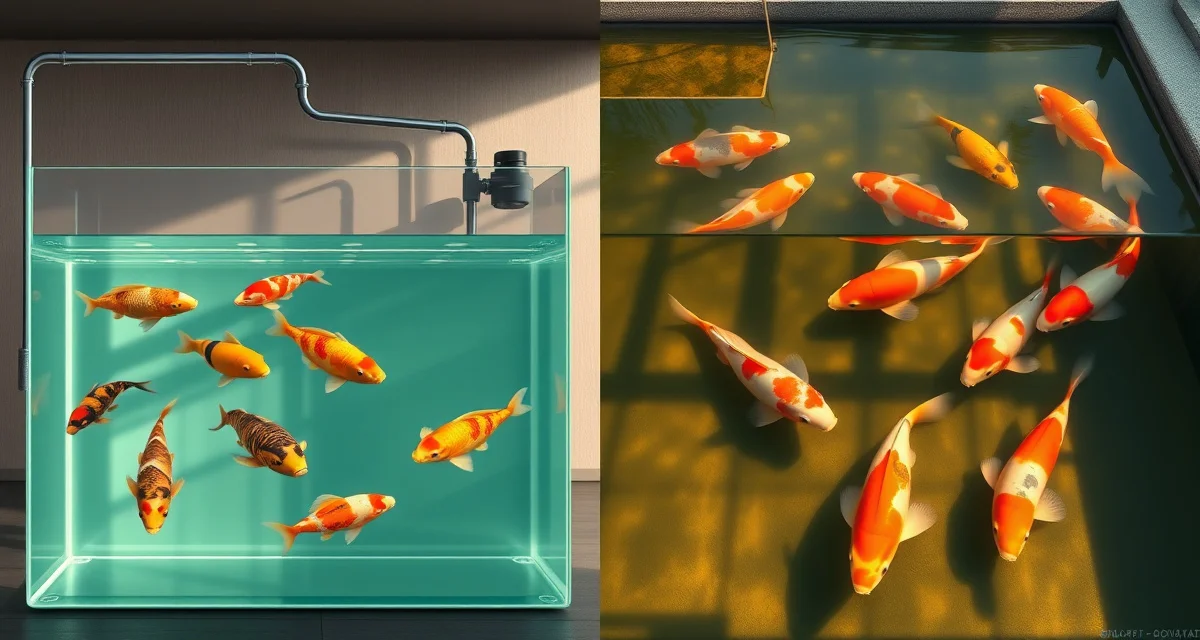
Quarantine in a Pond vs Tank: Pros and Cons
Some keepers don't have indoor quarantine tanks. Their setup is a permanent display pond-after-pond-treatment), and when they get new fish they want to know if an outdoor quarantine pond can fill that role.
The short answer: it can, but it's harder to manage correctly than a tank, and several common quarantine treatments become more difficult or less effective in a pond environment.
Here's the full comparison.
TL;DR
- A 1,500-gallon outdoor pond has temperature driven by ambient conditions, a bioload that fluctuates based on wildlife, algae, and organic debris, and a volume that varies with evaporation and rainfall.
- It's harder to hold at 65–68°F for KHV monitoring.
- A 10% volume error means a 10% dose error.
- A ulcer developing on a fish's flank that you'd catch on day 3 in a tank might not be visible for two weeks in a pond.
- A purpose-built quarantine pond at 2,000+ gallons is a better environment for very large fish.
- In a 2,000-gallon outdoor pond, the quantity required, the oxygen depletion risk, and the difficulty of maintaining concentration in a flowing system makes formalin treatment significantly more complex.
- A 2-inch rain event on a 2,000-gallon pond adds roughly 2,500 gallons - dropping your salt concentration by about 55%.
What Makes Tank Quarantine Easier
Parameter Control
A 300-gallon tank has stable, controllable chemistry. You heat it with a submersible heater, you manage ammonia with water changes, and you know exactly what volume you're treating when you add medications.
A 1,500-gallon outdoor pond has temperature driven by ambient conditions, a bioload that fluctuates based on wildlife, algae, and organic debris, and a volume that varies with evaporation and rainfall. It's harder to hold at 65–68°F for KHV monitoring. It's harder to maintain precise salt concentrations with rainfall dilution.
Treatment Precision
Treatment dose calculations are based on known volume. In a quarantine tank, you filled it yourself and you know the volume.
In an outdoor pond - even a small one - you may be less certain of the actual volume, especially if it's irregular in shape or the water level has varied. A 10% volume error means a 10% dose error. At the doses used for potassium permanganate, that margin matters.
Disease Containment
A bare-bottom tank is easy to sanitize between batches. A pond has substrate, plant material, biofilm on every surface, and in most cases a developed ecosystem that pathogen populations can persist in.
If a batch of fish in a quarantine pond has flukes, the flukes' eggs are now in the pond substrate and water. Treating successfully doesn't mean the pond is safe for the next batch - the lifecycle stages in the environment may still be present.
Observation Quality
In a clear-sided tank, you can observe fish from multiple angles, see them eating, count gill movements, and spot lesions early. In an outdoor pond, even a well-maintained one, visibility is limited to the surface view and fish behavior. A ulcer developing on a fish's flank that you'd catch on day 3 in a tank might not be visible for two weeks in a pond.
What Makes Pond Quarantine Easier
Capacity for Large Fish
A 30-inch, 15-pound jumbo koi in a 300-gallon quarantine tank is uncomfortable for the fish. A purpose-built quarantine pond at 2,000+ gallons is a better environment for very large fish.
Established Filtration
A properly established quarantine pond with mature biological filtration has better ammonia management than a tank being cycled between batches. If your quarantine is a permanent, always-running pond with an established filter, the nitrogen cycle is stable and reliable.
Fish Behavior Observation in Natural Setting
Some behavioral observations are actually better in a larger, pond-like setting. Aggression, natural swimming posture, and recovery from stress can be more accurately assessed in an appropriate-sized environment than a cramped tank.
Parasite Treatment in a Quarantine Pond
This is where pond quarantine gets complicated.
Formalin: At 15–25 mg/L, formalin is manageable in a tank. In a 2,000-gallon outdoor pond, the quantity required, the oxygen depletion risk, and the difficulty of maintaining concentration in a flowing system makes formalin treatment significantly more complex.
Potassium permanganate: PP is used in ponds but requires accurate organic load assessment. A pond with any substrate, algae, or organic debris has high organic demand that consumes PP rapidly. Achieving and maintaining effective concentration requires higher doses and potentially repeat application. You need to observe fish continuously during treatment.
Praziquantel: Relatively safe in pond treatment. The main issue is achieving and maintaining effective concentration in a flowing or evaporating system, and ensuring the full contact time.
Salt: Maintaining 0.3% salt in an outdoor pond exposed to rainfall is a math problem. A 2-inch rain event on a 2,000-gallon pond adds roughly 2,500 gallons - dropping your salt concentration by about 55%. You can compensate, but you need to be testing and adjusting after every significant rain event.
Managing a Quarantine Pond Correctly
If you use a pond for quarantine, these practices are non-negotiable:
Keep it covered or roofed. This addresses the rainfall dilution problem, reduces temperature fluctuation, and allows for covered observation. A simple greenhouse-style structure over a quarantine pond is a significant investment that serious dealers often make.
Bare or minimal substrate. Gravel and deep substrate make parasite treatment and sanitization between batches difficult. A liner pond with a smooth bottom that can be fully drained and cleaned is preferable to a natural-substrate pond.
Dedicated filtration. A strong, established biofilter on the quarantine pond maintains koi pond water quality tracker without relying on daily water changes. But be aware that filter media can harbor pathogens between batches - plan for media disinfection or replacement between uses.
Accurate volume measurement. Calculate and mark your pond volume at the standard operating water level. Know what rainfall addition looks like. Keep a log of evaporation and refill events so you know your current volume for dose calculations.
Indoor tank backup for sick fish. A quarantine pond is appropriate for initial quarantine of healthy-appearing new arrivals. If a fish shows active disease signs, it should be moved to an indoor tank for treatment where conditions are fully controllable.
The Hybrid Approach
Many serious dealers use both: an outdoor quarantine pond for the initial 2–3 week observation period of large, healthy-appearing fish, and indoor quarantine tanks for active disease management, small fish, or high-risk arrivals.
The outdoor pond provides comfortable space for large fish to settle after transport. The indoor tanks provide precision for disease treatment and post-treatment observation. This is the setup I've landed on for larger batches of jumbo koi.
Related Articles
- Maintaining pH Stability in a Koi Quarantine Tank
- Cycling a Koi Quarantine Tank: Methods and Timeline
FAQ
Can I use a small pond for koi quarantine?
Yes, but a quarantine pond introduces challenges that a tank doesn't - primarily difficulty maintaining precise salt and medication concentrations, reduced observation quality, and harder disinfection between batches. If using a pond for quarantine, cover it to prevent rainfall dilution, use minimal substrate, and move any fish showing disease signs to an indoor tank for treatment.
What are the disadvantages of quarantine in a pond vs a tank?
The main disadvantages: harder to maintain 65–68°F for KHV temperature monitoring, rainfall dilutes salt and medication concentrations, lower observation quality (you can't see lesions developing on the fish's flanks from above), harder to fully sanitize between batches, and organic load in a pond environment consumes potassium permanganate and formalin faster than in a clean tank.
How do I treat parasites in a quarantine pond vs tank?
Praziquantel is the most practical parasite treatment for a quarantine pond - it's safe at the required doses and doesn't deplete oxygen. Potassium permanganate can be used in a pond but requires careful organic load assessment and continuous observation. Formalin in a large outdoor pond is high-risk due to the oxygen depletion potential and the quantity required - tank treatment or short dip baths in a separate vessel are preferable for formalin applications.
What is Quarantine in a Pond vs Tank: Pros and Cons?
Quarantine in a Pond vs Tank: Pros and Cons is a practical guide comparing two methods of isolating new koi before introducing them to your main display pond. It covers the challenges of using an outdoor quarantine pond—such as temperature fluctuation, dosing accuracy, and fish visibility—versus the more controlled environment of an indoor tank. The article helps keepers choose the right quarantine setup based on their fish size, existing infrastructure, and treatment needs.
How much does Quarantine in a Pond vs Tank: Pros and Cons cost?
There is no direct cost associated with the quarantine method itself—it depends on your existing setup. A basic indoor quarantine tank can be assembled for a few hundred dollars. An outdoor quarantine pond requires more investment in infrastructure but may already exist on your property. The real cost consideration is the risk of getting it wrong: introducing disease to your display pond can result in significant fish loss, making proper quarantine a worthwhile investment regardless of method.
How does Quarantine in a Pond vs Tank: Pros and Cons work?
Quarantine works by isolating new fish in a separate environment for an observation period—typically 30 days—before introducing them to your main pond. In a tank, you monitor fish closely at controlled temperatures (65–68°F for KHV detection), administer treatments like salt or formalin at precise doses, and observe for early signs of illness. In a pond, the same principles apply but are harder to execute due to variable temperature, dilution from rain, and reduced fish visibility.
What are the benefits of Quarantine in a Pond vs Tank: Pros and Cons?
The key benefit of tank quarantine is control: stable temperature, accurate dosing, and close daily observation that lets you catch issues like ulcers or behavioral changes within days. Pond quarantine benefits very large koi that would be stressed in a small tank—a 2,000+ gallon outdoor pond provides more space and a more natural environment. However, pond quarantine demands more experience to manage treatments correctly, particularly when rain events can dilute salt concentration by over 50% overnight.
Who needs Quarantine in a Pond vs Tank: Pros and Cons?
Any koi keeper who acquires new fish needs a quarantine plan—regardless of experience level. Beginners benefit most from a simple indoor tank setup that keeps variables manageable. Experienced keepers with large or jumbo koi may find an outdoor quarantine pond more practical for fish that are difficult to handle in confined spaces. If you've ever had disease spread through a display pond after introducing new fish, this guide is essential reading for building a more reliable quarantine protocol.
Sources
- Associated Koi Clubs of America (AKCA)
- Koi Organisation International (KOI)
- University of Florida IFAS Extension Aquaculture Program
- Fish Vet Group
- Water Quality Association