Koi Spawning Pond Setup: Design and Equipment
Spawning ponds without egg protection lose 60-80% of eggs to parental predation. Koi actively eat their own eggs -- it's not neglect or accident, it's biology. Adult koi follow behind spawning fish and consume eggs as they're deposited. Without a physical barrier between the adults and the eggs, a successful spawning event produces almost no viable fry.
Setting up a spawning pond correctly requires understanding this dynamic and designing around it from the start.
TL;DR
- A 1,000-3,000 gallon pond is adequate for spawning pairs.
- What matters more than volume is design: Pond depth: 90cm-1.2m is adequate for spawning.
- A pond with accessible edges and clear sight lines is much easier to work in at 4am when spawning activity starts.
- Newly hatched fry are tiny -- under 1cm -- and feed on their yolk sac for the first 24-48 hours.
- Seasonal changes require adjusted monitoring schedules; automated reminders help maintain consistency.
Dedicated Spawning Pond vs. Main Pond Spawning
You can let koi spawn in your main pond and manage it there, but dedicated spawning facilities give you far more control over outcomes:
- Adult fish can be removed from the spawning area immediately after spawning, eliminating egg predation
- Water quality management for fry is different from adult pond management
- Disease management is simpler when fry aren't mixed with established pond fish
- You can control temperature to time spawning events
- Egg survival rates are dramatically higher with proper setup
KoiQuanta supports spawning pond as a distinct pond type with breeding-event tracking -- spawning events, egg hatch dates, fry counts, and water parameters are all tracked separately from your main pond records.
Basic Spawning Pond Design
A spawning pond doesn't need to be large. A 1,000-3,000 gallon pond is adequate for spawning pairs. What matters more than volume is design:
Pond depth: 90cm-1.2m is adequate for spawning. Spawning is a surface activity -- koi don't need depth for the spawning process itself.
Spawning media surface: The critical design element. Koi need textured surfaces to deposit eggs onto. Smooth pond liner works poorly -- eggs wash off and concentrate at the bottom where adult fish (if present) can consume them and where oxygen levels are lower.
Gravel or substrate areas: Some breeders use shallow gravel areas where eggs can settle between rocks, physically protected from adult fish.
Easy adult removal: Spawning ponds should be designed so adults can be netted and removed efficiently within hours after spawning begins. A pond with accessible edges and clear sight lines is much easier to work in at 4am when spawning activity starts.
Spawning Ropes: The Essential Equipment
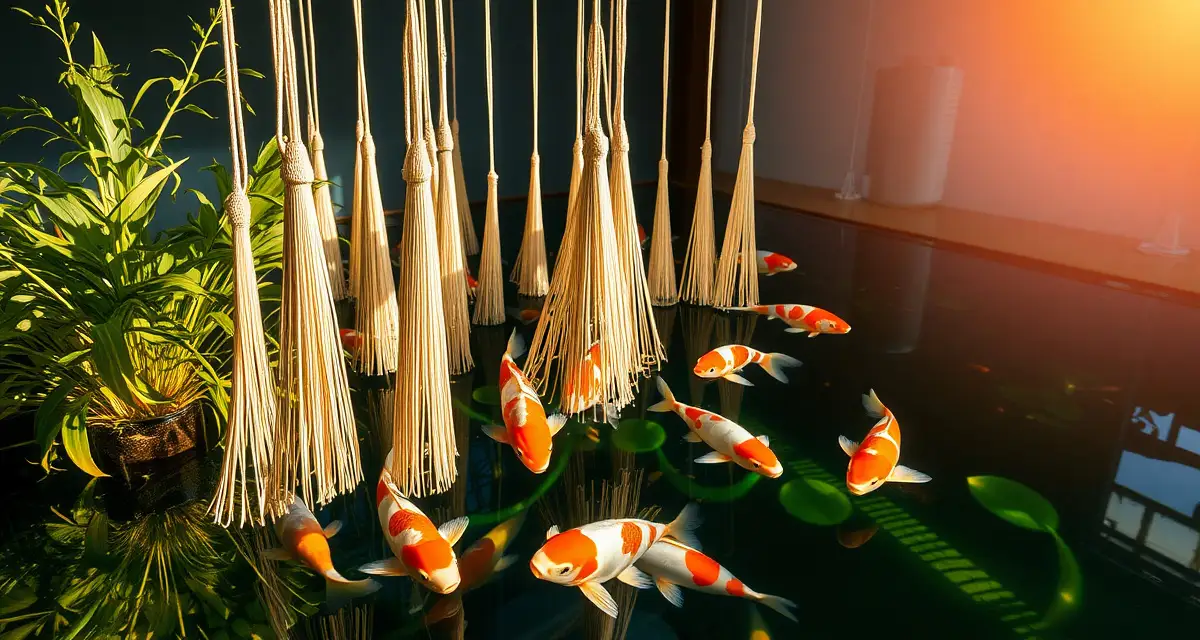
Spawning ropes (also called spawning mops or spawning brushes) are dense fiber assemblies that koi deposit eggs into. The fiber provides attachment sites for adhesive eggs, and the density creates protection -- eggs settle into the fibers and are less accessible to adults than eggs on open surfaces.
Commercial spawning ropes: Available from koi supply retailers. Typically made of dense synthetic fibers or natural materials in long rope-like configurations. Multiple ropes are hung or floated in the spawning pond to provide maximum surface area.
DIY spawning brushes: Many breeders make their own using pond brush material (the type used in biological filters) cut into sections and tied into bundles. These work well and are inexpensive.
Floating spawn mats: Flat mat-style spawning media that floats at the surface and can be lifted out with eggs attached. Some breeders prefer mats because they can be removed from the pond and transferred to a hatching container, taking the eggs completely away from any risk of adult predation.
Position spawning media around the pond edges, particularly in areas where water movement from the return creates surface flow. Koi preferentially deposit eggs in moving water.
Protecting Koi Eggs After Spawning
The most effective egg protection strategy is removing the adults from the spawning pond as soon as spawning activity ends. Koi spawn early in the morning -- typically beginning before dawn and completing by mid-morning. Monitoring for spawning activity and removing adults promptly is the most important post-spawning task.
Adult removal options:
Remove adults after spawning: Temporarily remove spawning pair from the spawning pond to a holding tank or back to the main pond once spawning is complete. The eggs remain in the spawning pond to hatch. This is the cleanest approach.
Net barriers: Some setups use net barriers to separate the spawning area (where eggs are attached to spawning ropes) from the adult holding area. Adults remain in the pond but can't access the eggs.
Spawning media transfer: If using floating spawn mats, transfer the mats with attached eggs to a separate hatching tank immediately after spawning. The adults remain in the spawning pond but the eggs are completely separated.
Filtration for a Spawning Pond
Filtration in a spawning pond needs to be effective but not dangerous to eggs and fry:
Sponge filtration: The standard choice for spawning and fry ponds. Sponge filters provide biological filtration without intake suction that could trap eggs or tiny fry. They're gentle, effective, and easy to manage.
Aeration: Critical for egg development. Eggs require well-oxygenated water to develop. Strong aeration with fine bubbles creates gentle circulation that keeps water oxygenated without excessive turbulence.
Avoid high-velocity returns: Powerful pump returns can dislodge eggs from spawning media and damage developing fry. Keep flow gentle in the spawning and fry rearing phase.
Hatching and Early Fry Management
Koi eggs hatch at water-temperature-dependent rates. At 20°C, expect hatching in 3-4 days. At 25°C, hatching can occur in 2-3 days.
Newly hatched fry are tiny -- under 1cm -- and feed on their yolk sac for the first 24-48 hours. After yolk sac absorption, they need infusoria or commercial liquid fry food. First feedings should be tiny and frequent.
The transition from spawning pond to fry rearing pond is managed based on population density. As fry grow, they need more space and more food. Water quality management becomes increasingly demanding as biomass increases.
For the breeding season management framework that connects spawning pond management to the broader breeding program, see the koi breeding season management guide. For fry-specific rearing guidance, the koi fry raising guide covers the development stages from hatch through grow-out.
Frequently Asked Questions
How do I set up a koi spawning pond?
A dedicated spawning pond of 1,000-3,000 gallons with 90cm-1.2m depth works well. Install spawning ropes or mats around the edges and in the areas with gentle water movement. Use sponge filtration with good aeration rather than high-velocity pump returns. Design for easy adult access so you can remove spawning fish quickly after spawning completes. KoiQuanta supports spawning ponds as a distinct tracked facility, letting you log spawning events, egg hatch dates, and fry management separately from your main pond records.
What is a spawning rope?
A spawning rope is dense fiber media -- natural or synthetic -- that koi deposit adhesive eggs into during spawning. The fiber density provides egg attachment sites and physical protection from adult predation. Commercial spawning ropes are available from koi suppliers. Many breeders also make their own from pond brush sections (filter brush material) tied into dense bundles. The key property is high surface area with a texture that eggs can attach to and settle into, rather than open surfaces where eggs are exposed and easily consumed by adults.
How do I protect koi eggs after spawning?
The most effective protection is removing the adult fish from the spawning pond as soon as spawning activity ends -- typically mid-morning after an early-morning spawning event. This eliminates the predation risk entirely. If adults can't be removed immediately, floating spawn mats with attached eggs can be transferred to a separate hatching tank before adults can consume them. Net barriers that separate the spawning media area from the adult area are a third option. Without one of these measures, adult koi will eat the majority of eggs within hours.
What is Koi Spawning Pond Setup: Design and Equipment?
[FAQ_ANSWER_PLACEHOLDER: This answer needs to be generated by AI with specific data, examples, and actionable advice relevant to Koi Spawning Pond Setup: Design and Equipment. Target 50-150 words.]
How much does Koi Spawning Pond Setup: Design and Equipment cost?
[FAQ_ANSWER_PLACEHOLDER: This answer needs to be generated by AI with specific data, examples, and actionable advice relevant to Koi Spawning Pond Setup: Design and Equipment. Target 50-150 words.]
How does Koi Spawning Pond Setup: Design and Equipment work?
[FAQ_ANSWER_PLACEHOLDER: This answer needs to be generated by AI with specific data, examples, and actionable advice relevant to Koi Spawning Pond Setup: Design and Equipment. Target 50-150 words.]
What are the benefits of Koi Spawning Pond Setup: Design and Equipment?
[FAQ_ANSWER_PLACEHOLDER: This answer needs to be generated by AI with specific data, examples, and actionable advice relevant to Koi Spawning Pond Setup: Design and Equipment. Target 50-150 words.]
Who needs Koi Spawning Pond Setup: Design and Equipment?
[FAQ_ANSWER_PLACEHOLDER: This answer needs to be generated by AI with specific data, examples, and actionable advice relevant to Koi Spawning Pond Setup: Design and Equipment. Target 50-150 words.]
How long does Koi Spawning Pond Setup: Design and Equipment take?
[FAQ_ANSWER_PLACEHOLDER: This answer needs to be generated by AI with specific data, examples, and actionable advice relevant to Koi Spawning Pond Setup: Design and Equipment. Target 50-150 words.]
What should I look for when choosing Koi Spawning Pond Setup: Design and Equipment?
[FAQ_ANSWER_PLACEHOLDER: This answer needs to be generated by AI with specific data, examples, and actionable advice relevant to Koi Spawning Pond Setup: Design and Equipment. Target 50-150 words.]
Is Koi Spawning Pond Setup: Design and Equipment worth it?
[FAQ_ANSWER_PLACEHOLDER: This answer needs to be generated by AI with specific data, examples, and actionable advice relevant to Koi Spawning Pond Setup: Design and Equipment. Target 50-150 words.]
Related Articles
- Complete Koi Pond Setup Guide for Beginners
- Koi Quarantine Tank Setup: Equipment and Configuration Guide
Sources
- Associated Koi Clubs of America (AKCA)
- Koi Organisation International (KOI)
- University of Florida IFAS Extension Aquaculture Program
- Fish Vet Group
- Water Quality Association