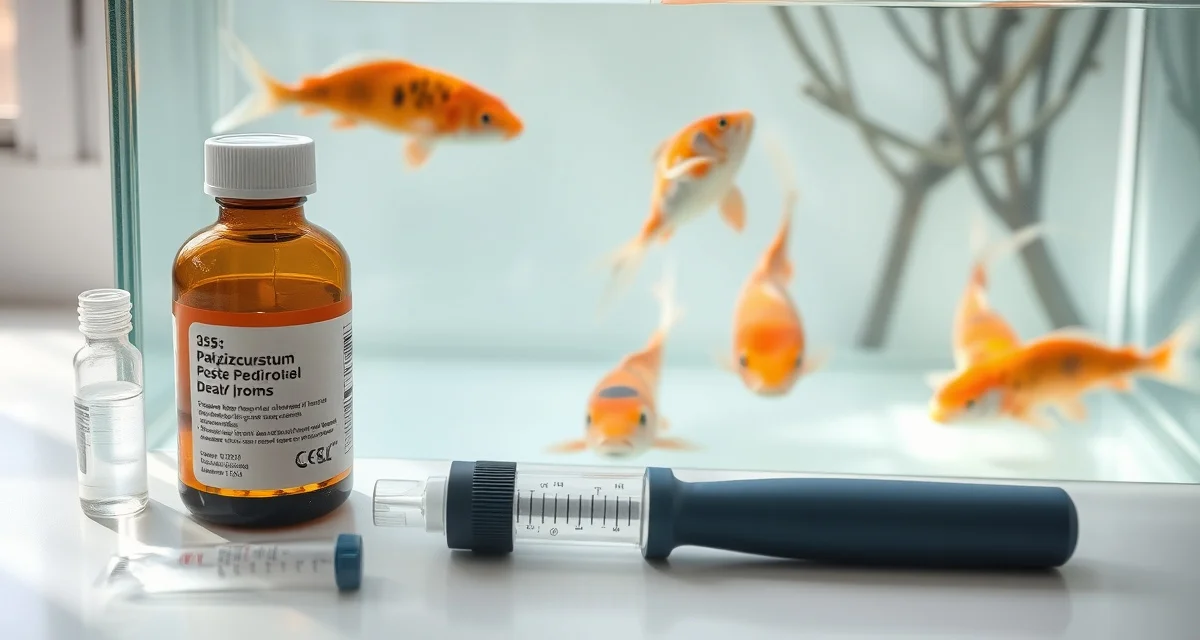
Praziquantel Treatment for Koi: Dosing, Timing, and the Two-Dose Protocol
Praziquantel (PZQ) is the safest, most effective treatment for monogenean flukes in koi. It's practically non-toxic to fish and filter bacteria at standard doses, it works quickly, and it doesn't require the careful monitoring that potassium permanganate demands. For routine koi quarantine program fluke treatment, it's the first choice.
The catch: one dose isn't enough for gill flukes. Here's why, and how to run the protocol correctly.
TL;DR
- The action is rapid: within 12-24 hours at therapeutic doses, you'll see significant fluke reduction.
- Eggs in the substrate or on tank walls survive the first treatment, hatch 7-10 days later (at 65-68°F), and the new juveniles begin reinfesting.
- Without a second dose timed correctly, you get a second-generation infestation within 2-3 weeks.
- A product that's 50% PZQ at 2.5 ppm target in 1,136 liters needs 5.68 grams of the product.
- Mix in a small container with warm (not hot) tank water 3.
- Stir for several minutes until dissolved or nearly dissolved 4.
- Dose is typically 25-50 mg/kg body weight in food.
What Praziquantel Treats
Highly effective:
- Gyrodactylus (skin flukes) - direct kill
- Dactylogyrus (gill flukes) - adult kill, eggs resistant
- Other monogenean flatworms
Limited or no effect:
- Ich (not effective)
- Crustacean parasites (anchor worm, lice)
- Bacterial or viral infections
- Trichodina (use salt or PP for protozoa)
How Praziquantel Works
PZQ disrupts tegument function in flatworms - essentially causing membrane disruption and paralysis. Affected flukes release their grip on gill tissue or skin and die. The action is rapid: within 12-24 hours at therapeutic doses, you'll see significant fluke reduction.
The egg problem: Praziquantel does not penetrate the egg capsules of Dactylogyrus (gill flukes). Eggs in the substrate or on tank walls survive the first treatment, hatch 7-10 days later (at 65-68°F), and the new juveniles begin reinfesting. Without a second dose timed correctly, you get a second-generation infestation within 2-3 weeks.
Dosing
Target concentration: 2.5-5 ppm (2.5-5 mg/L)
Standard quarantine dose: 2.5 ppm
Heavy infestation or higher water temperature: 3-5 ppm
Dose calculation:
- Determine tank volume in liters (gallons × 3.785)
- Multiply by target dose (mg/L)
- Divide by praziquantel purity % of your product
Example: 300-gallon tank at 2.5 ppm
- 300 × 3.785 = 1,136 liters
- 1,136 × 2.5 = 2,839 mg = 2.84 grams of pure PZQ
Commercial products: Most koi-specific PZQ products list active ingredient percentage. A product that's 50% PZQ at 2.5 ppm target in 1,136 liters needs 5.68 grams of the product. Read the label and calculate from the active ingredient, not the total product weight.
Administration
PZQ dissolves poorly in cold water. Improve dissolution:
- Weigh your dose
- Mix in a small container with warm (not hot) tank water
- Stir for several minutes until dissolved or nearly dissolved
- Pour slowly into the tank near a high-flow area
Some products are formulated as liquids for easier dosing. These are worth the extra cost for consistency.
PZQ can also be administered in medicated food - useful for fish that are actively eating and where bath treatment is difficult. Dose is typically 25-50 mg/kg body weight in food.
The Two-Dose Protocol
This is the protocol that actually resolves gill flukes:
Day 5-7 of quarantine: First dose at 2.5-5 ppm. Maintain for 5-7 days. The PP is relatively stable in water (unlike some oxidant treatments) and doesn't need to be re-dosed during this window unless major water changes are done.
Day 7: 25% water change.
Days 7-17: Salt maintenance at 0.3%. Watch for signs that hatching eggs are producing a second generation (return of flashing, gilling signs).
Day 17-21: Second dose at 2.5-5 ppm. This targets newly hatched juveniles before they mature and lay another round of eggs.
Day 21-24: 25% water change.
After two properly timed doses, you've broken the Dactylogyrus lifecycle. Skin scrapes at day 25+ should show minimal or zero flukes.
Temperature Effects
PZQ efficacy drops significantly below 60°F (15°C). At 50-55°F:
- The drug is less active
- Parasite metabolism is slower, reducing drug uptake
- You may need higher doses (3-5 ppm) or longer contact time
The practical fix: heat your quarantine tank to 65-68°F. Better for the fish (KHV observation), better for treatment efficacy, better for observation quality overall.
Praziquantel and Filter Bacteria
One of PZQ's biggest advantages: it doesn't significantly harm nitrifying bacteria at standard therapeutic doses. You can run a full treatment course without destabilizing your biological filtration. This makes it safer to use in quarantine tanks than more aggressive treatments like potassium permanganate or formalin.
Monitor ammonia and nitrite during treatment anyway. Sick fish have higher waste output, and you need to catch any spikes early.
Signs of Treatment Success
Within 24-48 hours of first dose:
- Reduced flashing
- Less scratching behavior
- Improved eating behavior
Within 5-7 days:
- Behavioral normalization
- If you have microscopy, repeat skin scrapes should show significant fluke reduction
Between dose 1 and dose 2 (days 7-17):
- Possible mild return of flashing as hatched juveniles appear - this is expected and confirms the two-dose protocol is necessary
After dose 2 (day 21+):
- No flashing or scratching
- Normal behavior and appetite
- Microscopy (if available) showing zero or minimal flukes
Common Mistakes
Only doing one dose: For Dactylogyrus, this leaves the egg population intact. Second generation appears in 2-3 weeks. People think the treatment "worked" when flashing stops after dose 1, then see problems return and assume PZQ "doesn't work." It works - you just needed the second dose.
Treating below 60°F: Reduced efficacy. Heat the tank.
Not accounting for water changes: If you do a 30% water change between doses, you've reduced the PZQ concentration. Redose the removed volume if you're within an active treatment window.
Not treating for the right thing: PZQ doesn't help with ich, bacterial infections, or crustacean parasites. If flashing doesn't improve after a PZQ course, reconsider the diagnosis - you might be dealing with ich or Trichodina, not flukes.
Related Articles
- Koi Dropsy Treatment Protocol: Isolation, Antibiotics, and Recovery Tracking
- Acriflavine Treatment for Koi: Fungal and Bacterial Protocol
- Standardize Koi Treatment Protocols Across Your Dealer Operation
FAQ
How do I dose praziquantel for koi?
Calculate your tank volume in liters, multiply by 2.5 mg/L for the standard dose. Dissolve in warm water before adding. The standard quarantine protocol uses two doses: day 5-7 and day 17-21 of quarantine. The timing between doses is designed to catch newly hatched Dactylogyrus juveniles after the first dose cleared adults.
How many doses of praziquantel do koi need?
Two doses for effective gill fluke management: the first dose kills adults, and the second dose (10-14 days later) kills the second generation that hatched from eggs after the first dose. A single dose is often sufficient for Gyrodactylus (skin flukes, which are viviparous and don't lay eggs), but the two-dose approach is good practice for all quarantine fluke treatment.
Is praziquantel safe for koi at quarantine temperatures?
Yes - PZQ is one of the safest koi treatments available. It has minimal toxicity to fish and doesn't harm filter bacteria at standard doses. Its effectiveness does decrease below 60°F, so maintain quarantine temperature at 65-68°F for best results. No special monitoring is required during treatment beyond standard daily observations.
What is Praziquantel Treatment for Koi: Dosing, Timing, and the Two-Dose Protocol?
Praziquantel (PZQ) treatment for koi is a two-dose antiparasitic protocol designed to eliminate monogenean flukes, including Gyrodactylus (skin flukes) and Dactylogyrus (gill flukes). The first dose kills adult flukes within 12-24 hours. Because fluke eggs survive the initial treatment and hatch 7-10 days later, a second dose is timed to eliminate the newly hatched juveniles before they can reproduce. Without this two-dose approach, a second-generation infestation typically occurs within 2-3 weeks.
How much does Praziquantel Treatment for Koi: Dosing, Timing, and the Two-Dose Protocol cost?
Praziquantel itself is an affordable medication, often available as a powder or premixed solution. Cost depends on the product concentration and pond volume. As a rough example, a 50% PZQ product dosed to 2.5 ppm in a 1,136-liter system requires about 5.68 grams per treatment — meaning two doses per cycle. Prices vary by brand and supplier, but PZQ is generally cost-effective compared to alternatives like potassium permanganate, which also requires more intensive monitoring and safety precautions.
How does Praziquantel Treatment for Koi: Dosing, Timing, and the Two-Dose Protocol work?
Praziquantel works by disrupting the neuromuscular function of parasitic flukes, causing them to lose their grip on the fish and die. It is added to the pond water at a target concentration of 2.5 ppm, pre-dissolved in warm tank water before dosing. It acts within 12-24 hours against adult flukes. Since eggs are resistant, a second dose is applied 7-10 days later (at 65-68°F) to kill newly hatched juveniles, breaking the parasite lifecycle before reinfection can establish.
What are the benefits of Praziquantel Treatment for Koi: Dosing, Timing, and the Two-Dose Protocol?
The primary benefits of praziquantel treatment are its safety, effectiveness, and ease of use. PZQ is practically non-toxic to koi and beneficial filter bacteria at standard doses, unlike harsher treatments. It works rapidly, eliminating adult flukes within 12-24 hours. It requires no intensive monitoring during treatment. When the two-dose protocol is followed correctly, it fully breaks the fluke lifecycle, preventing re-infestation. It is widely considered the first-choice treatment for routine fluke management in both quarantine and established koi ponds.
Who needs Praziquantel Treatment for Koi: Dosing, Timing, and the Two-Dose Protocol?
Any koi keeper dealing with a confirmed or suspected fluke infestation needs praziquantel treatment. It is especially critical during quarantine of new fish, where flukes are commonly introduced. Koi showing symptoms such as flashing, increased mucus production, gill irritation, or lethargy should be evaluated for flukes. Because Dactylogyrus (gill flukes) can cause serious gill damage if left untreated, hobbyists and professional koi keepers alike rely on the two-dose PZQ protocol as the standard of care for fluke management.
Sources
- Associated Koi Clubs of America (AKCA)
- Koi Organisation International (KOI)
- University of Florida IFAS Extension Aquaculture Program
- Fish Vet Group
- Water Quality Association