Fish Lice (Argulus) Treatment for Koi
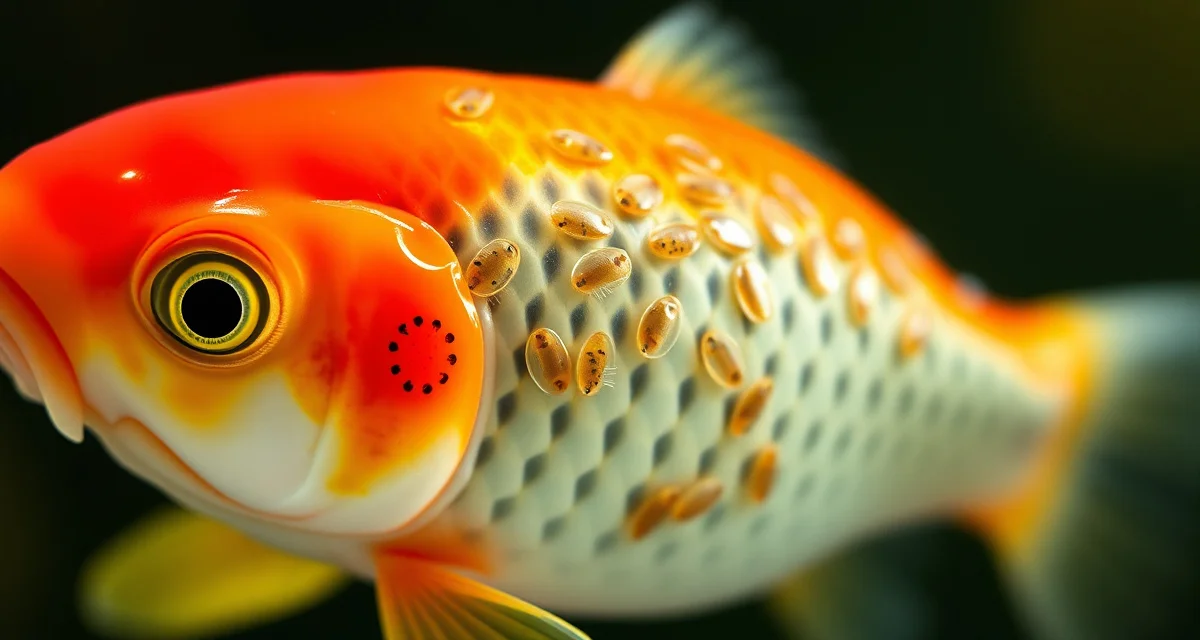
Argulus - fish lice - are visible to the naked eye and one of the most irritating koi parasites for both the fish and the keeper. A heavily infested koi flashes, jumps, and rubs constantly. Individual fish lice are about 5–10mm in diameter, flat and disc-shaped, transparent to pale green, and clearly visible against the fish's body when you look closely.
They're also more environmentally persistent than most koi parasites. An Argulus that leaves the fish can survive in pond water for up to 3 weeks - which is why treating the fish without treating the pond environment doesn't solve the problem.
TL;DR
- Individual fish lice are about 5–10mm in diameter, flat and disc-shaped, transparent to pale green, and clearly visible against the fish's body when you look closely.
- An Argulus that leaves the fish can survive in pond water for up to 3 weeks - which is why treating the fish without treating the pond environment doesn't solve the problem.
- Net the fish carefully and expose the affected area 2.
- Use forceps or simply a firm fingernail to dislodge the louse - Argulus attaches by suction and with careful pressure will release without leaving the stylet embedded 3.
- Apply betadine to each wound site after removal 4.
- One or two treatments at 3–4 week intervals.
- Short dip baths (10 mg/L for 20 minutes) can dislodge and kill lice on individual fish but require close supervision.
Identifying Argulus Fish Lice
Look for:
- Small (3–10mm) oval or disc-shaped organisms pressed flat against the skin, usually visible as a slightly raised disc with two prominent black eyes
- Most often found on the flanks, behind the head, and at fin bases
- Movement: Argulus can reposition themselves on the fish and occasionally leave the fish and swim freely in the water
- Wounds: each attachment site shows a small puncture wound - reddened, potentially hemorrhagic - from the stylet the louse uses to feed
- Fish behavior: intense, frantic flashing and jumping, repeated rubbing against pond walls or the bottom, fish seeking the shallows or surface
Heavy infestations (20+ lice per fish) cause significant blood loss and immune suppression. The attachment wounds are prime entry points for Aeromonas and fungal infection.
Manual Removal
Individual Argulus can be removed manually. This is practical for a small number of lice on a single fish - not for heavy infestations on multiple fish.
Procedure:
- Net the fish carefully and expose the affected area
- Use forceps or simply a firm fingernail to dislodge the louse - Argulus attaches by suction and with careful pressure will release without leaving the stylet embedded
- Apply betadine to each wound site after removal
- Return fish to the tank promptly
Don't crush Argulus on the fish. Smashing them releases the contents, which can cause local inflammation worse than the original attachment.
Manual removal doesn't treat the pond environment - Argulus in the water will reinfect the fish. Chemical treatment of the water is necessary alongside manual removal.
Chemical Treatment Options
Organophosphates (Trichlorfon/Dylox)
Trichlorfon is highly effective against Argulus. It works by inhibiting acetylcholinesterase in the louse's nervous system - they detach, die, and sink to the bottom.
Dose: 0.25–0.5 mg/L. Lower doses are used for maintenance concentration; higher doses for active infestations.
Critical caveats:
- Temperature-sensitive toxicity: at water temperatures above 24°C (75°F), trichlorfon's toxicity to koi increases significantly - reduce dose or avoid
- Not safe for use with anesthetics simultaneously
- Some jurisdictions require prescription
- Follow-up treatment needed at 3–4 week intervals to catch hatching eggs
Diflubenzuron (Dimilin)
Works against the larval stages of Argulus by inhibiting chitin synthesis. Less effective against adult lice than organophosphates, but useful as a follow-up to catch new generations hatching from eggs.
Dose: 0.066 mg/L. One or two treatments at 3–4 week intervals.
Potassium Permanganate
KMnO4 at 2–4 mg/L provides some control of Argulus in the free-swimming stage but isn't as effective against attached adults as organophosphates. Useful as part of a broader antiparasitic protocol.
Note: PP at treatment concentrations with full aeration and proper organic load management is the approach for pond treatment. Short dip baths (10 mg/L for 20 minutes) can dislodge and kill lice on individual fish but require close supervision.
Salt
Salt at 0.3% does not effectively control Argulus. Don't rely on salt treatment for fish lice.
Treating the Pond Environment
This is the step most hobbyists miss. Argulus lays eggs on hard surfaces in the pond - rocks, liner, filter inlet pipes, pond walls. These eggs hatch in 2–6 weeks depending on temperature, releasing new larvae that swim freely until they find a host.
Successful Argulus elimination requires:
- Treatment of fish (chemical to kill adults and larvae on/around fish)
- Treatment of the water (to kill free-swimming stages)
- Environmental management (to reduce egg-laden substrate)
Environmental management includes:
- Vacuuming and cleaning hard surfaces where eggs are likely deposited
- Follow-up chemical treatments at 3–4 week intervals through the entire spring-to-fall season (Argulus eggs can persist through winter and hatch the following spring)
- Maintaining flow over surfaces where eggs would otherwise settle
A single trichlorfon treatment that kills all current adults and larvae doesn't address eggs already deposited. This is why Argulus infestations often recur - one treatment clears the visible lice, keepers assume success, and 4 weeks later the next generation hatches.
Treatment in Quarantine
For fish arriving in quarantine with Argulus:
- Manual removal of visible adults on day 1
- Topical wound treatment at each attachment site
- Chemical treatment of quarantine tank water (trichlorfon or KMnO4) starting day 2–3
- Follow-up treatment at day 21–28 to catch any hatching eggs
- Keep quarantine tank clean - vacuum bottom regularly to remove any egg masses before they hatch
The sealed quarantine tank environment makes Argulus management easier than in a large display pond. You have full control over the water volume for accurate dosing, and you can vacuum the entire bottom systematically.
Secondary Infection Management
Every Argulus attachment wound is a potential Aeromonas entry point. For fish with significant lice burden:
- 0.3% salt throughout treatment (antibacterial support)
- Daily inspection of all known wound sites
- Topical antiseptic at time of manual removal
- Prophylactic antibiotic bath treatment (oxytetracycline 10 mg/L) if multiple wounds are present or if any wound shows expanding redness
A fish that clears the lice but then develops ulcers at the old attachment sites 2 weeks later is experiencing secondary Aeromonas infection - not a new parasitic infestation.
Related Articles
- How to Use Formalin on Koi Safely: Doses, Risks, and Monitoring
- How Long Do Koi Dealers Need to Quarantine New Fish? The Official Answer
- What to Do When a Koi Dies: Removal, Testing, and Pond Protection
- Koi Hemorrhagic Septicemia: Symptoms, Treatment, and Emergency Protocol
FAQ
How do I spot fish lice on my koi?
Fish lice (Argulus) are visible to the naked eye as small (3–10mm), flat, oval or disc-shaped organisms that appear semi-transparent with two dark eyes, pressed against the fish's skin. They're most commonly found on the flanks and behind the head. Behavioral signs include intense flashing, jumping, and repeated rubbing against surfaces. Close inspection in strong light - ideally with the fish briefly netted - reveals the lice as raised discs against the skin.
Can I manually remove fish lice?
Yes, for small numbers of lice on accessible areas, manual removal with forceps or firm fingertip pressure is effective. Argulus attaches by suction and can be dislodged cleanly with controlled pressure. Apply betadine to each wound site after removal. Manual removal must be combined with chemical water treatment - Argulus in the pond water and eggs on surfaces will reinfect the fish within days without treating the environment.
What chemical treats fish lice in a koi pond?
Trichlorfon (sold as Dylox or in proprietary formulations) is the most effective chemical treatment for Argulus in koi ponds at 0.25–0.5 mg/L. Its use at temperatures above 24°C requires dose reduction due to increased toxicity to koi. Diflubenzuron (Dimilin) is effective against larval stages and useful for follow-up treatments. Multiple treatments at 3–4 week intervals are needed to address both current adults and eggs that hatch between treatments.
What is Fish Lice (Argulus) Treatment for Koi?
[FAQ_ANSWER_PLACEHOLDER: This answer needs to be generated by AI with specific data, examples, and actionable advice relevant to Fish Lice (Argulus) Treatment for Koi. Target 50-150 words.]
How much does Fish Lice (Argulus) Treatment for Koi cost?
[FAQ_ANSWER_PLACEHOLDER: This answer needs to be generated by AI with specific data, examples, and actionable advice relevant to Fish Lice (Argulus) Treatment for Koi. Target 50-150 words.]
How does Fish Lice (Argulus) Treatment for Koi work?
[FAQ_ANSWER_PLACEHOLDER: This answer needs to be generated by AI with specific data, examples, and actionable advice relevant to Fish Lice (Argulus) Treatment for Koi. Target 50-150 words.]
What are the benefits of Fish Lice (Argulus) Treatment for Koi?
[FAQ_ANSWER_PLACEHOLDER: This answer needs to be generated by AI with specific data, examples, and actionable advice relevant to Fish Lice (Argulus) Treatment for Koi. Target 50-150 words.]
Who needs Fish Lice (Argulus) Treatment for Koi?
[FAQ_ANSWER_PLACEHOLDER: This answer needs to be generated by AI with specific data, examples, and actionable advice relevant to Fish Lice (Argulus) Treatment for Koi. Target 50-150 words.]
Sources
- Associated Koi Clubs of America (AKCA)
- Koi Organisation International (KOI)
- University of Florida IFAS Extension Aquaculture Program
- Fish Vet Group
- Water Quality Association