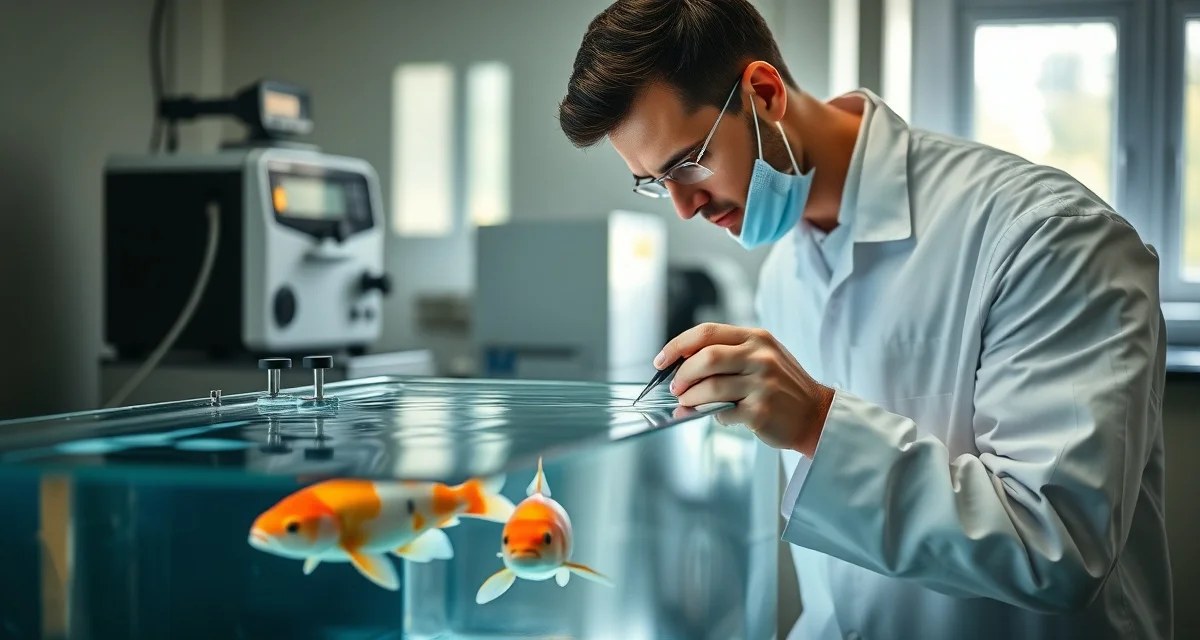
Koi Disease Screening Protocol: How to Inspect Every New Fish
Visual inspection alone misses subclinical bacterial infections in over 40% of cases without a structured protocol. This isn't because visual inspection is useless. It's because unstructured visual inspection is inconsistent. You look at the fish and assess whether it seems "fine." But "seems fine" misses early-stage gill disease, subclinical parasite loads, and the kind of bacterial infection that's multiplying under the surface without visible lesions yet.
A systematic disease screening protocol changes what you catch and when you catch it. The goal is to move from "this fish looks okay" to "this fish has been examined against a specific checklist and shows no signs of the following conditions."
TL;DR
- Hold the fish in water in a net or bowl 2.
- Gently lift one gill cover with a fingertip 3.
- These behavioral signs often precede any visible external symptoms by 24-72 hours.
- Early detection based on parameter trends reduces treatment costs and fish stress.
- Seasonal changes require adjusted monitoring schedules; automated reminders help maintain consistency.
When to Run Disease Screening
Disease screening should happen at three points during koi quarantine program:
Day 1: Arrival Screening. The initial assessment when fish first enter your quarantine tank. This establishes baseline and catches any acute conditions that require immediate response.
Day 10-14: Mid-Quarantine Screening. The most diagnostically productive screening. By this point, transport stress has peaked and passed, and subclinical conditions that were latent at arrival often become clinically apparent.
Day 28-30: Discharge Screening. Final clearance before fish move to the main pond. Must pass all discharge criteria.
Phase 1: Environmental Assessment
Before examining the fish, assess the environment. You can learn a lot from the tank itself.
Observe the tank before disturbing the fish:
- Are fish distributed normally throughout the water column, or are they all congregated near the surface, near the aerator, or in one corner?
- Any fish isolating from the group?
- Are all fish present and accounted for?
- Is there any unusual water appearance: excess foam, cloudiness, or color?
- Any scale impressions or mucus on the tank walls?
Record tank parameters:
- Temperature
- Ammonia
- Nitrite
- pH
Water quality problems explain a large proportion of behavioral abnormalities. Always test water before concluding there's a fish health issue.
Phase 2: Behavioral Observation (5 Minutes Without Disturbing)
Watch the fish without interacting with the tank for 5 minutes. Document:
Normal behavior:
- Fish swimming actively at all water depths
- Responsive to movement near the tank
- Competing for food when offered
- No fish isolating consistently from the group
Abnormal behavior. Note and investigate:
- Flashing: Fish rubbing or scraping against tank surfaces, bottom, or equipment. Primary indicator of skin or gill irritation from ectoparasites.
- Flared opercula: Gill covers held open wider than normal or asymmetrically. Indicates gill irritation or gill parasites.
- Surface hanging: Fish spending extended time at the surface, particularly at the waterfall or aerator. Can indicate gill disease, oxygen deficiency, or systemic illness.
- Clamped fins: Fins held close to the body rather than extended normally. General stress indicator. Can be behavioral or disease-related.
- Listing: Fish tilted to one side. Suggests swim bladder, buoyancy, or severe systemic illness.
- Bottom sitting: One or more fish resting on the tank bottom and not responding normally to stimulation. Serious sign requiring immediate investigation.
- Erratic or spiral swimming: Suggests neurological involvement or severe systemic illness.
Phase 3: Individual Fish Visual Examination
Now handle fish individually for close examination. This requires:
- Good light (a flashlight or head torch helps enormously)
- A smooth-mesh net
- A shallow examination bowl or photography tank (optional but useful)
- Calm, efficient technique. Minimize time fish are out of water.
Step 1: Body Surface Inspection
Work systematically from head to tail on each side:
Head:
- Eyes: Clear and bright? Any cloudiness, film, popping out (exophthalmia), or hemorrhage in the eye?
- Nares (nostrils): Any unusual discharge or blockage?
- Lips and mouth: Any sores, lesions, or unusual coloring around the mouth?
- Head skin: Any unusual spots, lesions, or mucus accumulation?
Body surface:
- Scale condition: Are scales lying flat and uniform? Any raised or missing scales?
- Ulcers or lesions: Red areas, open wounds, holes in the body surface?
- White spots: Uniform white spots (potential ich), diffuse gray film (Costia, Trichodina), or irregular white patches (lymphocystis, fungal infection)?
- Hemorrhage: Any areas of unusual redness, especially at the base of fins, around the vent, or in the body musculature visible through translucent areas?
- Tumors or growths: Any raised areas that aren't normal body contours?
- Parasites visible to naked eye: Anchor worm (Lernaea) appears as visible thin reddish stalks in the skin; fish lice (Argulus) appears as flat, disc-shaped parasites on the surface
Lateral line:
- Any irregularities or lesions along the lateral line?
Vent area:
- Any redness, swelling, or discharge around the vent?
- Prolapsed vent (tissue visible protruding from vent) is an emergency requiring immediate attention
Body shape:
- Any abnormal swelling? Abdominal bloating suggests ascites (fluid accumulation from bacterial infection, early dropsy)
- Pinecone-scale appearance: Scales standing out from the body in a radial pattern are a classic dropsy sign
Step 2: Fin Examination
Check each fin:
- Complete and undamaged?
- Fin rays intact or showing erosion, fraying, or dark discoloration at the base?
- Fin edges: Frayed edges with or without red bases indicate fin rot
- Unusual growths or spots on fin membrane?
Pectoral fins: Koi often hold their pectoral fins slightly out when swimming normally. Pectoral fins clamped against the body and not used in normal swimming is a concerning behavioral sign.
Step 3: Gill Examination
This is where most of the important diseases hide. Gill examination catches what the body surface inspection misses.
How to examine gills:
- Hold the fish in water in a net or bowl
- Gently lift one gill cover with a fingertip
- In good light, look at the gill tissue inside
Normal gills:
- Deep red to pink-red in color
- Smooth and even texture
- Moist and glistening
- Both gill arches covered evenly in tissue
Abnormal findings:
- Pale/gray gills: Anemia from internal bleeding, severe bacterial infection, or extreme fluke infestation. Serious.
- Brown or muddy coloration: Possible methemoglobin from nitrite toxicity (brown blood disease). Test nitrite immediately.
- Excessive mucus: Visible whitish mucus coating the gill tissue is a strong parasite indicator
- Hemorrhage: Bright red bleeding spots on the gill tissue
- Missing or damaged gill tissue: Notable tissue loss from severe fluke infestation or bacterial infection
- Cysts or nodules: Can indicate bacterial cysts or advanced bacterial gill disease
A thorough gill examination improves disease detection rates beyond visual body inspection alone.
Phase 4: Differential Diagnosis Guidance
Symptom-based differential diagnosis guides you from observation to likely diagnosis in under 5 minutes using KoiQuanta's screening tool. Without the tool, use this reference:
| Symptom | Primary Suspects | Secondary Suspects |
|---|---|---|
| Flashing, no visible spots | Costia, Trichodina, gill flukes | Skin irritation from water quality |
| White spots (uniform, 0.5-1mm) | Ich | Epistylis |
| Gray film, excess mucus | Costia, Chilodonella | Saprolegnia (fungus) |
| Surface hanging + flared opercula | Gill flukes, gill disease | Low DO, ammonia |
| Ulcers/open lesions | Bacterial (Aeromonas, Pseudomonas) | Advanced fluke damage |
| Raised scales (pinecone) | Dropsy/ascites | Internal bacterial infection |
| Pale gills | Flukes, severe bacterial | Nitrite toxicity |
| Bottom sitting, unresponsive | KHV, severe infection | Toxin exposure |
| Swollen eye(s) | Bacterial, viral (spring viremia) | Parasitic pressure |
| Visible parasites on skin | Anchor worm, fish lice | N/A |
Important: Multiple symptoms appearing together narrow the diagnosis. A fish with flashing + gill flaring + pale gills + no visible white spots most likely has gill parasites (flukes), not ich.
Phase 5: Scrape and Microscopy (When Indicated)
When behavioral signs (flashing, surface hanging) suggest parasites but nothing is visible on body inspection, or when gill appearance is abnormal, a scrape provides definitive diagnosis.
Gill scrape: Gently run a coverslip or microscope slide across the gill tissue to collect cells and any parasites for examination under 100-400x magnification.
Skin scrape: Press a coverslip against the body surface and draw it gently toward the tail. Sample from areas where parasites are suspected.
Sending a scrape to a fish vet or aquatic diagnostics lab is an option if you don't have a microscope. Many experienced hobbyists invest in a basic microscope. It makes a real difference for diagnostic accuracy.
Documenting Your Screening
Log every screening result in KoiQuanta's koi disease treatment tracker with:
- Date and time
- Which fish examined
- All findings (including "no abnormalities detected")
- Any follow-up actions taken
"No abnormalities detected" is meaningful data. It tells you what normal looks like for these fish and gives you the baseline for comparison at subsequent screenings.
Related Articles
- How to Reduce Stress When Introducing New Koi
- Koi Dealer New Arrivals Protocol: From Delivery to Quarantine
FAQ
What signs of disease should I look for in new koi?
The most useful early signs are behavioral: flashing (rubbing against surfaces), surface hanging or gasping, clamped fins, and isolation from the group. These behavioral signs often precede any visible external symptoms by 24-72 hours. On physical examination, look for white spots, gray films or excess mucus, ulcers or red lesions, raised scales (pinecone effect), pale or damaged gills, and visible external parasites. Any one of these warrants closer investigation and possibly treatment.
How do I check koi gills during quarantine?
Hold the fish in water in a shallow container or net in the quarantine tank. Gently lift one gill cover with your fingertip and use a flashlight to illuminate the gill tissue. Normal gills are deep red to pink-red, smooth, moist, and evenly covered in tissue. Abnormal findings include: pale or gray color (anemia or nitrite toxicity), excess whitish mucus (parasite indicator), hemorrhage spots, missing or damaged tissue (fluke damage), and brown discoloration (methemoglobin from nitrite). Compare both sides. Asymmetric gill condition is always abnormal.
Should I do a scrape during quarantine?
Yes, if behavioral signs suggest parasites but nothing is visible on external inspection. A scrape (gill scrape or skin scrape) examined under a microscope provides definitive parasite identification that visual inspection alone cannot. Running a prophylactic scrape on all newly arrived fish is good practice if you have microscope access. It catches subclinical loads before they become clinical infections. If you don't have microscope access, your fish vet or an aquatic diagnostics lab can examine a scrape. The cost of a professional scrape is typically less than the cost of treating the infection that a missed diagnosis allows to establish.
What is Koi Disease Screening Protocol: How to Inspect Every New Fish?
[FAQ_ANSWER_PLACEHOLDER: This answer needs to be generated by AI with specific data, examples, and actionable advice relevant to Koi Disease Screening Protocol: How to Inspect Every New Fish. Target 50-150 words.]
How much does Koi Disease Screening Protocol: How to Inspect Every New Fish cost?
[FAQ_ANSWER_PLACEHOLDER: This answer needs to be generated by AI with specific data, examples, and actionable advice relevant to Koi Disease Screening Protocol: How to Inspect Every New Fish. Target 50-150 words.]
How does Koi Disease Screening Protocol: How to Inspect Every New Fish work?
[FAQ_ANSWER_PLACEHOLDER: This answer needs to be generated by AI with specific data, examples, and actionable advice relevant to Koi Disease Screening Protocol: How to Inspect Every New Fish. Target 50-150 words.]
What are the benefits of Koi Disease Screening Protocol: How to Inspect Every New Fish?
[FAQ_ANSWER_PLACEHOLDER: This answer needs to be generated by AI with specific data, examples, and actionable advice relevant to Koi Disease Screening Protocol: How to Inspect Every New Fish. Target 50-150 words.]
Who needs Koi Disease Screening Protocol: How to Inspect Every New Fish?
[FAQ_ANSWER_PLACEHOLDER: This answer needs to be generated by AI with specific data, examples, and actionable advice relevant to Koi Disease Screening Protocol: How to Inspect Every New Fish. Target 50-150 words.]
Sources
- Associated Koi Clubs of America (AKCA)
- Koi Organisation International (KOI)
- University of Florida IFAS Extension Aquaculture Program
- Fish Vet Group
- Water Quality Association