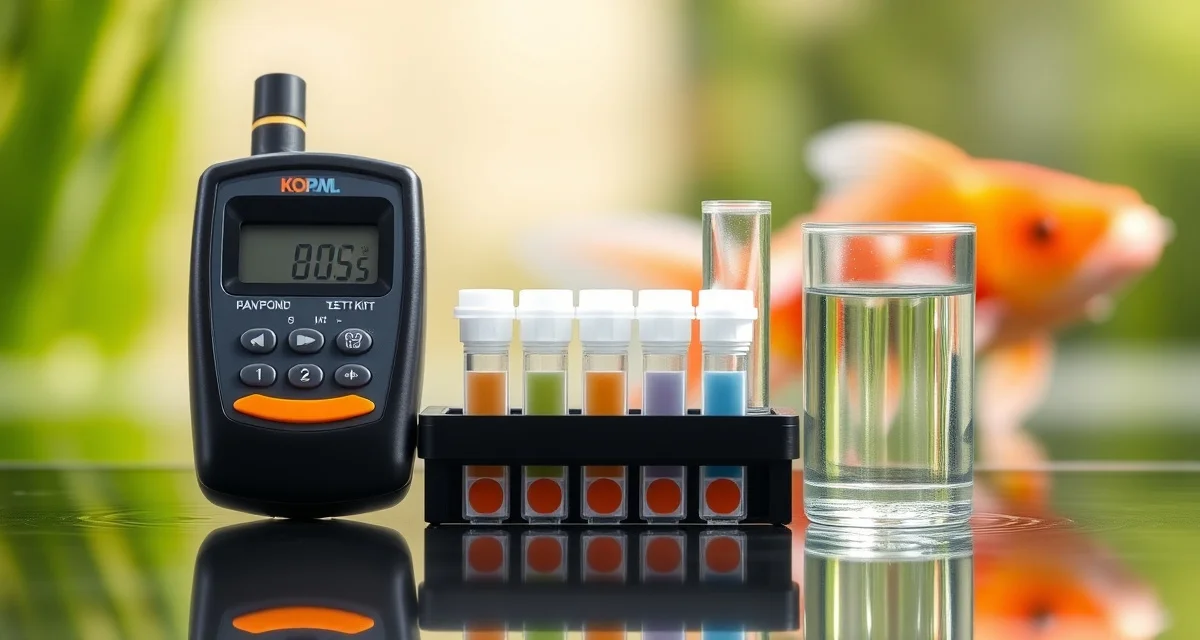
How to Test Koi Pond Water: Test Kits and Meters Explained
Most koi keepers test their water less often than they should and less accurately than they think.
Test strips in particular give people a false sense of certainty. You dip one, it turns a color, you compare it to the chart under the bathroom vanity light, you decide it's "probably fine." Then three days later a fish has ulcers and you're wondering what happened.
Water testing only works if you're testing the right parameters, at the right frequency, with tools accurate enough to matter, and if you're logging the results in a way that lets you see trends rather than isolated data points.
TL;DR
- Variation of 20–40% from actual values is common.
- Results within approximately 10% of true values when performed correctly.
- A good handheld unit ($80–$150) reads to 0.1 mg/L accuracy and provides results in 30 seconds.
- The most useful thing KoiQuanta's parameter logging shows is correlation: the nitrite spike that appeared 3 days after antibiotics were added.
- The pH crash that always follows two consecutive cloudy days (insufficient photosynthesis to drive pH up means higher baseline CO2 at night).
- The ammonia creep that preceded a bacterial outbreak by 10 days.
- During the first 6 weeks of a new pond or quarantine tank, test ammonia and nitrite daily.
What Parameters to Test
Essential - Test Every Time
Ammonia (NH3/NH4+): The most immediately dangerous parameter. Target: 0 mg/L. Any detectable ammonia requires investigation and often immediate action.
Nitrite (NO2-): The second most toxic parameter. Target: 0 mg/L in an established pond. During cycling, monitoring nitrite spikes is critical.
pH: Affects toxicity of other parameters and treatment efficacy. Target: 7.0–8.5 with 7.4–7.8 ideal.
Important - Test Regularly
Nitrate (NO3-): Accumulates over time. Target under 40 mg/L. Test monthly in established ponds; more often post-treatment.
KH (Carbonate Hardness): Determines pH stability. Target 100–150 mg/L. Test when setting up a pond, after water changes, and if pH starts fluctuating.
Temperature: Test every session. Temperature affects interpretation of all other parameters.
Critical When Relevant
Dissolved Oxygen: Test before and during any treatment with formalin or KMnO4. Test during hot weather or any time fish are gasping. A digital DO meter is required - test strips for DO are not sufficiently accurate.
GH (General Hardness): Test when setting up, when using purified water sources, or when fish seem stressed without clear cause.
Chlorine/Chloramine: Test whenever you use tap water for water changes or tank fills. Should be zero before water is added to fish.
Salinity/Salt concentration: If you're running salt treatment, test to confirm concentration before adding more.
Test Kit vs. Test Strips vs. Digital Meters
Test Strips
Accuracy: Poor to moderate. Variation of 20–40% from actual values is common.
Use case: A rough daily check where you're confirming "approximately zero" ammonia or nitrite. Not appropriate for detailed management decisions.
The problem: A strip showing 0.25 mg/L ammonia might be 0.1 mg/L (action not immediately needed) or it might be 0.5 mg/L (emergency water change needed). You can't manage with that uncertainty when the stakes are high.
If all you have is strips and you're seeing any color other than the "safe" zone, treat it as a problem and act. The inaccuracy matters most when you're trying to decide if a reading is borderline - and strips are least reliable in that borderline range.
Liquid Reagent Test Kits
Accuracy: Good. Results within approximately 10% of true values when performed correctly.
Use case: The workhorse of koi keeping water testing. API Master Test Kit (ammonia, nitrite, nitrate, pH) covers the essential parameters reliably. Salifert and Seachem produce more precise tests for specific parameters (particularly ammonia and nitrate).
How to get accurate results:
- Rinse the test tube with pond water before the sample
- Collect sample from mid-water, not the surface
- Use the correct number of reagent drops - count carefully
- Mix/shake as directed
- Wait the full incubation time before comparing color
- Read color in natural daylight or consistent lighting - fluorescent-only readings are often off
Expiry dates matter. Liquid test reagents expire. An old API kit that's sat in a warm garage for two years is giving you inaccurate readings even if the color seems to develop normally.
Digital Meters
Accuracy: High for parameters where they're well-designed. Essential for dissolved oxygen.
pH meters: A calibrated pH meter reads more accurately than a liquid test kit for pH, especially in the 6.5–7.5 range where color comparison gets hard. Calibrate regularly with fresh buffer solution.
Dissolved oxygen meters: This is where digital wins decisively. There's no accurate test kit or strip for DO - you need a meter. A good handheld unit ($80–$150) reads to 0.1 mg/L accuracy and provides results in 30 seconds. For any serious koi operation, this is required equipment.
Ammonia meters: Ammonia meters exist but most consumer-grade ones are less accurate than a good liquid test kit. Stick to liquid reagents for ammonia.
Conductivity/TDS meters: TDS meters measure total dissolved solids and are useful for confirming salt concentration and general water mineral content but don't give you specific parameter readings.
How Often to Test
There's no single answer - frequency depends on your system status:
New pond or quarantine tank (first 6 weeks):
- Ammonia and nitrite: daily
- pH: every 2–3 days
- Temperature: every observation
Established pond, normal conditions:
- Ammonia and nitrite: weekly minimum
- pH: weekly (test morning AND afternoon if you haven't characterized your daily swing)
- Nitrate: monthly
- Temperature: every observation or session
- KH: monthly to quarterly
During disease treatment or medication:
- Ammonia and nitrite: every other day (treatments often affect the biofilter)
- pH: every other day (some treatments affect pH)
- DO: before and during any oxygen-consuming treatment; every 30 minutes for formalin and KMnO4
Post-filter cleaning or after adding fish:
- Ammonia and nitrite: daily for 2 weeks
During hot summer:
- DO: daily morning readings
- Temperature: daily
The Missing Piece: Logging Results
A single test result is limited. A series of test results over time tells you:
- Is this normal or abnormal for this pond?
- Is the parameter trending up or down?
- Did something specific cause this reading to change?
Keeping a log - even a simple notebook, better a purpose-built app - transforms test results from isolated data points into diagnostic information.
The most useful thing KoiQuanta's parameter logging shows is correlation: the nitrite spike that appeared 3 days after antibiotics were added. The pH crash that always follows two consecutive cloudy days (insufficient photosynthesis to drive pH up means higher baseline CO2 at night). The ammonia creep that preceded a bacterial outbreak by 10 days.
These patterns are invisible without a log. With a log and a trend view, they're obvious.
Building a Testing Routine
The reason testing gets skipped: it takes time and doesn't seem urgent when fish look fine.
The routine that actually gets done:
- Set a consistent test day and time (same day of week, same time of morning)
- Stage your test kits where you actually access the pond, not inside the house
- Test before feeding so you don't forget
- Log the result immediately - in KoiQuanta, in a notebook, wherever - before you forget the number
- Set a standard: if ammonia is above 0, or nitrite is above 0, something happens today (even if it's just a 20% water change)
Test when fish look fine. That's when testing is preventive. Testing after fish look sick is diagnostic - useful, but you're already behind.
Related Articles
- Koi Pond Water Testing Schedule: How Often to Test Each Parameter
- How to Test Koi Pond Water: Parameters, Frequency, and What Results Mean
- KHV Testing for Koi: PCR Test Guide
- New Koi Pond Cycling: The Nitrogen Cycle Explained
FAQ
What water tests do I need for a koi pond?
The essential tests are ammonia, nitrite, pH, and temperature - these should be tested at every regular session. Nitrate (monthly), KH (quarterly or when pH fluctuates), and dissolved oxygen (during treatments and hot weather with a digital meter) cover the remaining important parameters. A liquid reagent test kit for ammonia, nitrite, nitrate, and pH, plus a digital DO meter for dissolved oxygen, is the core testing toolkit.
How often should I test koi pond water?
Weekly testing of ammonia, nitrite, and pH is the minimum for an established pond. During the first 6 weeks of a new pond or quarantine tank, test ammonia and nitrite daily. After any chemical treatment, test every 2 days for 2 weeks. During hot summer months, test dissolved oxygen daily in the morning when it's at its lowest point. During disease events, test daily at minimum.
Are digital meters worth it for koi ponds?
For dissolved oxygen, a digital meter is non-negotiable - there's no accurate alternative for DO. For pH, a calibrated digital pH meter is more accurate and faster than liquid test kits, particularly in the 6.5–7.5 range where color comparison becomes difficult. For ammonia and nitrite, good liquid reagent kits are accurate enough and significantly cheaper than the meter alternatives. The essential digital investment is a DO meter ($80–150) for any serious koi operation.
What is How to Test Koi Pond Water: Test Kits and Meters Explained?
This article explains how to accurately test koi pond water using test strips, liquid reagent kits, and digital meters. It covers which parameters matter most—ammonia, nitrite, pH, and others—how to choose the right testing tool, how often to test, and how to log results over time. Most koi keepers test less accurately than they realize, and this guide helps close that gap with practical, specific guidance on getting reliable readings.
How much does How to Test Koi Pond Water: Test Kits and Meters Explained cost?
The article itself is free to read on KoiQuanta. The testing tools it covers range in price: test strips cost a few dollars per pack, liquid reagent kits run $20–$50, and quality handheld digital meters typically cost $80–$150. Ongoing costs include replacement reagents and probe calibration solutions. KoiQuanta also offers parameter logging tools to help you track trends across tests over time.
How does How to Test Koi Pond Water: Test Kits and Meters Explained work?
The article walks you through each type of testing method—strips, liquid kits, and digital meters—explaining how each works and where each falls short. Test strips can vary 20–40% from true values. Liquid kits are more accurate at around 10% variance when used correctly. Digital meters provide results in about 30 seconds with 0.1 mg/L precision. The article also explains how to log results to catch patterns like ammonia creep or pH crashes before they cause fish health problems.
What are the benefits of How to Test Koi Pond Water: Test Kits and Meters Explained?
Accurate water testing helps you catch dangerous parameter shifts before your koi show symptoms. The real benefit isn't any single reading—it's trend visibility. KoiQuanta's logging tools reveal correlations like nitrite spikes appearing three days after antibiotics, or pH crashes following two consecutive cloudy days. Catching these patterns 5–10 days early gives you time to intervene before fish develop ulcers, bacterial infections, or worse.
Who needs How to Test Koi Pond Water: Test Kits and Meters Explained?
Anyone keeping koi needs to understand water testing—but this article is especially useful for new pond owners in the first 6 weeks of a setup, keepers who've had unexplained fish health problems, and anyone relying solely on test strips. If your pond has recently been treated with antibiotics, experienced unusual weather, or added new fish, targeted and accurate testing is critical to maintaining a stable, healthy environment.
Sources
- Associated Koi Clubs of America (AKCA)
- Koi Organisation International (KOI)
- University of Florida IFAS Extension Aquaculture Program
- Fish Vet Group
- Water Quality Association