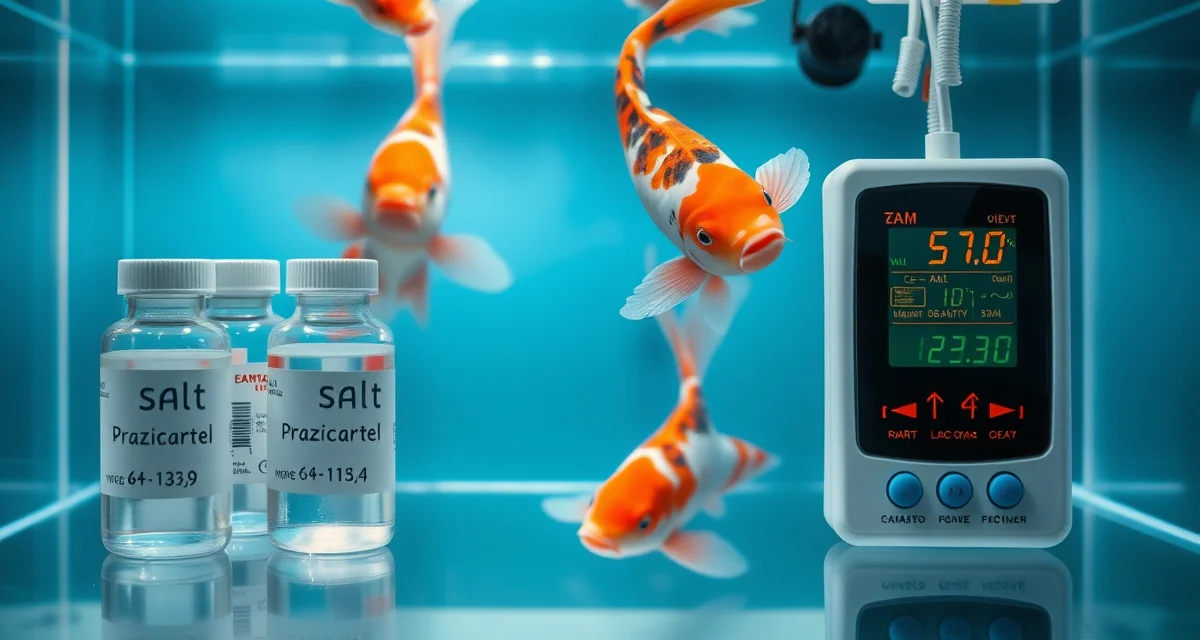
Best Medications for Koi Quarantine: Evidence-Based Selection
Salt and praziquantel remain the two most evidence-supported first-line koi quarantine-implementation) treatments-after-pond-treatment). The rest of the quarantine medication toolkit has variable evidence behind it, and the effectiveness claims on many products significantly exceed what the scientific literature supports. This guide focuses on what has the strongest evidence for each disease category.
KoiQuanta-documentation-for-sales)'s treatment outcome logging builds personal efficacy data across users-malachite-green). No competitor evaluates medication efficacy to guide treatment selection.
TL;DR
- Treat at days 7 and 21 of quarantine to cover two treatment cycles and address parasites that were developing during the first dose.
- Don't treat at high temperatures (above 25°C) without additional aeration.
- Salt at 0.3% provides general ectoparasite inhibition and osmotic support but doesn't reliably eliminate flukes or ich at therapeutic concentrations.
- The most effective quarantine approach is prophylactic praziquantel at days 7 and 21 for all new fish, addressing the most prevalent parasite group preventively.
- The evidence-based minimum quarantine medication protocol is salt at 0.3% combined with prophylactic praziquantel at days 7 and 21.
TL;DR
- Treat at days 7 and 21 of quarantine to cover two treatment cycles and address parasites that were developing during the first dose.
- Don't treat at high temperatures (above 25°C) without additional aeration.
- Salt at 0.3% provides general ectoparasite inhibition and osmotic support but doesn't reliably eliminate flukes or ich at therapeutic concentrations.
- The most effective quarantine approach is prophylactic praziquantel at days 7 and 21 for all new fish, addressing the most prevalent parasite group preventively.
- The evidence-based minimum quarantine medication protocol is salt at 0.3% combined with prophylactic praziquantel at days 7 and 21.
1. Salt (Sodium Chloride) - General Quarantine Support
What it does: Reduces osmotic stress, inhibits some ectoparasites, supports osmoregulatory function during stress periods.
Evidence level: Strong. Well-established physiological mechanism. Widely used in professional koi keeping with consistent reported benefit.
How to use: 0.3% for standard quarantine support (300g per 100L). Use non-iodized salt only. Measure carefully - salt can't be removed easily once added.
Limitations: Doesn't eliminate flukes, ich, or most bacterial pathogens at therapeutic concentrations. Can interfere with zeolite ammonia removal if used together. Don't use in softened water ponds where sodium is already elevated.
Best for: General quarantine support, reducing transport stress, osmotic stress management during disease events.
2. Praziquantel - Fluke Treatment
What it does: Kills monogenean flatworms - specifically Dactylogyrus (gill flukes) and Gyrodactylus (body flukes). Works by causing spastic paralysis in the parasites.
Evidence level: Very strong. One of the best-evidenced treatments in koi medicine. Well-studied mechanism of action, consistent efficacy in controlled studies.
How to use: 2 mg/L (2 ppm) as a bath treatment. Treat at days 7 and 21 of quarantine to cover two treatment cycles and address parasites that were developing during the first dose. Praziquantel is not significantly affected by temperature within the normal koi pond range.
Limitations: Has no effect on ich (a protozoan, not a flatworm). Doesn't treat bacterial infections. May need additional doses for heavy infestations.
Best for: Prophylactic treatment of all new fish in quarantine regardless of visible signs. The prevalence of subclinical fluke infestation makes prophylactic treatment appropriate rather than diagnostic.
3. Formalin - Ectoparasite Treatment
What it does: Kills a broad range of ectoparasites including Trichodina, Costia, Chilodonella, and other protozoan parasites. More effective against surface parasites than praziquantel.
Evidence level: Strong. Well-established efficacy against a wide range of ectoparasites.
How to use: Short bath (30 minutes to 1 hour) at 125-250 ppm, or continuous low-dose treatment at 15-25 ppm. Requires careful temperature and oxygen monitoring - formalin depletes dissolved oxygen significantly. Don't treat at high temperatures (above 25°C) without additional aeration.
Limitations: Toxic to biological filter bacteria. Significant handling safety concerns - wear gloves and work in ventilated area. Carcinogenic with chronic exposure. Depletes oxygen.
Best for: Trichodina and other ciliate/flagellate ectoparasite infestations that don't respond to praziquantel. Use as a targeted treatment when these parasites are confirmed, not as routine prophylaxis.
4. Potassium Permanganate - General Ectoparasite and Bacterial
What it does: Strong oxidising agent that kills bacteria and ectoparasites on contact. Used for gill cleanses, dip treatments, and as a pond treatment for mixed parasite and bacterial issues.
Evidence level: Moderate to strong. Long history of use in fish medicine. Variable efficacy depending on organic load (organic matter neutralises it rapidly).
How to use: Short bath (30-60 minutes) at 10-20 mg/L. Monitor carefully - overdose causes severe gill damage. Treat to the point of colour change from purple to brown, which indicates the permanganate has been consumed. In high organic load water, it's consumed quickly.
Limitations: Efficacy highly dependent on organic load - ineffective in heavily organically loaded water. Toxic to biological filter. Dangerous if overdosed - causes oxidative gill damage. Don't use with other oxidising agents.
Best for: Dip treatments for skin and gill conditions where quick-acting broad-spectrum treatment is needed. Useful for new fish assessment and initial treatment before quarantine system establishment.
5. Metronidazole - Internal Parasites (Hexamita, Spironucleus)
What it does: Antiprotozoal medication effective against internal flagellate parasites such as Hexamita, which are associated with hole-in-the-head disease and internal infections in some fish.
Evidence level: Moderate. Well-established use in ornamental fish medicine. Evidence in koi specifically is less than in tropical fish.
How to use: Medicated food at 5mg/kg fish per day, or bath treatment at 6.25 mg/L for extended period. Medicated food is preferred for internal parasite treatment.
Best for: Suspected internal flagellate infections. Not a first-line treatment for routine quarantine.
6. Oxytetracycline - Bacterial Infections
What it does: Broad-spectrum antibiotic effective against many gram-negative bacteria including Aeromonas and Pseudomonas. Has been widely used in koi medicine for ulcer disease and fin rot.
Evidence level: Variable. Historically effective, but Aeromonas resistance to tetracyclines has been documented in hobbyist koi. Efficacy depends on local resistance patterns.
How to use: Medicated food containing oxytetracycline for bacterial infections. Treating the water is less effective than medicated food for internal bacterial infections. Complete the full course.
Limitations: Increasing resistance concerns. Requires veterinary prescription in many countries. Kills biological filter bacteria. Interacts with calcium (reduced efficacy in hard water).
Best for: Bacterial ulcer disease and fin rot where Aeromonas sensitivity to tetracyclines is likely. Consider fish veterinary consultation for antibiotic selection to account for local resistance patterns.
Medication Selection in KoiQuanta
When logging treatment events in KoiQuanta, record:
- Product name and active ingredient
- Dose administered (mg/L or g/100L)
- Treatment duration and dates
- Outcome (resolved, partial resolution, no response)
Over time, your treatment log shows which products have produced consistent resolution for specific disease types in your setup. This is your personal efficacy data set - more relevant to your management decisions than generalised efficacy claims.
The koi quarantine medications overview covers the full medication range. The koi parasite treatment guide provides detailed treatment protocols for each parasite type.
Frequently Asked Questions
What is the most effective koi antiparasitic treatment?
Praziquantel is the most effective treatment for monogenean flukes (Dactylogyrus and Gyrodactylus) - the most commonly encountered parasites in koi quarantine - with strong evidence supporting consistent efficacy. For broader ectoparasite coverage including Trichodina and other ciliate parasites, formalin short-bath treatment has strong evidence. Salt at 0.3% provides general ectoparasite inhibition and osmotic support but doesn't reliably eliminate flukes or ich at therapeutic concentrations. For ich (Ichthyophthirius multifiliis), prolonged temperature-appropriate treatment targeting the free-swimming stage is required; no single product eliminates it quickly. The most effective quarantine approach is prophylactic praziquantel at days 7 and 21 for all new fish, addressing the most prevalent parasite group preventively.
What antibiotic is most effective for koi bacterial infections?
Antibiotic selection for koi bacterial infections should ideally be guided by culture and sensitivity testing from a fish veterinarian, because resistance patterns vary by region and population. That said, oxytetracycline in medicated food has been the most widely used treatment historically, though resistance concerns are growing. Where veterinary access is available, a sensitivity test on a swab from the affected lesion gives you a specific recommendation for your case. When veterinary consultation isn't available, medicated food containing oxytetracycline or amoxicillin is commonly used for bacterial ulcer disease. Complete the full treatment course regardless of apparent recovery.
Is salt enough medication for basic koi quarantine?
Salt alone is not sufficient for basic koi quarantine. Salt reduces osmotic stress and inhibits some ectoparasites but doesn't eliminate gill flukes (Dactylogyrus), which are present in a significant proportion of incoming koi and are the most important parasite to address in quarantine. The evidence-based minimum quarantine medication protocol is salt at 0.3% combined with prophylactic praziquantel at days 7 and 21. This addresses the most prevalent parasites (flukes) reliably. Salt alone leaves a substantial proportion of subclinically infested fish untreated during quarantine, allowing those fish to complete quarantine and introduce flukes to the display pond.
What records should I keep during this type of event?
Record the date, water temperature, and full parameter readings (ammonia, nitrite, pH, dissolved oxygen), a description of observed signs in each affected fish, any treatments applied with dose and rationale, and the fish's response at 24, 48, and 72 hours post-treatment. These records in KoiQuanta build the health history that makes future events faster to diagnose and treat.
What is Best Medications for Koi Quarantine: Evidence-Based Selection?
[FAQ_ANSWER_PLACEHOLDER: This answer needs to be generated by AI with specific data, examples, and actionable advice relevant to Best Medications for Koi Quarantine: Evidence-Based Selection. Target 50-150 words.]
How much does Best Medications for Koi Quarantine: Evidence-Based Selection cost?
[FAQ_ANSWER_PLACEHOLDER: This answer needs to be generated by AI with specific data, examples, and actionable advice relevant to Best Medications for Koi Quarantine: Evidence-Based Selection. Target 50-150 words.]
How does Best Medications for Koi Quarantine: Evidence-Based Selection work?
[FAQ_ANSWER_PLACEHOLDER: This answer needs to be generated by AI with specific data, examples, and actionable advice relevant to Best Medications for Koi Quarantine: Evidence-Based Selection. Target 50-150 words.]
What are the benefits of Best Medications for Koi Quarantine: Evidence-Based Selection?
[FAQ_ANSWER_PLACEHOLDER: This answer needs to be generated by AI with specific data, examples, and actionable advice relevant to Best Medications for Koi Quarantine: Evidence-Based Selection. Target 50-150 words.]
Who needs Best Medications for Koi Quarantine: Evidence-Based Selection?
[FAQ_ANSWER_PLACEHOLDER: This answer needs to be generated by AI with specific data, examples, and actionable advice relevant to Best Medications for Koi Quarantine: Evidence-Based Selection. Target 50-150 words.]
How long does Best Medications for Koi Quarantine: Evidence-Based Selection take?
[FAQ_ANSWER_PLACEHOLDER: This answer needs to be generated by AI with specific data, examples, and actionable advice relevant to Best Medications for Koi Quarantine: Evidence-Based Selection. Target 50-150 words.]
What should I look for when choosing Best Medications for Koi Quarantine: Evidence-Based Selection?
[FAQ_ANSWER_PLACEHOLDER: This answer needs to be generated by AI with specific data, examples, and actionable advice relevant to Best Medications for Koi Quarantine: Evidence-Based Selection. Target 50-150 words.]
Related Articles
- Do Plants Harbor Koi Parasites?-plant-risk)
Sources
- Associated Koi Clubs of America (AKCA)
- Koi Organisation International (KOI)
- University of Florida IFAS Extension Aquaculture Program
- Fish Vet Group
- Water Quality Association
Sources
- Associated Koi Clubs of America (AKCA)
- Koi Organisation International (KOI)
- University of Florida IFAS Extension Aquaculture Program
- Fish Vet Group
- Water Quality Association