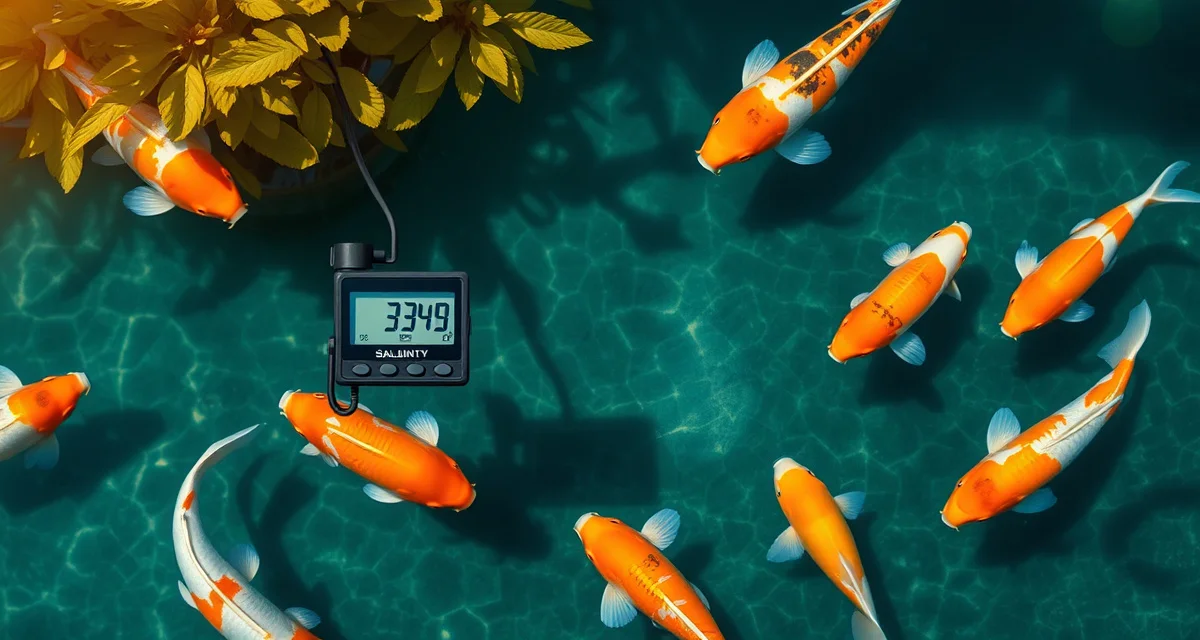
Koi Pond Maintenance Salt: Ongoing Use and Levels
A 0.1% maintenance salt concentration reduces osmotic stress without inhibiting plant growth. That's the key balance point for maintenance salt use: beneficial for fish health at this concentration while remaining compatible with most aquatic plants. Above 0.3%, you start affecting sensitive plants; below 0.05%, the physiological benefit for fish diminishes. The 0.1% range is where the practice makes practical sense.
Whether to run maintenance salt permanently is a genuine debate in koi keeping. The evidence supports modest benefits at the right concentration; the arguments against center on environmental concerns and the need for accurate monitoring.
TL;DR
- Above 0.3%, you start affecting sensitive plants; below 0.05%, the physiological benefit for fish diminishes.
- The 0.1% range is where the practice makes practical sense.
- Low-level salt (0.1-0.3%) reduces this concentration gradient slightly, lowering the osmoregulatory workload and freeing energy for growth and immune function.
- At 0.1%, most common koi pond plants tolerate it well, but sensitive species may be affected.
- If you run a heavily planted pond, even 0.1% may be a consideration.
- If you're going to run maintenance salt, 0.1% is the minimum where it provides meaningful benefit.
- If you changed 20% of the water in a pond running at 0.1%, you need to add 20% of the total salt dose to restore the concentration.
The Case For Maintenance Salt
Osmotic stress reduction: Koi expend energy maintaining the salt balance between their body fluids and the surrounding water. Their body is saltier than freshwater, so water constantly moves in by osmosis while salts are lost. Low-level salt (0.1-0.3%) reduces this concentration gradient slightly, lowering the osmoregulatory workload and freeing energy for growth and immune function.
Electrolyte supplement: Salt provides sodium and chloride ions that support gill function and osmotic regulation.
Mild antibacterial environment: Low salt concentrations don't have significant antimicrobial effects, but they do create a slightly less favorable environment for some freshwater pathogens. This is a minor benefit, not a treatment.
Nitrite protection: Chloride ions from salt compete with nitrite for gill transport sites, reducing nitrite toxicity. This is most relevant during filter cycling or partial filter crashes, providing a buffer before you catch the problem.
KoiQuanta logs salt additions and tracks estimated current concentration over time. Because salt doesn't evaporate (unlike water), it accumulates -- every water change removes some salt, and every salt addition adds some. Tracking additions and water changes gives you an estimated running concentration without needing to test constantly.
The Case Against Permanent Maintenance Salt
Plant compatibility: At 0.3%+, many aquatic plants show stress. At 0.1%, most common koi pond plants tolerate it well, but sensitive species may be affected. If you run a heavily planted pond, even 0.1% may be a consideration.
Chloride accumulation concerns: If you're adding salt but also doing regular water changes with hard tap water that already contains some chloride, monitoring actual concentration rather than just tracking additions becomes important over time.
The treatment salt dilemma: If you're running maintenance salt at 0.1%, achieving a therapeutic 0.3% or 0.5% concentration for disease treatment requires topping up only the difference. This is manageable but requires knowing your starting concentration.
Gradual concentration drift: Without careful tracking, maintenance salt levels can drift high over time if water changes aren't corrected for, or fall to zero if you do several large water changes without adding back.
What Level of Salt Is Safe as Maintenance in a Koi Pond?
0.1% (1 g/L or approximately 3.8 g/gallon): The standard recommendation for maintenance salt. Beneficial for osmotic stress reduction, compatible with most aquatic plants, and doesn't interfere with biological filtration.
0.15-0.2%: Used by some keepers who prioritize fish health over plant compatibility. Still well within koi-safe range but begins to affect sensitive aquatic plants.
Above 0.3%: No longer "maintenance" -- this is treatment concentration territory. Effects on sensitive plants are real. Not appropriate for indefinite maintenance use.
The tonic threshold: Below about 0.05%, the physiological benefit of salt is minimal. You're essentially treating your pond with such dilute salt that the osmoregulatory benefit is negligible. If you're going to run maintenance salt, 0.1% is the minimum where it provides meaningful benefit.
How to Maintain Salt Concentration During Water Changes
Salt doesn't evaporate. Every liter of water that evaporates leaves its salt behind, concentrating the salt in the remaining water. Every water change removes a fraction of the salt you've added.
To maintain a target concentration:
After a water change: Add back the fraction of salt that was removed. If you changed 20% of the water in a pond running at 0.1%, you need to add 20% of the total salt dose to restore the concentration. For a 3,000-gallon pond at 0.1%: total salt = approximately 11.4 kg. A 20% change removed about 2.3 kg. Add 2.3 kg of salt back.
Accounting for evaporation: Unlike water changes, evaporation removes water but leaves salt. Don't add salt when topping up for evaporation -- the concentration actually increases slightly as the pond level drops. Only add salt after water changes where you're replacing pond water with fresh water.
Using KoiQuanta's salt tracking: When you log a water change and your current salt additions in KoiQuanta, the koi salt treatment calculator tracks your estimated current concentration and calculates how much salt to add after each water change to restore your target concentration.
Testing Salt Concentration
You can estimate concentration from known additions and water changes, but direct measurement is more accurate. Options:
Refractometer: Most accurate for the concentrations involved in koi pond work. A basic aquatic refractometer readable to 0.01% is inexpensive and gives direct readings. Calibrate with distilled water before use.
Hydrometer: Less accurate at low concentrations but functional. Float-type hydrometers designed for pond use work at koi maintenance concentrations.
Conductivity meter (TDS): Measures total dissolved solids as a proxy for concentration. Not as direct as a refractometer but useful for tracking trends. Your baseline TDS without added salt, compared to TDS with salt added, gives a relative measure.
Frequently Asked Questions
Is it good to keep salt in a koi pond permanently?
At 0.1%, maintenance salt provides modest but real benefits: reduced osmotic stress, electrolyte support for gill function, and a buffer against nitrite toxicity during filter fluctuations. It's a low-risk practice for most koi ponds without heavy aquatic plant planting. The main requirement is accurate tracking -- without knowing your current concentration, you can't dose treatments correctly or maintain your target level. If you have a heavily planted pond or prefer to keep management simpler, not running maintenance salt is a perfectly valid choice.
What level of salt is safe as maintenance in a koi pond?
0.1% (1 g/L) is the standard recommendation: meaningful physiological benefit for fish, compatible with most aquatic plants, and no harm to biological filtration. This is approximately 9.5 kg (21 lbs) per 2,500 gallons. You can run up to 0.2% without significant plant effects in most ponds. Above 0.3%, you're in treatment territory, not maintenance -- this isn't appropriate for indefinite use and will affect sensitive aquatic plants.
How do I maintain salt concentration during water changes?
Add back the same fraction of salt that the water change removed. If you changed 20% of your pond volume, add 20% of your total pond salt dose. For a 3,000-gallon pond at 0.1%: total salt needed = approximately 11.4 kg. A 20% water change removed about 2.3 kg -- add that back. KoiQuanta's salt tracking logs your additions and water changes to estimate running concentration. Don't add salt when topping up for evaporation -- evaporation removes water but leaves salt, so the concentration increases when you don't add water during a top-up.
What is Koi Pond Maintenance Salt: Ongoing Use and Levels?
[FAQ_ANSWER_PLACEHOLDER: This answer needs to be generated by AI with specific data, examples, and actionable advice relevant to Koi Pond Maintenance Salt: Ongoing Use and Levels. Target 50-150 words.]
How much does Koi Pond Maintenance Salt: Ongoing Use and Levels cost?
[FAQ_ANSWER_PLACEHOLDER: This answer needs to be generated by AI with specific data, examples, and actionable advice relevant to Koi Pond Maintenance Salt: Ongoing Use and Levels. Target 50-150 words.]
How does Koi Pond Maintenance Salt: Ongoing Use and Levels work?
[FAQ_ANSWER_PLACEHOLDER: This answer needs to be generated by AI with specific data, examples, and actionable advice relevant to Koi Pond Maintenance Salt: Ongoing Use and Levels. Target 50-150 words.]
What are the benefits of Koi Pond Maintenance Salt: Ongoing Use and Levels?
[FAQ_ANSWER_PLACEHOLDER: This answer needs to be generated by AI with specific data, examples, and actionable advice relevant to Koi Pond Maintenance Salt: Ongoing Use and Levels. Target 50-150 words.]
Who needs Koi Pond Maintenance Salt: Ongoing Use and Levels?
[FAQ_ANSWER_PLACEHOLDER: This answer needs to be generated by AI with specific data, examples, and actionable advice relevant to Koi Pond Maintenance Salt: Ongoing Use and Levels. Target 50-150 words.]
How long does Koi Pond Maintenance Salt: Ongoing Use and Levels take?
[FAQ_ANSWER_PLACEHOLDER: This answer needs to be generated by AI with specific data, examples, and actionable advice relevant to Koi Pond Maintenance Salt: Ongoing Use and Levels. Target 50-150 words.]
What should I look for when choosing Koi Pond Maintenance Salt: Ongoing Use and Levels?
[FAQ_ANSWER_PLACEHOLDER: This answer needs to be generated by AI with specific data, examples, and actionable advice relevant to Koi Pond Maintenance Salt: Ongoing Use and Levels. Target 50-150 words.]
Is Koi Pond Maintenance Salt: Ongoing Use and Levels worth it?
[FAQ_ANSWER_PLACEHOLDER: This answer needs to be generated by AI with specific data, examples, and actionable advice relevant to Koi Pond Maintenance Salt: Ongoing Use and Levels. Target 50-150 words.]
Related Articles
- What Is the Correct Salt Percentage for Koi Ponds? Complete Guide
- Koi Pond Bead Filter: Sizing, Cleaning, and Maintenance
- Activated Carbon in Koi Ponds: When to Use It and When to Remove It
Sources
- Associated Koi Clubs of America (AKCA)
- Koi Organisation International (KOI)
- University of Florida IFAS Extension Aquaculture Program
- Fish Vet Group
- Water Quality Association