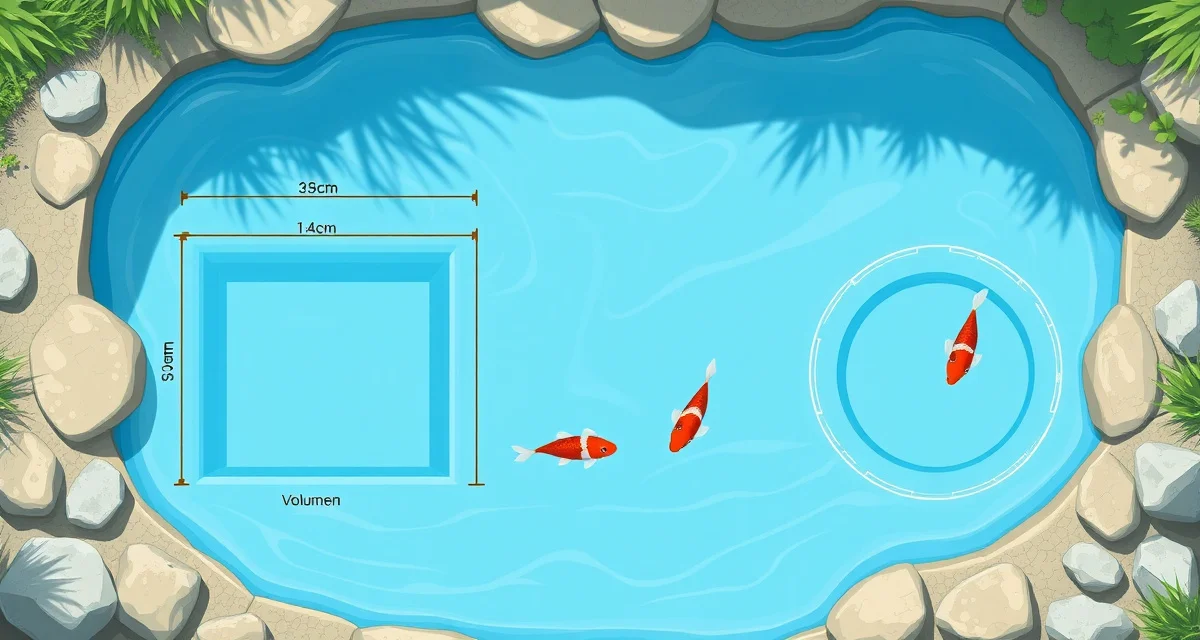
How to Calculate Koi Pond Volume: Formulas for Every Pond Shape
A 10% underestimate of pond volume means every single treatment you calculate will be 10% too weak to be fully effective. Get this number right once and you won't have to think about it again. KoiQuanta saves it to your pond profile and uses it in every future dose calculation automatically.
Online calculators give you a number but can't apply it to treatment doses. This guide gives you the formulas for every common pond shape, covers irregular ponds, and explains how to handle the single most common error: calculating at full capacity rather than at operating water level.
TL;DR
- A pond you think holds 3,000 gallons but actually holds 2,700 gallons will result in you calculating doses 11% too high.
- For formalin, an 11% overdose at high temperatures can be dangerous.
- Measure depth in 3–4 locations and average them.
- This approach has about 5–10% accuracy, which is acceptable for most calculations.
- You may need litres for some calculations: - Gallons to litres: Gallons × 3.785 - Litres to gallons: Litres × 0.264 Some European treatments are dosed in mg/L or grams per cubic metre (g/m³).
- If you calculate treatment doses against a "full" volume that's 15% higher than your actual water level, you'll consistently underdose.
- Length (feet) × Width (feet) × Average Depth (feet) × 7.48 = Volume in gallons.
Why Pond Volume Matters for Treatment
Every chemical treatment dose is calculated against pond volume. If your calculated volume is wrong, every dose is wrong by exactly the same percentage.
A pond you think holds 3,000 gallons but actually holds 2,700 gallons will result in you calculating doses 11% too high. That's usually manageable for salt. For formalin, an 11% overdose at high temperatures can be dangerous.
Get the volume right. Save it. Use it consistently.
The Key Rule: Operating Volume, Not Total Volume
Your pond has a maximum fill capacity. But you probably don't run it full to the brim: you run it at operating water level, which might be a few inches below the top edge.
Always calculate pond volume at operating water level. This is the actual amount of water in your pond when you're adding treatment.
If you're not sure of your operating level, mark a spot on the pond wall or skimmer box with a waterproof marker at your normal water level. Measure the actual water depth from there, not from the theoretical maximum.
Formula: Rectangular Pond
The most common residential pond shape.
Volume (gallons) = Length (ft) × Width (ft) × Average Depth (ft) × 7.48
Example: A pond 12 ft long × 8 ft wide × 3 ft average depth
= 12 × 8 × 3 × 7.48
= 2,157 gallons
Important: Use average depth, not maximum depth. Most ponds have a shallow shelf around the edges and a deeper centre. Measure depth in 3–4 locations and average them.
Formula: Circular Pond
Volume (gallons) = π × Radius² × Depth (ft) × 7.48
Or simplified: Diameter² × 0.785 × Depth × 7.48
Example: A circular pond 10 ft diameter × 3 ft deep
= 10² × 0.785 × 3 × 7.48
= 1,763 gallons
Formula: Oval Pond
Volume (gallons) = π × (Length/2) × (Width/2) × Average Depth (ft) × 7.48
Or simplified: Length × Width × 0.785 × Depth × 7.48
Example: A pond 14 ft long × 8 ft wide × 3 ft deep
= 14 × 8 × 0.785 × 3 × 7.48
= 1,976 gallons
Calculating Volume for Irregular Shaped Ponds
This is where hobbyists get into difficulty. A kidney-shaped or free-form pond doesn't fit neatly into any formula.
Method 1: Subsection averaging
Divide the pond into two or three roughly rectangular sections. Calculate the volume of each section separately using the rectangular formula. Add the sections together. This approach has about 5–10% accuracy, which is acceptable for most calculations.
Method 2: Water volume measurement
Fill the pond from a known-volume source (a hose with a flow meter, or a container of known size) and count. This is time-consuming but the most accurate method. Good to do once for an irregular pond.
Method 3: KoiQuanta's interactive volume tool
KoiQuanta's pond volume calculator includes an irregular pond estimator that lets you trace your pond outline on a grid, enter depth measurements at multiple points, and calculates volume by numerical integration. More accurate than subsection averaging for complex shapes.
Converting Between Units
All formulas above give you gallons. You may need litres for some calculations:
- Gallons to litres: Gallons × 3.785
- Litres to gallons: Litres × 0.264
Some European treatments are dosed in mg/L or grams per cubic metre (g/m³). KoiQuanta's dose calculators accept both metric and imperial volume inputs.
Should I Calculate Pond Volume at Full or Operating Water Level?
Always at operating water level: the actual water level when you're running the pond day-to-day. This is the volume you're adding treatment to.
If you calculate treatment doses against a "full" volume that's 15% higher than your actual water level, you'll consistently underdose. Your treatments will be weaker than intended and may fail to reach therapeutic concentrations.
Measure your pond with water in it, at the level you actually maintain. That's the number to save.
What is the formula for calculating a rectangular pond volume?
Length (feet) × Width (feet) × Average Depth (feet) × 7.48 = Volume in gallons. Use the average depth measured across multiple points in the pond, not the maximum depth. Make sure you're measuring at operating water level, the actual depth you maintain, not the maximum the pond could theoretically hold. KoiQuanta's water quality calculator stores this volume and applies it automatically to every dose calculation going forward.
How do I calculate volume for an irregular shaped pond?
The most practical approach for home hobbyists is the subsection method: divide your pond into two or three roughly regular sections, calculate the volume of each using the rectangular formula, and add them together. For greater accuracy, KoiQuanta's pond volume calculator includes an irregular shape estimator where you can map your pond outline and enter depth measurements at multiple points. The tool calculates volume by numerical integration, giving you a more precise result than manual subsection estimates.
Should I calculate pond volume at full or operating water level?
Always at operating water level: the actual depth you maintain day-to-day, typically a few inches below the pond rim or overflow point. Your pond is rarely filled to its theoretical maximum, and you add treatments to the actual water in the pond, not an imaginary full volume. Using full capacity volume when your pond is at operating level consistently underestimates doses. Save your operating volume in KoiQuanta's pond profile so every future calculation uses the correct number automatically.
FAQ
What is How to Calculate Koi Pond Volume: Formulas for Every Pond Shape?
This article is a practical guide to accurately measuring your koi pond's water volume using shape-specific formulas — rectangular, circular, oval, L-shaped, and irregular ponds. It explains why precise volume matters, how to avoid the most common measurement mistake (calculating at full rather than operating depth), and how to convert between gallons and litres for treatments dosed in metric units. KoiQuanta stores your calculated volume and applies it automatically to every future treatment dose.
How much does How to Calculate Koi Pond Volume: Formulas for Every Pond Shape cost?
The guide is free to read on KoiQuanta. The formulas require nothing more than a tape measure and a calculator. For ongoing accuracy, KoiQuanta's pond profile feature — which saves your volume and applies it to dose calculations automatically — is part of the KoiQuanta platform, so check the current plan pricing on the KoiQuanta website for full feature access.
How does How to Calculate Koi Pond Volume: Formulas for Every Pond Shape work?
You measure your pond's length, width, and depth at three to four points, average the depth readings, then apply the correct formula for your pond's shape. Rectangular ponds use length × width × average depth × 7.48. Circular ponds use radius² × π × depth × 7.48. Irregular ponds are broken into simpler geometric sections and summed. The result is your operating volume — the number used for all treatment and stocking calculations.
What are the benefits of How to Calculate Koi Pond Volume: Formulas for Every Pond Shape?
Accurate volume calculation eliminates systematic dosing errors. A 10% volume underestimate makes every treatment 10% too weak; a 15% overestimate from measuring at full rather than operating depth causes consistent underdosing. For formalin and other sensitive treatments, even an 11% overdose can be dangerous at high temperatures. Getting this number right once protects your fish across every future treatment, feeding, and stocking decision.
Who needs How to Calculate Koi Pond Volume: Formulas for Every Pond Shape?
Any koi keeper who calculates treatment doses, manages stocking density, or runs water quality programmes needs an accurate pond volume figure. It is especially important for hobbyists treating disease, since underdosed treatments fail and overdoses harm fish. Keepers with irregularly shaped, split-level, or partially filled ponds benefit most, as these are the scenarios where guesswork or online calculators are most likely to produce significant errors.
How long does How to Calculate Koi Pond Volume: Formulas for Every Pond Shape take?
The actual measurement process takes 10 to 20 minutes — long enough to measure length, width, and depth at multiple points and do the calculation. Irregular ponds with several distinct sections may take slightly longer. Once the number is saved to your KoiQuanta pond profile, you never need to repeat the process unless you physically alter the pond or change your operating water level.
What should I look for when choosing How to Calculate Koi Pond Volume: Formulas for Every Pond Shape?
Look for a method that accounts for your actual operating water level rather than your pond's maximum capacity. A good approach averages depth across three to four measurement points rather than relying on a single reading. It should handle your specific pond shape — generic rectangular formulas are wrong for circular or kidney-shaped ponds. Metric conversion support matters if you use European treatments dosed in mg/L or g/m³.
Is How to Calculate Koi Pond Volume: Formulas for Every Pond Shape worth it?
Yes. A single accurate volume measurement eliminates a source of error that silently affects every treatment you ever calculate. For common treatments the margin is inconvenience; for sensitive medications like formalin, the margin is fish health and safety. The measurement takes under 20 minutes and the formulas are straightforward. If you keep koi seriously enough to treat disease or manage stocking density, this is one of the most high-value things you can do.
Sources
- Associated Koi Clubs of America (AKCA)
- Koi Organisation International (KOI)
- University of Florida IFAS Extension Aquaculture Program
- Fish Vet Group
- Water Quality Association
Save Your Volume, Never Recalculate
Calculate your pond volume once, save it to your KoiQuanta pond profile, and every future dose calculation: salt, formalin, KMnO4, or any other treatment, uses your exact pond volume automatically. The pond volume calculator handles the math, and the water quality calculator puts that volume to work.
Start your free KoiQuanta trial and set up your pond profile today.