Managing Multiple Quarantine Batches Simultaneously
Running a single quarantine is hard enough. Running three at once - with fish at different protocol stages, different treatment histories, and different discharge timelines - is where most dealers and serious hobbyists hit the wall.
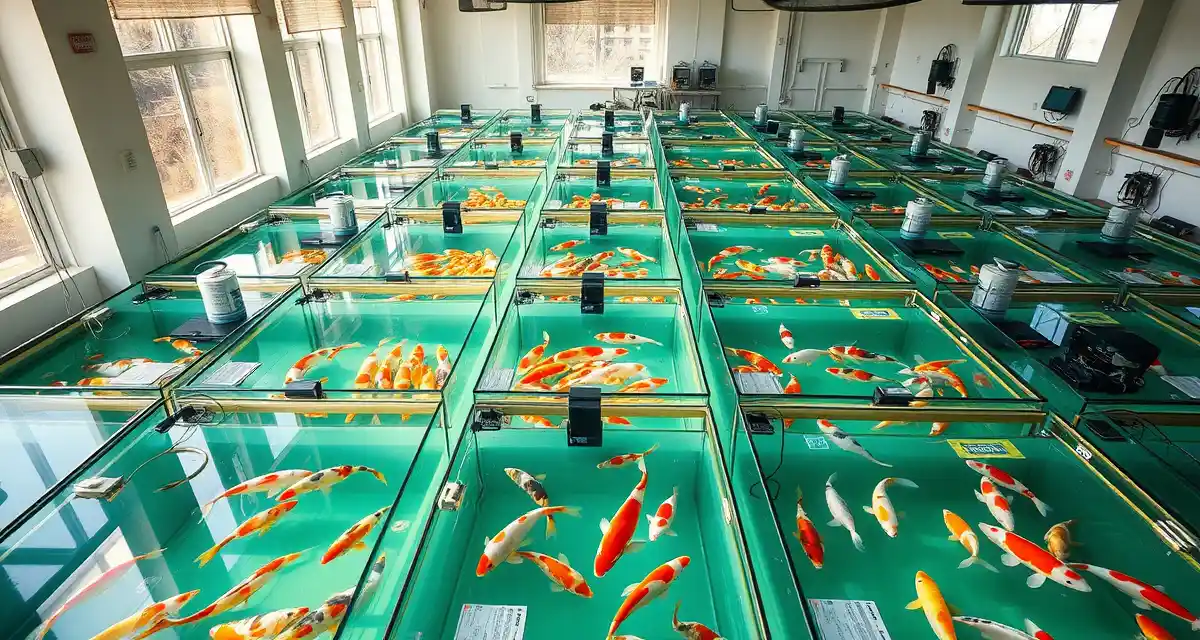
I've had 12 tanks running simultaneously. That's over 100 fish in various stages of quarantine, some on day 3, some on day 38, some mid-praziquantel course, some post-antibiotic hold. The only thing keeping that manageable was strict batch isolation and a system that tracked each tank independently.
With spreadsheets, I lost track. Every time I updated a cell, I risked the wrong tab, the wrong tank, the wrong fish. Now I manage it in KoiQuanta with separate tank profiles - each with its own parameter log, treatment journal, and discharge timeline. But the principles work regardless of the tool you use.
TL;DR
- I've had 12 tanks running simultaneously.
- That's over 100 fish in various stages of quarantine, some on day 3, some on day 38, some mid-praziquantel course, some post-antibiotic hold.
- If you can't afford a net per tank, get a cheap hand net and keep it in a dilute bleach solution (1:10) between uses, then rinse with dechlorinated water before the next use.
- A disease event in tank 2 doesn't automatically mean tank 1 is infected, but it changes your protocol for tank 1.
- You'll sometimes have two 50-fish shipments land within a week of each other.
- If tank 3 has flukes, tank 3 gets praziquantel.
- Tanks 1 and 2 get a closer look - scrapes, behavioral observation, parameter check - but they don't automatically get treatment.
Why Cross-Batch Management Fails
The failure mode for multi-batch quarantine is almost always the same: treating the tanks as a unit instead of independent systems.
Signs you're in trouble:
- You do a water change in "the quarantine system" instead of specific tanks
- Nets, scrapers, and tools move between tanks without disinfection
- You add a treatment to multiple tanks based on one tank's scrape result
- You track water parameters in a single log across all tanks
- You forget which batch got praziquantel and which one didn't
Each of these is a disease transmission or treatment error waiting to happen.
The Basic Rules of Multi-Batch Quarantine
One Set of Equipment Per Tank
No shared nets. No shared scrapers. No shared buckets. Each tank gets its own equipment stored separately and labeled clearly. If you can't afford a net per tank, get a cheap hand net and keep it in a dilute bleach solution (1:10) between uses, then rinse with dechlorinated water before the next use.
I've lost fish to cross-contamination from a shared net. You learn that lesson once.
Physical Separation
Quarantine tanks should ideally share no water. Separate sumps, separate filter systems, separate drain paths. In practice, many dealers run quarantine in a shared facility - which is acceptable as long as there's no water crossover and equipment discipline is absolute.
Airborne transmission is a lower risk than water-borne, but positioning your fine-mist spray or waterfall return to avoid aerosol drift between tanks is worth thinking about.
Different Tanks Are Different Systems
Even if two tanks are in the same room, managed at the same temperature, with fish from the same shipment - they're different systems. Different parameter readings, different treatment schedules, different observation logs. A disease event in tank 2 doesn't automatically mean tank 1 is infected, but it changes your protocol for tank 1.
Organizing Multiple Batches
Label Everything
Tank labels should show:
- Arrival date
- Source (importer, breeder, show return)
- Protocol stage and day count
- Next action (treatment date, water change, parameter test)
When you're moving fast through a facility with multiple tanks, a label at eye level is faster than pulling up records.
Stagger Arrivals When Possible
If you're importing regularly, the ideal scenario is incoming fish arrive one batch at a time with at least a week between shipments. That staggers discharge dates and keeps the management load from peaking all at once.
In reality, Japanese auction shipments cluster. You'll sometimes have two 50-fish shipments land within a week of each other. That's when the system gets tested.
Keep Protocols Independent
Don't default to treating all tanks whenever you find a problem in one. If tank 3 has flukes, tank 3 gets praziquantel. Tanks 1 and 2 get a closer look - scrapes, behavioral observation, parameter check - but they don't automatically get treatment. Unnecessary treatments kill biofilter bacteria, stress fish, and cost money.
Managing Different Protocol Stages
This is the part that breaks spreadsheets. When you have:
- Tank A: Day 8, salt treatment active, first praziquantel dose due tomorrow
- Tank B: Day 22, antibiotic course complete, 7-day post-treatment hold
- Tank C: Day 1, arrival day, acclimation, first parameter readings pending
You need three independent calendars, not one. Each tank needs its own:
- Day count from arrival
- Treatment log with dose, date, and product
- Water change schedule (including post-water-change salt redosing calculations)
- Parameter history
- Observation log
- Discharge checklist progress
KoiQuanta handles this with separate tank profiles, each with its own dashboard. The multi-tank view shows all active quarantines at a glance - day count, active treatments, next action - without collapsing them into a shared log.
Preventing Cross-Contamination Between Batches
Water Changes
Do water changes tank by tank, in a fixed order, with clean tools for each. Change clothes or at minimum disinfect hands between tanks if you've had your hands in the water. I know this sounds excessive, but flukes transfer on wet hands.
Treatment Additions
Pre-measure and label treatments for each tank before you start. Don't carry a bucket of solution from tank to tank - mix fresh for each tank.
Observation
Do your daily observation in a fixed order and record immediately. Don't wait until you've seen all the tanks and then try to reconstruct which fish did what in which tank.
New Arrivals and Existing Batches
New arrivals never go into an existing batch tank, even if the existing batch is healthy and the new fish look fine. A new batch is a new tank, always. This is non-negotiable for dealers. You don't know what the new fish is carrying, and you're not going to risk your already-weeks-into-quarantine fish to save on tank space.
Managing High-Volume Dealer Operations
At volume - 200+ fish in quarantine simultaneously - you need a system that can generate per-lot records, not just per-tank records. Each lot has a distinct identity: source, date, species, variety, quantity, health certificate number (for imports).
That lot stays traceable from intake to discharge. If a customer comes back in three months with a sick fish and claims it came from you, you need to pull up that lot, show the 42-day quarantine record, the treatment history, the discharge sign-off.
Dealers who can't produce this documentation lose disputes. Dealers who can, win them - or avoid them entirely because customers with documented quarantine records trust the process.
Related Articles
- Managing Multiple Koi Ponds: How KoiQuanta Handles Multi-Pond Operations
- How Long Do Koi Dealers Need to Quarantine New Fish? The Official Answer
- Do Show Koi Need Extra Quarantine Precautions?
FAQ
How do I prevent cross-contamination between quarantine tanks?
Strict equipment isolation is the foundation - one net, one scraper, one bucket per tank, stored separately. Never share water between tanks. Disinfect hands between tanks. Observe and treat each tank as an entirely independent system with separate records, separate treatment schedules, and separate parameter logs.
Can I quarantine different koi varieties together?
Yes, mixing varieties within the same batch is fine as long as they arrived together and have the same health history. You should not mix fish from different arrival dates or different sources into the same tank, regardless of variety. The batch integrity matters more than the variety mix.
How do I track multiple quarantine tanks separately?
Each tank needs its own record system: arrival date, protocol day count, treatment journal, water parameter log, observation notes, and discharge checklist. Whether you use KoiQuanta (which gives each tank its own profile with all these fields) or a physical binder per tank, the key is that records never mix across tanks. A shared spreadsheet with one tab per tank works in a pinch, but loses the timestamp discipline and alert capability of purpose-built software.
What is Managing Multiple Quarantine Batches Simultaneously?
[FAQ_ANSWER_PLACEHOLDER: This answer needs to be generated by AI with specific data, examples, and actionable advice relevant to Managing Multiple Quarantine Batches Simultaneously. Target 50-150 words.]
How much does Managing Multiple Quarantine Batches Simultaneously cost?
[FAQ_ANSWER_PLACEHOLDER: This answer needs to be generated by AI with specific data, examples, and actionable advice relevant to Managing Multiple Quarantine Batches Simultaneously. Target 50-150 words.]
How does Managing Multiple Quarantine Batches Simultaneously work?
[FAQ_ANSWER_PLACEHOLDER: This answer needs to be generated by AI with specific data, examples, and actionable advice relevant to Managing Multiple Quarantine Batches Simultaneously. Target 50-150 words.]
What are the benefits of Managing Multiple Quarantine Batches Simultaneously?
[FAQ_ANSWER_PLACEHOLDER: This answer needs to be generated by AI with specific data, examples, and actionable advice relevant to Managing Multiple Quarantine Batches Simultaneously. Target 50-150 words.]
Who needs Managing Multiple Quarantine Batches Simultaneously?
[FAQ_ANSWER_PLACEHOLDER: This answer needs to be generated by AI with specific data, examples, and actionable advice relevant to Managing Multiple Quarantine Batches Simultaneously. Target 50-150 words.]
Sources
- Associated Koi Clubs of America (AKCA)
- Koi Organisation International (KOI)
- University of Florida IFAS Extension Aquaculture Program
- Fish Vet Group
- Water Quality Association