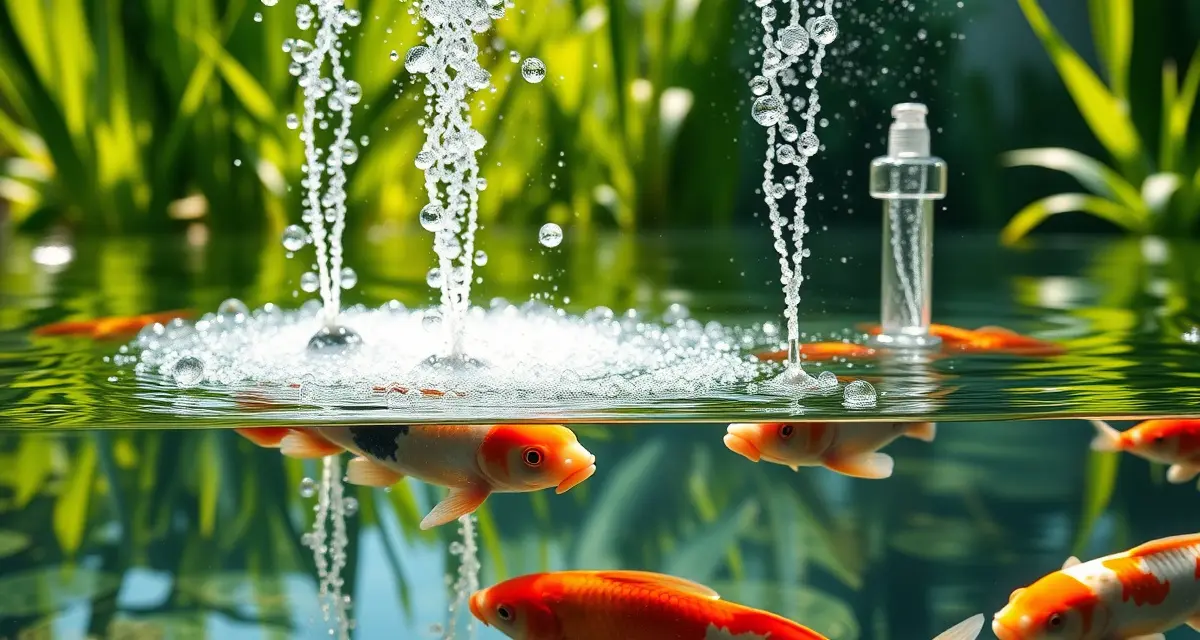
Koi Pond Aeration: Air Pumps, Diffusers, and Waterfalls
A koi pond at 75% stocking without supplemental aeration risks oxygen crashes overnight. Not theoretical risks. Actual crashes that kill fish before sunrise when algae respiration and fish metabolism consume the night's oxygen supply. Koi keeping without a dedicated aeration plan is a gamble, especially in summer.
This guide covers the koi pond aeration options, how to calculate what you need, and which approaches work best for different pond situations.
TL;DR
- Koi begin showing stress below 6 mg/L dissolved oxygen.
- In warm summer water, you can move from 8 mg/L at dusk to below 4 mg/L before dawn.
- A pond stocked to 75% of capacity (which most would consider a well-stocked koi pond) has far less oxygen buffer than a lightly stocked pond.
- A power outage at 2am that kills your air pump in a summer night isn't just an inconvenience.
- For heavily stocked ponds or hot climates, use 2-3 liters per minute per 1000 gallons.
- A pump failure at 3am can cause mass mortality before morning.
- Overkill for backyard ponds under 10,000 gallons, but effective for large setups or extreme climates where conventional aeration is struggling.
Why Aeration Is Non-Negotiable
Dissolved oxygen (DO) in water comes from two sources: diffusion at the water surface (where air meets water) and photosynthesis from algae and plants during daylight. Both are variable and neither is sufficient alone in a stocked koi pond without supplemental aeration.
The overnight problem: During daylight, photosynthesis adds oxygen. At night, respiration consumes it. Fish, bacteria, plants, and algae all consuming oxygen simultaneously. In a heavily planted or algae-rich pond in summer, the overnight drop can be dramatic. Koi begin showing stress below 6 mg/L dissolved oxygen. Mass mortality begins below 4 mg/L. In warm summer water, you can move from 8 mg/L at dusk to below 4 mg/L before dawn.
The stocking density factor: More fish means more oxygen demand. A pond stocked to 75% of capacity (which most would consider a well-stocked koi pond) has far less oxygen buffer than a lightly stocked pond. A power outage at 2am that kills your air pump in a summer night isn't just an inconvenience. It's a potentially lethal event within hours.
The temperature factor: Warm water holds less dissolved oxygen. At 20°C, water holds about 9.1 mg/L. At 30°C, only about 7.6 mg/L maximum. And fish metabolic demand is higher at higher temperatures. The combination of hot weather + heavy stocking + no supplemental aeration is the most common setup for summer fish kills.
Aeration Options: How Each Works
Air Pumps and Diffuser Stones
The most practical and reliable primary aeration method for most koi ponds.
How it works: An electric air pump (diaphragm or piston type) pushes air through tubing to diffuser stones or aeration discs placed on the pond bottom. Tiny bubbles rise through the water column, creating surface agitation where they break and promoting gas exchange across the water surface.
Sizing: As a starting point, allow 1-2 liters of air per minute per 1000 gallons of pond volume. For heavily stocked ponds or hot climates, use 2-3 liters per minute per 1000 gallons.
Types of air pumps:
- Diaphragm pumps: Quiet, reliable for smaller volumes (under 100 GPH), suitable for most backyard ponds
- Piston/linear pumps: Better for larger volumes, more durable, lower energy cost per liter of air output
Diffuser placement: Place diffusers on the pond bottom distributed across the area, not all in one corner. Multiple points of aeration distribute oxygen throughout the water column better than a single large diffuser.
Backup power consideration: In summer or when heavily stocked, an air pump battery backup or generator is worth having. A pump failure at 3am can cause mass mortality before morning.
Waterfalls and Stream Returns
Many koi ponds return filtered water to the pond via a waterfall or cascade. This creates surface turbulence and splash that adds oxygen to the water.
How it works: As water falls and splashes at the pond surface, the turbulence increases the surface area between water and air, allowing oxygen to dissolve. The splashing and misting effect adds oxygen at the re-entry point.
Effectiveness: Waterfalls add meaningful oxygen, especially if the return creates good turbulence and a large splash zone. However, the contribution is variable and location-specific. The area near the waterfall return is well-oxygenated, but the far end of a long pond may not benefit equally.
Limitations:
- Turned off at night by some keepers for quiet. This eliminates aeration at exactly the time it's most needed
- Reduced effectiveness in hot weather when water temperature is high
- Doesn't provide whole-pond oxygen distribution if the pond is large relative to the waterfall output
Should you run your waterfall 24/7? In summer with a stocked pond: yes. The temptation to turn it off at night for quiet is understandable, but overnight is when oxygen demand is highest and natural sources are lowest.
Venturi Fittings
Venturi devices use the velocity of flowing water to draw air into the water stream. They're installed in-line on the return pipe from your pump.
How it works: As water flows through a constricted venturi, velocity increases and creates low pressure that draws air in through a small inlet. The air mixes with the water flow and enters the pond as fine bubbles.
Effectiveness: Good supplemental aeration with no moving parts and no additional electricity cost. Output is directly proportional to pump flow rate. More pump flow means more venturi aeration.
Limitations: Only functions when the pump is running. If pump flow drops (clogged filter, power issue), venturi aeration drops with it. Not suitable as the only aeration in a heavily stocked pond.
Paddle Wheel Aerators
Used primarily in commercial aquaculture but occasionally in large koi ponds. Paddle wheels agitate the surface across a wide area, increasing gas exchange across a broad surface.
Overkill for backyard ponds under 10,000 gallons, but effective for large setups or extreme climates where conventional aeration is struggling.
Calculating Required Aeration
Dissolved Oxygen Demand Estimate
Koi oxygen consumption varies with temperature and activity, but a rough guide:
- At 20°C: approximately 200-300 mg of oxygen per kg of fish per hour
- At 28°C: approximately 400-500 mg per kg per hour (roughly double the 20°C rate)
For a 1000-gallon pond holding 10kg of koi at 28°C, the fish alone need approximately 4000-5000 mg of oxygen per hour to be replenished by aeration (in addition to natural diffusion).
In practice, calculate aeration capacity using the air pump output method:
- 1 liter of air contains approximately 210 mg of oxygen
- Not all oxygen transfers to the water (efficiency depends on bubble size, depth, and water turbulence)
- Assume approximately 10-20% oxygen transfer efficiency for typical diffusers
- 1 liter of air per minute provides roughly 21-42 mg O2/minute = 1260-2520 mg O2/hour to the water
For 10kg of koi needing 5000 mg O2/hour at 28°C: you need at least 2-4 liters per minute of air delivery. More if your diffuser efficiency is low.
Practical guidance: Rather than calculating exactly, size your aeration conservatively above your estimated need and test with a DO meter at the worst-case time (early morning in summer). If DO is consistently above 7 mg/L at dawn in peak summer, your aeration is adequate.
Aeration System Design
Layer Your Aeration
The most resilient aeration design combines multiple methods:
- Waterfall or stream return: Provides consistent baseline aeration when pump is running
- Venturi on the return pipe: Adds supplemental oxygen at no additional cost
- Dedicated air pump and diffusers: Independent of the main pump, provides aeration even if the main system fails
This layered approach means any single component failure doesn't eliminate all aeration.
Position Diffusers Strategically
Place diffusers:
- At the pond's deepest points (oxygen stratification is worst at depth in warm water)
- At the end of the pond farthest from the waterfall return
- Near any areas with low circulation (corners, behind plants)
For dissolved oxygen monitoring to confirm your aeration is working, the dissolved oxygen guide covers testing protocols and target ranges. KoiQuanta logs aeration events and correlates with dissolved oxygen readings, so you can see whether a change to your aeration setup actually improved DO at the critical early-morning window.
Related Articles
- Koi Pond Bead Filter: Sizing, Cleaning, and Maintenance
- Koi Pond Drum Filter: Benefits and Installation Guide
- First Koi Pond Guide: Everything New Hobbyists Need to Know
FAQ
How much aeration does my koi pond need?
Start with 1-2 liters per minute of air output per 1000 gallons of pond volume from a dedicated air pump. In summer or with heavy stocking, use 2-3 liters per minute per 1000 gallons. Test with a dissolved oxygen meter at dawn during the hottest period. If DO is consistently above 7 mg/L at that time, your aeration is adequate. If it's below 6 mg/L, you need more aeration capacity. Always have more than the theoretical minimum because stocking loads increase over time and power outages happen.
What type of aeration is best for koi ponds?
A combination is best. A dedicated air pump with diffuser stones provides reliable baseline aeration independent of the main circulation pump. A waterfall or stream return adds meaningful oxygen at the re-entry point. A venturi fitting on the return pipe adds supplemental oxygen at no additional cost. No single method is ideal alone. Layered aeration systems are more reliable because they have no single point of failure. For heavily stocked ponds or hot climates, dedicated air pumps with battery backup are the most important element.
Can a waterfall provide enough aeration for koi?
It depends on the waterfall design, pond volume, and stocking density. For a lightly stocked smaller pond, a good waterfall creating turbulent surface agitation at the re-entry point may be sufficient. For a heavily stocked pond or one in a hot climate, a waterfall alone is typically not enough. Especially because many keepers turn waterfalls off at night, removing aeration at exactly the time it's most needed. A waterfall is valuable aeration, but pair it with a dedicated air pump for insurance, particularly during summer.
What is Koi Pond Aeration: Air Pumps, Diffusers, and Waterfalls?
Koi pond aeration refers to the methods used to increase dissolved oxygen levels in a pond, including air pumps, diffusers, and waterfalls. Air pumps push air through diffuser stones to create fine bubbles that oxygenate water. Waterfalls and fountains agitate the surface to promote gas exchange. Together, these systems prevent dangerous oxygen crashes, especially overnight in summer when fish metabolism and algae respiration compete for the same dissolved oxygen supply.
How much does Koi Pond Aeration: Air Pumps, Diffusers, and Waterfalls cost?
Aeration equipment varies widely in cost. A basic air pump with diffuser stones runs $20–$80 for smaller ponds. Mid-range submersible aerators cost $100–$300. Waterfall pumps range from $50 to several hundred dollars depending on flow rate. For heavily stocked ponds requiring redundant systems, total investment can reach $500 or more. Operating costs are modest—most air pumps draw minimal electricity—making aeration one of the most cost-effective investments in koi pond management.
How does Koi Pond Aeration: Air Pumps, Diffusers, and Waterfalls work?
Aeration works by increasing the surface area where water contacts air, allowing oxygen to dissolve in and carbon dioxide to escape. Air pumps force air through diffuser stones, creating fine bubbles that rise through the water column and agitate the surface. Waterfalls and fountains achieve similar results through turbulence. The goal is maintaining dissolved oxygen above 6 mg/L at all times, including overnight when photosynthesis stops and oxygen consumption from fish and algae continues.
What are the benefits of Koi Pond Aeration: Air Pumps, Diffusers, and Waterfalls?
Proper aeration prevents overnight oxygen crashes that can kill an entire koi collection before sunrise. It reduces fish stress, supports immune function, and promotes healthy growth. Aeration also improves water circulation, which helps distribute heat and nutrients evenly and prevents stagnant dead zones where anaerobic bacteria thrive. In summer, when warm water holds less dissolved oxygen, supplemental aeration is the primary buffer between a stable pond and a catastrophic mass mortality event.
Who needs Koi Pond Aeration: Air Pumps, Diffusers, and Waterfalls?
Any koi keeper with a moderately or heavily stocked pond needs a dedicated aeration plan. Ponds stocked at 75% capacity have minimal oxygen buffer and are especially vulnerable. Koi keepers in hot climates face heightened risk since warm water holds less dissolved oxygen. Overnight crashes are most dangerous in summer. Anyone who has experienced a warm-season fish loss should audit their aeration immediately. Even lightly stocked ponds benefit from aeration as a low-cost insurance policy against equipment failure or extreme weather.
Sources
- Associated Koi Clubs of America (AKCA)
- Koi Organisation International (KOI)
- University of Florida IFAS Extension Aquaculture Program
- Fish Vet Group
- Water Quality Association