Formalin Treatment for Koi: Protocol and Safety Guide
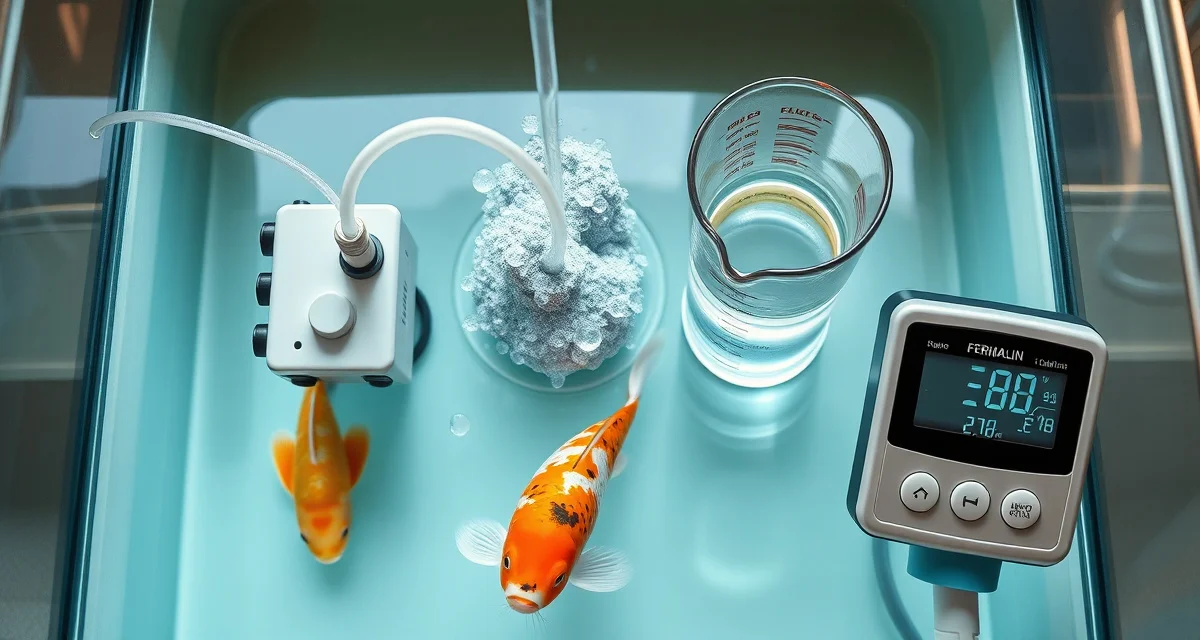
Formalin depletes dissolved oxygen -- inadequate aeration during treatment is lethal. This is the most important safety requirement for formalin use, and it's non-negotiable. Formalin (a solution of formaldehyde gas in water, typically 37% formaldehyde) is an effective treatment for external parasites, but it consumes oxygen in the treatment environment through chemical reactions and the stress response of treated fish. Without sufficient aeration, fish can die of oxygen depletion during treatment.
Have your maximum aeration running before you dose. Not during, not after -- before.
TL;DR
- Store formalin above 10°C to prevent precipitation.
- Monitor fish continuously for the first hour 3.
- After 4-6 hours, do a 20-30% water change to dilute the remaining formalin 4.
- Bath concentrations are typically 100-250 mg/L (much higher than pond treatment concentrations).
- Use the lower end (15 mL/1,000L) for first treatments, warmer water, or fish that are weakened.
- Run maximum aeration before dosing, treat for 4-6 hours, then do a partial water change to dilute residual formalin.
- Never treat in water above 25°C or use formalin that shows white precipitate.
What Formalin Treats
Formalin is effective against a broad range of external parasites:
- Trichodina and other ciliated protozoa
- Costia (Ichthyobodo)
- Chilodonella
- Ich (free-swimming tomite stage)
- Monogenean flukes (skin and gill)
- Velvet (Oodinium)
It is not effective against anchor worm, fish lice (crustacean parasites), or internal parasites. For those, different medications are needed.
Formalin Safety: The Full Safety Requirements
Beyond oxygen depletion, a few other safety considerations:
Temperature limit: Never use formalin in water above 25°C (77°F). Oxygen solubility drops with increasing temperature, and the risk of oxygen depletion during treatment becomes unacceptable at higher temperatures. In warm summer conditions, treat during the coolest part of the day (early morning) and verify water temperature before dosing.
Precipitation: Old formalin stored in cold conditions can polymerize to produce paraformaldehyde (a white precipitate). Paraformaldehyde is highly toxic to koi. Never use formalin with any white precipitate -- discard it. Store formalin above 10°C to prevent precipitation.
Protective equipment for handlers: Formalin vapor is irritating to eyes, nose, and lungs. Work in a ventilated area and avoid inhaling vapor during dosing. Gloves prevent skin exposure. This is a chemical that warrants basic personal protective equipment.
Activated carbon: Remove any activated carbon from your filter before treatment. Carbon absorbs formalin and renders the treatment ineffective.
Dosing Protocol
Standard pond treatment concentration: 15-25 mL of 37% formalin per 1,000 liters (approximately 5-8 mL per 264 gallons).
The lower end of that range (15 mL/1,000L) is appropriate for:
- First-time treatment or any time you're uncertain how fish will respond
- Temperatures above 20°C (where oxygen stress is higher)
- Fish that are already weakened or stressed
The higher end (25 mL/1,000L) is used for:
- Confirmed heavy parasite burdens requiring stronger treatment
- Fish that tolerated lower doses without distress
- Cooler water temperatures where treatment efficacy is reduced
Always use the koi treatment dose calculator to calculate the exact volume for your pond. Pond volume errors translate directly to dosing errors -- measure your pond carefully before calculating.
Treatment Duration
Formalin pond treatment is typically maintained for 4-6 hours rather than as a permanent addition. The approach is:
- Calculate and add the dose
- Monitor fish continuously for the first hour
- After 4-6 hours, do a 20-30% water change to dilute the remaining formalin
- Or allow natural breakdown over 24 hours if fish are tolerating treatment well
For bath treatments (short-duration high-concentration), fish are held in a formalin solution at higher concentration for 20-45 minutes, then returned to clean water. Bath concentrations are typically 100-250 mg/L (much higher than pond treatment concentrations). Bath treatments require even more careful observation.
Monitoring During Treatment
Stay at the pond for at least the first hour after dosing. You're watching for:
Surface congregation: Fish gasping or congregating at the surface indicates oxygen depletion. Increase aeration immediately. If maximum aeration is already running and fish are at the surface, begin a water change to dilute the treatment.
Erratic swimming: Flipping, rolling, or loss of balance indicates chemical irritation or oxygen depletion. Same response -- increase aeration first, water change if needed.
Color changes: Extreme color paling or flushing can indicate stress. Mild responses are expected; severe or rapid color changes warrant intervention.
Normal response: Increased surface agitation as fish breathe faster in treated water is normal. Fish should remain swimming normally and maintain their balance.
For guidance on the broader parasite treatment protocol context, the koi parasite treatment guide covers where formalin fits into a complete parasite treatment plan.
Emergency Response
Have your emergency plan ready before you dose:
- Aeration maximum: Know how to quickly set all aerators to full.
- Water change readiness: Have a pump ready to remove water and clean water ready to add.
- Neutralizer: Sodium thiosulfate at concentration will neutralize formalin quickly in an emergency. Having it pre-dissolved and ready means faster response.
If you need to stop treatment: remove fish to a clean, well-aerated container immediately if they're in distress. Formalin effects can resolve fairly quickly once fish are moved to clean water, provided no permanent gill damage has occurred.
Multiple Treatment Courses
Like most parasite treatments, formalin rarely clears an infection with a single dose. For ich, trichodina, and similar organisms, repeat treatments are needed at temperature-dependent intervals:
- At 25°C: repeat every 3-4 days
- At 20°C: repeat every 5-7 days
- At 15°C: repeat every 7-10 days
Each subsequent treatment uses the same dose but should be assessed against fish response from the previous treatment. If fish showed notable distress on the first dose, reduce concentration or extend intervals on subsequent doses.
Frequently Asked Questions
How do I dose formalin for koi?
The standard pond treatment concentration is 15-25 mL of 37% formalin per 1,000 liters. Use the lower end (15 mL/1,000L) for first treatments, warmer water, or fish that are weakened. Use the higher end for confirmed heavy infestations at cooler temperatures. Always calculate from your accurate pond volume using a dose calculator. Run maximum aeration before dosing, treat for 4-6 hours, then do a partial water change to dilute residual formalin. Never treat in water above 25°C or use formalin that shows white precipitate.
Is formalin safe for koi?
Yes, when used correctly -- it's been used in koi and fish farming for decades. The risks are manageable with proper preparation: run maximum aeration before dosing, treat below 25°C water temperature, never use precipitated (white-cloudy) formalin, start at the lower concentration range, monitor fish continuously during treatment, and have a neutralizer and emergency water change ready. The dangers come from inadequate preparation. Done correctly, formalin is one of the most effective treatments available for external parasite infections.
What does formalin treat in koi ponds?
Formalin is effective against a broad spectrum of external parasites: trichodina, costia, chilodonella, ich (free-swimming stage), monogenean flukes (skin and gill), and velvet. It is not effective against anchor worm, fish lice (which are crustaceans requiring different treatment), or internal parasites. It also has some antimicrobial activity that can help with concurrent bacterial surface infections, but it's primarily used for protozoan and fluke treatment.
What is Formalin Treatment for Koi: Protocol and Safety Guide?
[FAQ_ANSWER_PLACEHOLDER: This answer needs to be generated by AI with specific data, examples, and actionable advice relevant to Formalin Treatment for Koi: Protocol and Safety Guide. Target 50-150 words.]
How much does Formalin Treatment for Koi: Protocol and Safety Guide cost?
[FAQ_ANSWER_PLACEHOLDER: This answer needs to be generated by AI with specific data, examples, and actionable advice relevant to Formalin Treatment for Koi: Protocol and Safety Guide. Target 50-150 words.]
How does Formalin Treatment for Koi: Protocol and Safety Guide work?
[FAQ_ANSWER_PLACEHOLDER: This answer needs to be generated by AI with specific data, examples, and actionable advice relevant to Formalin Treatment for Koi: Protocol and Safety Guide. Target 50-150 words.]
What are the benefits of Formalin Treatment for Koi: Protocol and Safety Guide?
[FAQ_ANSWER_PLACEHOLDER: This answer needs to be generated by AI with specific data, examples, and actionable advice relevant to Formalin Treatment for Koi: Protocol and Safety Guide. Target 50-150 words.]
Who needs Formalin Treatment for Koi: Protocol and Safety Guide?
[FAQ_ANSWER_PLACEHOLDER: This answer needs to be generated by AI with specific data, examples, and actionable advice relevant to Formalin Treatment for Koi: Protocol and Safety Guide. Target 50-150 words.]
How long does Formalin Treatment for Koi: Protocol and Safety Guide take?
[FAQ_ANSWER_PLACEHOLDER: This answer needs to be generated by AI with specific data, examples, and actionable advice relevant to Formalin Treatment for Koi: Protocol and Safety Guide. Target 50-150 words.]
What should I look for when choosing Formalin Treatment for Koi: Protocol and Safety Guide?
[FAQ_ANSWER_PLACEHOLDER: This answer needs to be generated by AI with specific data, examples, and actionable advice relevant to Formalin Treatment for Koi: Protocol and Safety Guide. Target 50-150 words.]
Is Formalin Treatment for Koi: Protocol and Safety Guide worth it?
[FAQ_ANSWER_PLACEHOLDER: This answer needs to be generated by AI with specific data, examples, and actionable advice relevant to Formalin Treatment for Koi: Protocol and Safety Guide. Target 50-150 words.]
Related Articles
- Koi Hemorrhagic Septicemia: Symptoms, Treatment, and Emergency Protocol
- Koi Dropsy Treatment Protocol: Isolation, Antibiotics, and Recovery Tracking
Sources
- Associated Koi Clubs of America (AKCA)
- Koi Organisation International (KOI)
- University of Florida IFAS Extension Aquaculture Program
- Fish Vet Group
- Water Quality Association